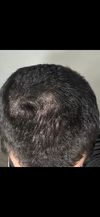
Hair loss treatment should target dermal white adipose tissue (DWAT) to restore hair follicles. Potential remedies include tocopherol (vitamin E), botox, rosiglitazone, niacin, kojyl cinnamate esters, and ADP355.
A user is making a topical finasteride solution with 0.01% finasteride, 50% ethanol, 15% glycerine, and 35% water, but it doesn't adhere well to the scalp. They seek advice on improving the mixture's consistency without taking oral pills.
The user discusses their experience with diffuse unpatterned alopecia and acquired progressive hair kinkering, noting improvements with treatments including biotin, pantothenic acid, finasteride, ketoconazole, and zinc pyrithione shampoo. They report thicker, healthier hair and improved scalp condition, attributing success mainly to biotin, pantothenic acid, and finasteride.
PP405 is a potential hair loss treatment that inhibits mitochondrial pyruvate carriers, increasing lactate dehydrogenase activity and stimulating hair follicle stem cells. In a phase 1 trial, 31% of participants showed over 20% hair density increase with PP405 treatment.
The post is an update on the user's hair loss journey. They have a strong hair follicle that has remained unaffected by hair loss for almost 3 years. The user is starting finasteride and using ketoconazole, alfatradiol, and oral castor oil for hair maintenance.
The user is considering using dutasteride or finasteride for hair loss and has recurrent folliculitis. Another user suggests treating the folliculitis and notes diffuse thinning.
The conversation is about whether topical finasteride and minoxidil need to be applied directly to the affected areas of the scalp or if they can be spread through blood vessels. It also asks how long topical finasteride remains on a pillow.
A 17-year-old is frustrated with hair thinning and receding temples, seeking advice after a dermatologist dismissed concerns. Suggestions include starting Minoxidil for regrowth and considering Finasteride if androgenetic alopecia is suspected.
A user is considering microneedling to enhance absorption of a prescribed topical hair loss treatment containing Minoxidil, Dutasteride, and Latanoprost, while already taking oral Minoxidil and Dutasteride. They seek advice on the effectiveness and safety of combining these treatments, especially due to the cost and their desire to maximize results.
A 23-year-old shares progress in hair quality after 4 months using dutasteride, topical minoxidil, and other treatments, noting improved crown thickness but persistent temple thinning. They switched from finasteride to dutasteride due to side effects and started testosterone replacement therapy, which they believe helps mitigate side effects.
The conversation is about using tretinoin to enhance minoxidil's effectiveness for hair loss, discussing whether to mix tretinoin with minoxidil or apply it separately, and considering the concentration of tretinoin to use.
A user who had two hair transplants and is still concerned about their crown area, despite other people reassuring them that it looks normal. The advice given was to use Minoxidil, Finasteride, SMP, and to consider speaking with a therapist.
The conversation discusses an extensive hair loss treatment regimen including dutasteride, GT20029, RU58841, pyrilutamide, minoxidil, microneedling, ketoconazole shampoo, and experimental compounds. The user humorously describes their approach as a comprehensive strategy to combat hair loss while maintaining hair growth.
A user successfully improved their hairline after 15 months using topical minoxidil and dutasteride. Some commenters question the necessity of treatment given the user's original hair condition, while others support early intervention.
Topical finasteride can effectively reduce scalp DHT by targeting local enzymes, despite less systemic impact compared to oral forms. Combining oral dutasteride with topical finasteride and minoxidil may enhance hair loss prevention, though evidence of its effectiveness is limited.
Male pattern baldness (MPB) may be influenced by androgen receptors in scalp hair follicles and potentially poor blood flow. Transplanted hair is not immune to DHT, and factors like inflammation and scalp tension might also contribute to hair loss.
The conversation discusses scalp issues and hair loss, with treatments like Accutane, Nizoral, and H&S being used. Suggestions include considering finasteride, minoxidil, and jojoba oil, with caution advised for the latter.
The conversation discusses hair regrowth progress from Norwood scale 4 to 2.5 over a year using daily 8.5-9% RU58841, topical Dutasteride 0.1%, RU58841 5% 1.5 times a week, and daily caffeine redensyl scalp treatment.
A user is experiencing hair loss in the center of their hairline and has been using topical finasteride for seven months with minimal progress. They are considering switching treatments due to concerns about losing ground and potential side effects of other options.
The conversation humorously discusses using semen as a topical treatment for hair growth, with users joking about its effectiveness and comparing it to other treatments like finasteride. The tone is light-hearted and sarcastic, with no serious endorsement of the method.
The user lost ground on oral finasteride and plans to switch to topical finasteride/minoxidil and microneedling. They are curious if topical treatments are more effective than oral ones.
The user has been using finasteride, minoxidil, and a derma stamp for hair loss for nearly three months and is considering adding tretinoin. They are advised to be patient, as results typically take 6-12 months, and are exploring other options like oral minoxidil and dutasteride.
Dutasteride may reduce scalp oil and itchiness more effectively than finasteride, with some users experiencing drier skin and improved hair thickness. Users report varying results, with some noticing benefits after switching from finasteride to dutasteride, while others use a combination of treatments including minoxidil.
Oleic acid and microneedling are being explored for hair regrowth, but results are mixed. Addressing DHT and fibrosis is crucial, with treatments like finasteride, minoxidil, and scalp massage also discussed.
The user shared progress pictures after using topical minoxidil for 8 months and topical finasteride for 5 months, along with other treatments like tretinoin cream, microneedling, and specialized shampoos. They are seeking feedback on their hair regrowth progress and are concerned about reaching a plateau.
The conversation discusses using minoxidil and microneedling to potentially thicken small hairs on the forehead after a hair transplant. It also mentions the importance of using an oral DHT blocker for hair growth.
The user shared a 4-month update on their hair loss treatment, using 2.5 mg OM daily, 0.5 mg Dutasteride three times a week, and a multivitamin with biotin. They provided progress pictures to show their results.
A user shared progress pictures after 4 months of using topical finasteride and minoxidil, dutasteride, rosemary oil shampoo, ketoconazole, and pumpkin seed oil, reporting great results and increased hair thickness. Other users commented on the mild initial hair loss and congratulated the user on their success.