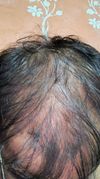
Oral minoxidil and vitamins reduced shedding for one user. Others distrust dermatologists and prefer personal research on treatments like finasteride and microneedling.
Unused Minoxidil tablets should be disposed of at a pharmacy with take-back services or according to packaging instructions. It's not recommended to give them to others due to legal and safety concerns.
Dermal incision with verteporfin is being explored as a potential hair loss treatment by dermatologist Melissa Toyos, with promising before-and-after photos shared on social media. The conversation discusses its potential effectiveness compared to other treatments like Minoxidil, Finasteride, and RU58841.
The conversation discusses hair loss treatments, focusing on a new slow-release oral minoxidil compared to topical minoxidil and finasteride. The results show that twice-daily dosing of the new treatment is slightly more effective than once-daily, but concerns about cost, side effects, and the accuracy of reported results remain.
Transplanting mice skin to humans is not feasible due to immune rejection, but some suggest genetic modification or immune suppression could make it possible. Xenograft hair transplants are discouraged.
The conversation discusses the use of trichoscopy to predict hair loss patterns and inform treatment approaches. Treatments mentioned include minoxidil, finasteride, and dutasteride, with varying effectiveness based on gender-specific hair loss patterns.
The conversation discusses concerns about RU58841 degrading when exposed to light and transferring pyri to a dark glass bottle to prevent this. The user keeps the pyri out for only two minutes before storing it in a dark place.
A user shared their 2+ years progress on Oral Dutasteride and Sublingual Minoxidil for hair loss. Another user asked about the form of Minoxidil used sublingually.
A 23-year-old male switched to a topical solution containing Fin 0.1% and Min 5% from a previous solution with Fin 1% and Min 5%, noticing increased hair shedding. He is concerned about losing around 50 hairs while using ketoconazole shampoo.
SCUBE3 is available online but poses risks like tumor promotion and high costs. Users advise against using it due to health concerns and inefficacy as a standalone treatment.
The conversation discusses whether stemoxydine needs to be used for life for hair loss treatment. One user suggests that stemoxydine does not require lifelong use and can make hair exit the resting phase faster, but the benefits may be temporary.
Emerging hair loss treatments like PP405, a topical MPC inhibitor, show promise in activating stem cells for hair growth. The conversation seeks information on the development stages and accessibility of these treatments.
Combining Minoxidil with Finasteride or RU58841 may cause interference, irritation, or reduced absorption. It might be better to apply one topical at a time and wait an hour before applying another.
Affordable 92-LED caps may be more effective for hair growth than expensive 270-laser caps due to higher power output and irradiance. The LED caps deliver more energy to the scalp, making them a cost-effective alternative for red light therapy.
Minoxidil should be applied first, allowed to dry, then emu oil can be applied. Emu oil is recommended for daily use, but it may not need to be washed off daily.
User on fin, minox, and ketoconazole seeks to add another topical anti-androgen. Hierarchy of effectiveness: 1. RU55841, 2. Fluridil - Eucapil, 3. CB-03-01 - Breezula, 4. Ketoconazole; alfatradiol suggested as addition.
Hair loss discussion involved Finasteride, Minoxidil, and RU58841. User experienced sudden shedding after 1.5 years of Finasteride and Minoxidil use, seeking advice.
Dr. Toyos is recruiting more participants for a larger trial on hair loss treatments. The discussion mentions Minoxidil, finasteride, and RU58841 as potential treatments.
Oral DHT blockers like finasteride are preferred for their ease of use, effectiveness, and long-term safety data, while topical treatments like RU58841 lack extensive safety data and can be more cumbersome to apply. Oral treatments are generally considered more effective and convenient despite potential side effects.
RU58841 helped reduce scalp itching for some users within a week, while others experienced immediate relief. Some users reported initial irritation from the solution, possibly due to the carrier used.
The user is experiencing stage 2 hair loss and thinning, noticing more scalp visibility with short hair. They are considering diet, yoga, scalp massage, supplements, and a serum recommended by their doctor, and questioning if it's safe to stop using the serum and whether to get a blood test since hair loss isn't a family trait.
A user is concerned about the long-term commitment and potential side effects of using oral finasteride and topical minoxidil for hair loss. They are debating whether to accept their hair loss or start the treatment despite mixed results from others.