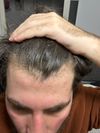
Treatments for hairloss, including the use of minoxidil and microneedling; as well as discussing the potential of using finasteride or a ketoconazole shampoo.
A new hairloss lotion by Dr. Brotzu, expected to regrow up to 5 years of lost hair, is set to be released by Fidia Farmaceutici. It claims to work like minoxidil and finasteride without side effects, but skepticism exists due to its classification as a cosmetic product.
The conversation discusses hairloss treatments, specifically mentioning Minoxidil, finasteride, RU58841, and Xeljanz. The user inquires about Xeljanz and shares a link suggesting it may help with hairloss.
The post discusses a user's hairloss treatment routine, which includes daily 1mg finasteride, twice daily topical rogaine, biotin vitamin intake, and a new microneedling regimen of 0.5mm three times a week. The user is turning 24 next month.
Treatments for hairloss, with the user considering Pyrilutamide and RU58841 as options. It is noted that although Pyrilutamide has been studied more and is allegedly more effective, there are doubts about its authenticity in the market. KX-826 is suggested as an alternative as it has a stronger effect than RU58841 and there is scientific research on it.
User experienced hairloss improvement after 7 months using finasteride, zinc, vitamin D, minoxidil, and microneedling. Others praised the progress and discussed the importance of zinc and vitamin D in hair health.
Treatments for hairloss, including finasteride, dutasteride, minoxidil, ketoconazole, microneedling, and low level laser light therapy, which aim to reduce DHT production, increase cell absorption and blood flow, and stimulate epidermal stem cells. It also stresses the importance of patience when using these treatments.
Celebrities using hairloss treatments like finasteride, minoxidil, and hair transplants is common and helps normalize these practices for the public. Many believe acknowledging this reduces stigma and provides reassurance that these treatments are effective and widely used.
The conversation discusses hairloss treatments, specifically Minoxidil, finasteride, and RU58841. The user seeks opinions on the effectiveness of these treatments.
Many delay hairloss treatment due to lack of awareness, denial, or fear of side effects. Treatments like finasteride, minoxidil (oral and topical), and hair transplants are discussed, with mixed results and concerns about side effects.
The conversation discusses hairloss treatments, including Avodart (Dutasteride), finasteride, minoxidil, and peptide serums with ingredients like Redensyl and Saw Palmetto. Users share experiences and opinions on the effectiveness and side effects of these treatments, with some skepticism about claims regarding DHT and its role in hairloss.
People with hairloss experience emotional struggles and body dysmorphia. Treatments like minoxidil, finasteride, and dutasteride are used, but results vary and can take time.
A user experiencing hairloss received three different diagnoses: androgenic alopecia, traction alopecia, and scarring alopecia, and tried treatments like minoxidil and finasteride without success. They are considering dutasteride but were advised to seek anti-inflammatory medication instead.
The user has been experiencing hairloss for over 5 years and is currently using a topical treatment of finasteride, minoxidil, and tretinoin, along with derma rolling and a hair growth oil. They have previously tried oral finasteride, pyrithione zinc, RU58841, and dutasteride, but are seeking advice on whether to retry dutasteride or find a more reliable source for RU58841 due to ongoing hair density loss.
Using oral finasteride in combination with topical minoxidil and dermarolling for hairloss. Some users have reported significant regrowth when adding finasteride to their minoxidil routine, suggesting that reducing DHT levels may be a key factor in hair regrowth.
User discusses hairloss treatment progress using Dutasteride for 2 years, RU58841 for 5 months, and oral Minoxidil for 1 year. Some users share side effects and experiences with these treatments.
Progress in hairloss recovery over the course of one year, using oral finasteride and topical minoxidil. Suggestions were made to try topical finasteride and minoxidil with microneedling, and other factors such as stress, iron, nutrition discussed.
Treatments for hairloss, including Minoxidil, finasteride, and RU58841. The post discusses the potential benefits of Pyrilutamide compared to RU58841 in terms of strength and longevity.
Treatments for hairloss, focusing on Fluridil/Topilutamide (Eucapil), Finasteride and RU58841 (Alfatradiol). The user reported that the Fluridil seemed to work well but had side effects of testicle ache, decreased mood and sex drive.
Treatments for hairloss, including microneedling (dermarolling and dermapen) and the use of minoxidil, finasteride, and RU58841. It provides detailed information about cost and usage of the various treatments, as well as potential side effects.
User experiencing hairloss tried Minoxidil, Finasteride, Microneedling, Ketoconazole shampoo, and Biotin. Others suggest continuing current treatment for 1-2 years before considering Dutasteride and RU58841.
The user is experiencing continued hairloss despite using dutasteride and oral minoxidil, and is considering adding finasteride or adjusting their current treatment. They are seeking advice on whether to change their approach due to lack of improvement, especially at the temples and crown.
A user experienced no visible improvement in hairloss after 10 months on 0.5mg finasteride and increased the dose to 1mg, noticing a possible shedding phase. They also use topical minoxidil, ketoconazole shampoo, and dermastamping, and are seeking others' experiences with similar treatments.
The conversation discusses hairloss treatments, specifically finasteride, minoxidil, ketoconazole shampoo, and microneedling, with users experiencing initial success followed by increased shedding and regression. Many users suggest patience, as hair cycles can take years, and some attribute changes to seasonal shedding.
Young individuals experiencing hairloss are discussing their experiences with treatments like minoxidil and finasteride. Some report positive results with finasteride, despite side effects, while others share tips for managing minoxidil-related dandruff.
New hairloss treatments, including Breezula, VDPHL01, and PP405, are nearing Phase 3 trials, offering hope for effective solutions. Current treatments like finasteride and minoxidil remain effective, but early intervention is crucial.