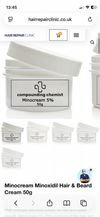
Minoxidil 5% combined with 0.01% tretinoin may be as effective as using minoxidil twice daily. Users discuss switching to oral minoxidil for consistency, with concerns about side effects.
Retinoids, like Retin-A and retinol, can be beneficial when used with minoxidil for hair loss. Retin-A is the strongest and requires a prescription, while retinol is over-the-counter.
A user is considering switching from a 5% minoxidil spray to a minoxidil cream for easier application and less greasiness. They are inquiring about the Hair Repair Clinic 5% minoxidil cream, which includes optional tretinoin and other ingredients like isopropyl myristate and beeswax.
The conversation is about someone considering adding topical Cetirizine 1% to their existing hair loss treatment regimen and seeking advice on where to buy it and others' experiences with it.
Switching from 2% liquid minoxidil to 5% foam minoxidil reduced scalp irritation but increased eyebrow flakiness and thinning. The user speculates that propylene glycol in the liquid formulation might have been protecting against seborrheic dermatitis while causing contact dermatitis.
The conversation is about the best vehicle for RU58841, comparing trichosol and Garnier/Vichy Stemoxydine, avoiding propylene glycol (PG) or ethanol due to previous scalp damage. The user is also seeking sources for these products in the EU.
A user has been using a 5% RU58841 solution for hair loss without much result and is considering increasing to an 8% solution to improve outcomes. They are unsure if they should increase the concentration or wait longer for results.
Using 0.025% tretinoin may enhance minoxidil's effects for hair loss. Users suggest starting with 0.025% and gradually increasing the concentration, and discuss combining treatments like microneedling.
The conversation is about a new acne treatment cream called Clascoterone Cream 1%, which is the first new mechanism of action for acne in nearly 40 years. One person joked about hoping their face will be as clean as their bald head after using the cream.
The user discusses their hair regrowth success with minoxidil, red light therapy, massage, and derma stamping but expresses concerns about using finasteride due to potential side effects. They are interested in using clascoterone as a topical treatment for hair loss and are exploring the possibility of creating a topical formula from raw clascoterone powder.
Adding retinol to a hair loss routine, with a user suggesting starting with a lower dose. Another user mentions using tretinoin with minoxidil for potential benefits.
PP405 is a topical gel being tested for hair regrowth in adults with androgenetic alopecia. Volunteers aged 18-55 are needed for a 16-week trial in several US locations.
Retinoids, like tretinoin, may enhance minoxidil absorption and effectiveness on the scalp. Over-the-counter retinols lack strong evidence for similar benefits.
The conversation is about finding a source for a topical solution combining minoxidil with other ingredients like finasteride, dutasteride, or retinol. The user seeks recommendations for purchasing these enhanced formulations.
The user has been using minoxidil for over a year with little success, added tretinoin cream, and is considering adding red light therapy. They are advised to use moisturizer to counteract skin sensitivity from tretinoin.
PP405 is moving to late-stage trials, showing potential for hair regrowth, with 31% of male patients experiencing a 20% increase in hair density. Veradermics is developing an oral minoxidil version, and there is interest in combining treatments for better results.
A 43-year-old from Thailand shares progress after 1 month using topical finasteride, minoxidil, tretinoin cream, and weekly microneedling for diffused thinning. Users compliment his appearance and suggest he doesn't need treatment.
A user is seeking recommendations for a minoxidil and tretinoin topical solution, including dosage and purchase locations in the US. They are looking for effective hair loss treatments.
A user is starting a hair loss treatment with a 3-in-1 spray containing 6% minoxidil, 0.3% finasteride, and 0.025% tretinoin. Users are skeptical about its effectiveness due to advanced hair loss, but some suggest adding microneedling and using affordable generics.
Topical Finasteride is most effective at 0.1-0.25%, and Minoxidil at 5%. Tretinoin is optional, and additional ingredients like biotin, caffeine, and saw palmetto are recommended.
PP405 shows initial promise for treating androgenetic alopecia, with safety confirmed in early trials, but skepticism remains due to limited data. Further trials are needed to determine its true efficacy and potential market impact.
The conversation discusses hair loss treatments, specifically using 5% minoxidil foam, Vitamin B12, and Vitamin D, with suggestions to add oral finasteride and minoxidil for better results. Concerns about side effects, particularly from finasteride, and the need for a DHT blocker are also highlighted.
The conversation discusses concerns about using a high concentration of 1% topical finasteride for hairline balding, with some users suggesting starting with a lower dose. It also mentions the use of GHK-CU peptide and the importance of considering the formulation to avoid excessive absorption.
The user is considering switching from pyrilutamide to 0.025% topical finasteride due to concerns about effectiveness and past side effects from a scalp elixir. They aim to maintain hair until new treatments like breezula or GT00029 become available.
The conversation discusses using tretinoin for hair loss and skincare. Users share experiences, noting tretinoin's effectiveness in combination with minoxidil for hair and its proven benefits for anti-aging skincare.
The FDA will now require only one clinical trial for drug approval, potentially speeding up the release of hair loss treatments like PP405. Pelage is expected to present full results of PP405 Phase 2a trials and move to Phase III in mid-2026.
User discusses a topical hair solution containing Tretinoin, Dutasteride, and Ketoconazole, and asks if it's safe to combine and leave in hair. Concerns include Ketoconazole being left in hair and Tretinoin's effects with Dutasteride and Ketoconazole.
Tazarotene may be more effective than tretinoin when combined with topical minoxidil for hair loss due to its selective binding to RAR-beta and gamma, though it can cause irritation. Tazarotene's potency can lead to indirect inflammatory reactions despite potentially causing less irritation than tretinoin.