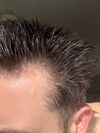
The conversation discusses difficulty in distinguishing between new hair growth and thinning hair at the temples after using microneedling and a rosemary peppermint topical for four weeks. The advice given is to wait a few months to see if the hairs grow out to determine their nature.
The conversation discusses personal experiences with hair loss and highlights the potential impact of anemia and nutrient deficiencies on hair health. Treatments mentioned include changing shampoo/conditioner, taking MSM, collagen, hyaluronic acid, astaxanthin, B12, folate, and bovine blood capsules.
The conversation is about hair loss and the conclusion is that genetics play a significant role in hair loss, and lifestyle choices or being a well-adjusted person do not prevent male pattern baldness.
Hair loss may be linked to DHT, which can both suppress and increase inflammation, potentially as a defense mechanism. Treatments like Minoxidil, Finasteride, and RU58841 are discussed, but the exact cause of hair loss remains unclear.
Researching whether pyri and enza, which are stereoisomers of each other, share the same features related to CNS penetration/GABA Inhibition; safety and efficacy when used topically at 0.5-1%; and cost comparison between the two treatments.
Setipiprant and Fevipiprant are questioned for their effectiveness in hair maintenance, with skepticism due to lack of convincing results beyond vellus hair growth. The user is satisfied with Minoxidil and Finasteride but is curious about the potential of DP2 inhibitors.
The user experiencing diffuse hair loss is using various treatments including RU58841, finasteride, minoxidil with tretinoin, anti-hair loss shampoo, and microneedling, and is considering adding peptides TB500, BPC157, and GHK-Cu. They have low growth hormone levels and are questioning its impact on hair loss, while another user suggests androgenic alopecia and androgens are likely the main cause of hair loss.
The phase 3 trial results for Pyrilutamide showed no significant difference from the control treatment in increasing hair count, leading to the company halting its development. Users discussed their disappointment and skepticism about hair loss treatments, with some mentioning other treatments like Minoxidil, Finasteride, and RU58841.
The conversation discusses Kintor's initiation of a new Phase 3 trial to assess the long-term safety of Pyrilutamide (KX-826) for hair loss, which will last 52 weeks. Specific treatments mentioned include Pyrilutamide.
Pelage is developing a topical hair follicle stem cell therapy, PP405, for non-scarring alopecias like androgenetic alopecia, with Phase III trials planned and a potential market launch by 2027. The treatment may not require continuous use after initial regrowth.
PP405 is discussed as a potential treatment for hair loss, with excitement about its promise but skepticism about its current effectiveness. Users mention combining it with treatments like minoxidil, finasteride, and microneedling, but emphasize it is not a cure.
PP405 shows promise in hair regrowth, with 31% of participants experiencing over 20% increase in hair density after 8 weeks. Phase 3 trials are expected in 2026, with potential market availability by 2029-2031.
Comparing the effectiveness of RU58841, Pyrilutamide and CB-03-01 as treatments for hair loss, with people discussing different aspects such as binding affinity, time of inhibition, safety data and cost.
Pelage PP405 is a new hair loss treatment in trials, potentially reactivating dormant hair follicles without affecting hormones. Results are expected in February 2025, offering an alternative to minoxidil and finasteride.
The conversation discusses the comparison of Pyrilutamide Phase II US trial results with 1 mg finasteride for hair loss treatment. It mentions that the total hair count increase in the US trial was not as good as the China trial.
The conversation discusses hair loss, genetics, and treatments like Dutasteride. It highlights the influence of genetics on hair loss, noting that indigenous people are less prone to it.
The user is experiencing hair shedding despite using finasteride, minoxidil, and microneedling, and is concerned about the non-linear progress. Other users share similar experiences, suggesting shedding is normal and cyclical, with some recommending less frequent microneedling.
The user tried a product labeled as PP405 from Umbrella Labs for hair loss but saw no changes, and it was revealed to be a fake or misidentified product. The user is also using finasteride, minoxidil, and other treatments but is still experiencing hairline issues.
The conversation discusses using peptides BPC-157 and TB-500, combined with microneedling, to potentially enhance hair regrowth. The user plans to try BPC-157 due to its lower cost and reports of hair growth, despite limited human trials and concerns about side effects from other treatments like minoxidil and finasteride.
The user experienced significant hair regrowth using finasteride and minoxidil, leading to doubts about proceeding with a planned hair transplant. Many suggest postponing the transplant to save grafts for future needs, as the current results are impressive.
User shared 15-month results using finasteride and minoxidil, showing no loss but minimal growth, considering a hair transplant. Replies suggest starting treatment earlier, continuing current treatment, or getting a transplant.
User doing PRP with exosomes for hair loss, sees possible regrowth after two treatments. Another user suggests providing before and after pictures for better assessment.
The user has been using minoxidil, finasteride, a laser cap, and ketoconazole shampoo for hair loss without success and is seeking advice on further tests or treatments. They have a family history of hair loss and have not yet undergone dermatologist or trichology tests.
How easy it is to fake hair growth, and the skepticism of progress pictures on the subreddit. Some treatments mentioned include finasteride, minoxidil, microneedling, Toppik/Hair Fibers, Dermmatch and a hair transplant.
PP405 shows promise as a hair loss treatment, with 31% experiencing increased hair density in a short trial. It may complement treatments like finasteride and minoxidil, but long-term effectiveness and safety need confirmation.
L'Oreal is working on hair cloning, with multiple companies using similar techniques, making hair cloning likely by 2030. The conversation expresses optimism about the progress and potential affordability of hair cloning solutions.
PP405 is a promising molecule that may reactivate dormant hair follicles, potentially offering a new treatment for hair loss. It is in phase 2 trials, with possible availability between 2027 and 2030.
The post discusses a new hair loss treatment involving an improved pyri formula that has shown promising results, including thicker hair and a restored hairline, with minimal side effects. The author seeks investors to collaborate with Kintor or acquire the pyri patent, offering equity rewards and complimentary samples for verification.