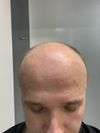
The user started using topical minoxidil 5% and ketoconazole shampoo for hair loss, noticing minimal progress after three months, with fine hairs appearing. They experienced a setback when reducing the application to once a day but resumed twice daily applications.
The user's progress with their hair loss treatment of topical minoxidil and finasteride solution, as well as scalp massage; other users commenting on the results being impressive for someone of Asian background.
A user shared their 2-month progress on hair regrowth using oral minoxidil, oral finasteride, and topical minoxidil with pyrilutamide. They reported seeing tiny hairs growing and no side effects from finasteride so far.
The user has been using a combination of 0.3% topical finasteride, minoxidil, ketoconazole, and microneedling once a week for two months with positive results and no side effects. They apply the treatment daily using a spray and have short hair, which makes application easier.
The user saw decent results using Minoxidil 2%, Alpecin shampoo, and Mycoseb shampoo for hair loss. They are considering starting Finasteride and Minoxidil 5% but seek advice on whether to use them now or later.
The user is concerned about hair loss and is using treatments like dutasteride, microneedling, and topical finasteride, while considering adding RU58841. They are also using Minoxidil on the temples and are worried about testosterone-related hair loss.
Finasteride and Dutasteride do not cause depression or "Post Finasteride Syndrome," with concerns often linked to the nocebo effect and preexisting mental health issues. The EU is unlikely to ban these drugs, but access may become more restricted due to ongoing debates.
A user shared a 3.5-month hair loss treatment progress using topical Minoxidil, Finasteride, and RU58841, noting improved confidence and satisfaction with the results. Other users congratulated and praised the progress shown in the pictures.
The conversation discusses a 4-month hair regrowth protocol that includes finasteride (1.25mg), RU58841, dermarolling, ketoconazole, minoxidil, peppermint oil, and fatty acids/oils. Progress pictures are shared to show the results of these treatments.
A 19-year-old is experiencing hair loss and has been using Rogaine for a month and finasteride for four days without improvement, while also experiencing testicular discomfort. They are concerned about losing hair density and potential DUPA, comparing their situation to their father's hair condition.
A 22-year-old male with hair loss is considering treatments like finasteride, minoxidil, and derma rolling after being diagnosed with MPB, vitamin D deficiency, and dandruff. He seeks advice on whether these treatments can realistically improve his hair density and achieve a healthier NW2.
The conversation discusses using minoxidil foam as a solvent for topical finasteride. Ingredients of minoxidil foam include butane, cetyl alcohol, glycerin, and purified water.
Potential treatments for hair loss, specifically the combination of liquid minoxidil and pyrilutamide, with some suggesting that adding finasteride may be beneficial.
A 22-year-old male with male pattern baldness wants to use minoxidil and finasteride but can't find topical finasteride. He is considering natural DHT blockers like saw palmetto and caffeine and seeks advice on their effectiveness.
A user has been using finasteride, minoxidil, RU58841, dutasteride, saw palmetto, and pumpkin seed oil but continues to experience significant hair shedding. They are seeking advice on what to do next.
The user started using topical finasteride 0.025% and minoxidil 5% twice daily, seeing initial improvement but later experiencing shedding and scalp pain. They are considering increasing the finasteride dose to 0.05% while using keto shampoo and dermarolling, and are debating the effectiveness of low versus standard doses of finasteride.
A 24-year-old noticed hair thinning over 4-6 years and is seeking advice on whether it can be salvaged. Treatments mentioned include Minoxidil, finasteride, and RU58841.
Hair follicle stem cells remain in bald individuals, but progenitor cells do not, raising questions about hair regrowth claims by Pelage. PP405 is discussed as a potential treatment, with skepticism about its effectiveness compared to existing treatments like Minoxidil and Finasteride.
Hair loss treatments like Minoxidil, finasteride, and RU58841, focusing on their effectiveness and side effects. It also highlights the disparity in medical research funding between hair loss and conditions like endometriosis.
A 35-year-old is using finasteride, minoxidil, ordinary serum, dermarolling, and Nizoral shampoo for hair loss. After two months, they see improvement despite initial worsening and anticipate future shedding.
A 34-year-old male shares a nine-month update on hair loss treatment using 1.25mg oral finasteride daily, 5% topical minoxidil 5-7 times a week, and 1% ketoconazole shampoo twice a week. He reports stopping diffuse thinning and regaining crown density, though his hairline may require a transplant.
A 23-year-old is using finasteride, minoxidil, nizoral, a dermapen, rosemary oil, and peppermint oil for hair loss treatment. They are seeking feedback on their progress.
A 28-year-old male is happy with his hair regrowth on the crown after using topical Minoxidil 5% and Finasteride 0.25% once daily, micro needling weekly, and Nizoral shampoo once a week. He has experienced no significant side effects, and his hair has become darker and thicker, with improvements in his hairline.
People are hopeful about future hair loss treatments like PP405, GT20029, and VDPHL01, while some are currently using finasteride and minoxidil. There is skepticism about the effectiveness of new treatments, and some advise against hair transplants until more promising drugs are available.
The user used finasteride but stopped due to side effects, then used topical minoxidil for 13 months, and later added KX826/pyrilutamide for 8 months. They experienced shedding after starting pyrilutamide and use minoxidil and KX826 once daily.
PP405 shows potential for hair growth, with 31% of advanced balding men experiencing over 20% increase in hair density in 8 weeks. However, skepticism persists due to selective data presentation and lack of long-term results, with comparisons to treatments like minoxidil and finasteride.
Delayed release oral minoxidil is seen as a promising advancement for hair loss treatment, offering safer, higher doses and more consistent hair follicle stimulation compared to current options. However, it is not expected to replace finasteride or dutasteride, as it does not prevent androgenetic alopecia.
The user shared progress pictures after using a topical treatment of 0.3% finasteride and 6% minoxidil once a day for a year, noting improvement in the front but needing suggestions for the crown. They confirmed using a product from Hims.
The user shared progress photos showing significant hair regrowth over two months using finasteride, minoxidil, derma stamping, and mint and rosemary oil. Some users doubted the authenticity of the results, while others congratulated the user on the noticeable improvement.