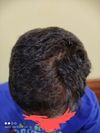
The user has been taking oral finasteride for 2 months, experiencing more hair loss but noticing some fuzzy hair growth on the scalp. They are questioning if this new hair growth is significant.
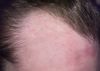
A 19-year-old trans man has been using Finasteride 1mg for a little over two months and is concerned about worsening hair loss, noting a fuzzy and soft hairline and crown. The user is upset as the hair loss appears worse than before starting the treatment.
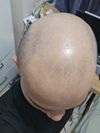
The conversation discusses concerns about getting a buzz cut years after a FUE hair transplant due to an unnatural look and thinning hair. Suggestions include trying a buzz cut and considering scalp micropigmentation (SMP) as an option.
Cold shock therapy may promote hair growth by stimulating follicular muscles and affecting stem cells. The exact mechanisms and full range of elements involved are not yet fully understood.
A 33-year-old female with androgenic alopecia experienced alopecia areata patches after PRP treatment. She is seeking others' experiences with PRP worsening alopecia areata.
A 29-year-old considering hair loss treatment received advice to explore a theory on androgenic/anabolic balance and was encouraged to read a beginner's guide for better recovery chances. The user expressed gratitude and willingness to try the suggested approach.
A user has been using Minoxidil and Finasteride for 2 years without improvement, experiencing worsening hair loss. They are considering other treatments like Dutasteride, PRP, and microneedling.
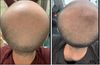
The user takes 1mg of finasteride daily and applies Rogaine (minoxidil) twice a day. The first picture is from July 2023, and the last is from November 2024, showing hair progress.
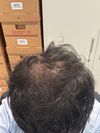
The user has been taking 1 mg of finasteride daily for four months and is questioning if they are experiencing hair regrowth, as suggested by their barber. Another user suggests taking better photos to assess the crown area more clearly.
The user has been using Finasteride for over four months to treat androgenetic alopecia but continues to experience hair loss and thinning. They recently started using Minoxidil and are considering switching to Dutasteride due to concerns about Finasteride's effectiveness.
Dutasteride can be taken daily or weekly, depending on individual goals and side effect tolerance. Daily use maximizes suppression, while less frequent dosing reduces side effects.
The user is experiencing significant hair shedding after starting dutasteride, which is considered a normal part of the treatment process. Despite the shedding, the user notes some improvement in hairline appearance and is seeking advice and reassurance.
The user is considering adding minoxidil to their current dutasteride treatment to recover lost hair, particularly in the temple areas. Other users suggest that minoxidil is necessary for better results, with one user sharing their positive experience using a combination of minoxidil, dutasteride, and other treatments.
The user is experiencing increased hair shedding and is considering switching from a topical solution containing minoxidil, finasteride, and tretinoin to oral minoxidil while continuing oral dutasteride. They are seeking advice on whether to make this switch or wait for the shedding to stabilize, and are concerned about potential side effects of oral minoxidil.
After 8 months of using topical finasteride, hair miniaturization continues, raising concerns about its effectiveness. Microneedling is suggested as a possible complementary treatment.
Topical finasteride and minoxidil, combined with microneedling, are recommended for treating thinning hair areas, with 1-2 sprays daily being effective and having fewer side effects than oral finasteride. Starting microneedling at 1.0mm is advised for effectiveness while minimizing invasiveness.
FCE 28260 (PNU 156765), an under-explored 5α-reductase inhibitor, showcases promising results in research by Giudici et al., outperforming well-known treatments like Finasteride in reducing the conversion of testosterone to DHT. Its superior efficacy, demonstrated through lower IC50 values in both natural and human recombinant enzyme studies, suggests it could offer more effective management of DHT-related conditions. Additionally, its lower molecular weight hints at better potential for topical application, potentially offering advantages in treating conditions such as androgenic alopecia. Despite its potential, it has not advanced in development, possibly due to financial limitations, leaving its therapeutic prospects and side effect profile largely unexplored.
RU58841 powder from a lab supplier was tested at a free drug testing service. The discussion includes using Minoxidil and finasteride for hair loss treatment.
Pyrilutamide is a selective AR antagonist with a high binding affinity, making it effective in competing with DHT for androgen receptors. The 1% concentration is more effective than the 0.5%, but the latter may suffice for mild hair loss; the drug is considered a good option for those avoiding 5AR blockers due to side effects.
A user is experiencing accelerated hair loss and is struggling to maintain their mohawk. They are seeking alternatives to Minoxidil and Finasteride, considering a hair transplant, and looking for a doctor in Berlin who can prescribe Finasteride.
Topical dutasteride is suggested as a low side-effect treatment for hair loss, with a proposed dose of 0.025% 1ml/day. It is considered better than finasteride due to its even inhibition of DHT isoforms and lower systemic absorption.
A user shared their 4-month hair transplant progress with 3740 grafts, showing before and after pictures. They had a generally good experience, except for the anesthesia part.
For hair loss, start with Finasteride, Minoxidil, Ketoconazole shampoo, and Microneedling. For severe cases, consider Dutasteride, oral Minoxidil, or hair transplants.
A user is considering using RU58841 for female pattern baldness and is also planning to use Minoxidil. They are hesitant to ask their doctor for spironolactone due to its cosmetic nature and are experiencing significant hair loss possibly due to stress and hormonal issues.
A 34-year-old male used Minoxidil 5% and dermarolling for 2 months, seeing significant hair regrowth. He avoided finasteride due to concerns about hormonal effects.
USER19 shared progress pictures 1.5 years after a hair transplant of 4180 grafts by Dr. Ahmet Yildirim, with no medications used. New hair growth started after the 3rd month.
A user is comparing Capillus Ultra and Capillus ONE for hair loss treatment, questioning if the number of diodes matters. Another user suggests the OMG helmet as the only worthwhile option.
User seeks help calculating dosages for liquid minoxidil (2% and 5%) and generic finasteride (5mg tablets) to treat hair loss. They want to know how to achieve 2.5 mg of minoxidil and 1 mg of finasteride per ml of solution.
A 25-year-old male is using topical minoxidil and plans to start finasteride and a keratin supplement to combat hair loss. He will document his progress with photos and track any side effects.