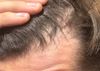
RU58841, a potential hair loss treatment, was not commercialized due to marketability issues and lack of long-term safety data. Concerns about its formulation and delivery methods further complicate its use.
PP-405, a potential hair loss treatment, shows promise in stimulating dormant hair follicles and may help with various hair loss types. Current treatments like Minoxidil are still recommended as PP-405 is in early trials and may take years to become available.
A user's 14-month journey with finasteride, microneedling, and Nizoral to treat hair loss. They experienced some side effects such as ball ache, needing to pee constantly, and less semen, but the results were generally positive.
Discussion on hair loss treatments, focusing on pp405, with skepticism about its effectiveness and concerns about its association with the cosmetic industry. Users also mention treatments like Minoxidil and Finasteride.
People are hopeful about future hair loss treatments like PP405, GT20029, and VDPHL01, while some are currently using finasteride and minoxidil. There is skepticism about the effectiveness of new treatments, and some advise against hair transplants until more promising drugs are available.
Dr. Muñoz's discovery suggests that targeting potassium channels in fibroblasts could reactivate hair growth, offering new treatment possibilities for alopecia. Potential strategies include using minoxidil, diazoxide, and other potassium channel openers, as well as bioelectric devices and direct growth factor applications.
The user improved their hair loss from stage 5 to stage 3 using Minoxidil, Finasteride, and a Dermapen. They saw results after 6 months, experienced a shedding phase, then saw more gains, advising others not to be discouraged during the shedding phase.
A 31-year-old male shared his 3-year progress using finasteride 1 mg daily, with additional treatments including nutrafol, multivitamins, vitamin D, marine collagen, PRP scalp injections, micro-needling, and Nizoral. He experienced temporary libido issues but currently has no side effects.
A user reported that Procerin, containing Saw Palmetto and Pumpkin seed oil, provided similar hair thickening results as finasteride but with milder side effects. They experienced reduced libido and watery ejaculations but are adjusting the dose to minimize these effects.
The conversation discusses scalp itching and tenderness after microneedling, despite using medicated shampoos and proper sanitation. The user plans to see a dermatologist and is concerned about possible infection or allergic reaction.
The conversation discusses struggles with diffuse thinning and hair loss treatments, including the use of dutasteride, minoxidil, and finasteride, with limited success. The original poster regrets having a hair transplant at 21 due to weak donor hair and ongoing thinning.
The FDA will now require only one clinical trial for drug approval, potentially speeding up the release of hair loss treatments like PP405. Pelage is expected to present full results of PP405 Phase 2a trials and move to Phase III in mid-2026.
A person is experimenting with microneedling on one temple while using Minoxidil to address hair loss. They plan to needle weekly and apply Minoxidil twice daily, avoiding application around needling sessions.
People are discussing the use of an untested hair loss treatment called PP405, which is not available on the grey market. Some users are trying a mimic formulation called HP3, reporting thicker hair but no new growth yet.
PP405 is being discussed as a potential treatment for hair loss, with uncertainty about its effectiveness compared to existing treatments like finasteride, dutasteride, and minoxidil. There is cautious optimism, but its impact on hair transplants remains unclear.
A product called "PP405 Hair Follicle Serum" is being sold on Shopee, claiming to cure baldness without clinical trials or FDA approval, but users are skeptical and refer to it as "snake oil." Some users discuss testing the product's contents, while others share their experiences with hair loss treatments like finasteride.
PP405 is a new hair loss treatment in phase 2 trials that may promote hair growth by increasing lactate production and activating hair follicle stem cells. It could potentially replace hormone-disrupting treatments like Minoxidil and finasteride.
FCE 28260 (PNU 156765), an under-explored 5α-reductase inhibitor, showcases promising results in research by Giudici et al., outperforming well-known treatments like Finasteride in reducing the conversion of testosterone to DHT. Its superior efficacy, demonstrated through lower IC50 values in both natural and human recombinant enzyme studies, suggests it could offer more effective management of DHT-related conditions. Additionally, its lower molecular weight hints at better potential for topical application, potentially offering advantages in treating conditions such as androgenic alopecia. Despite its potential, it has not advanced in development, possibly due to financial limitations, leaving its therapeutic prospects and side effect profile largely unexplored.
Kintor's Pyrilutamide (KX-826) showed hair growth in Chinese Phase III trials but did not significantly outperform placebo. The treatment was safe with no major adverse reactions reported.
PP405 is discussed as a potential hair loss treatment, but its effectiveness and safety are uncertain. Some users express skepticism, while others are hopeful, comparing it to existing treatments like Minoxidil and Finasteride.
PP405 may promote short-term hair growth by pushing follicles into the growth phase, but concerns exist about long-term effects due to lack of rest phases. Users discuss various treatments like finasteride, minoxidil, spironolactone, alfatradiol, and investigational drugs like KX-826 and GT20029 for hair maintenance and regrowth.
The conversation discusses the ineffectiveness of dutasteride in halting hair loss for the user and explores the potential of PP405, which works through a different mechanism. Suggestions include considering a biopsy to determine the cause of hair loss and exploring other treatments like RU58841.
The user is asking for opinions on whether their hair growth is due to Pantostin and hormone treatments. One commenter confirms regrowth and asks about the hormone treatments.
A 29-year-old man experienced significant hair thickening at the front and top after using finasteride and microneedling for two months, as noticed by his hairdresser. He used 0.5 mg/day of finasteride orally, switched to a topical solution, and performed microneedling with a Derminator2 every 6-7 days.
Piroctone olamine is more effective than ketoconazole for increasing hair growth and reducing itching and dandruff. Treatments discussed include Minoxidil, finasteride, and RU58841.
The conversation is about the long-term safety trial results for pyrilutamide, which are expected soon. Treatments mentioned include Minoxidil, finasteride, and RU58841.
A 33-year-old female with androgenic alopecia experienced alopecia areata patches after PRP treatment. She is seeking others' experiences with PRP worsening alopecia areata.
The post and conversation are about HMI-115, a potential treatment for hair loss. The conclusion is that HMI-115 is not a 5ar-inhibitor and is instead a prolactin receptor inhibitor. Some users are skeptical about its effectiveness and believe that baldness will still be a problem in the future.
After a second session of Platelet-Rich Plasma (PRP) treatment for hair regrowth, the user is experiencing increased shedding of thick and dark hairs and is concerned about whether this is temporary. They are seeking others' experiences with PRP, specifically regarding the duration of shedding and eventual positive outcomes.