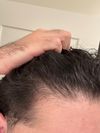
Dr. Toyos is recruiting more participants for a larger trial on hair loss treatments. The discussion mentions Minoxidil, finasteride, and RU58841 as potential treatments.
The conversation is about using finasteride and KX826 for hair loss treatment. The original poster is using 0.25 mg of finasteride every other day due to side effects at a higher dose.
Pelage Pharmaceuticals' PP405 aims to treat hair loss by reactivating dormant hair follicle stem cells, showing promising results in early trials. The company plans to present their findings at the American Academy of Dermatology Annual Meeting in 2026.
Actifolic RU-58841 powder and GhK-Cu peptide were tested and found to be accurate. The user is satisfied with the product's authenticity for hair loss treatment.
The user experienced severe hair shedding despite using oral finasteride, minoxidil, dutasteride, and RU58841, and was diagnosed with Non-Alcoholic Fatty Liver Disease (NAFLD). They are considering switching to topical treatments due to the ineffectiveness of their current regimen.
TDM-105795 showed promising hair growth results, with higher efficacy than placebo and minimal side effects. It activates dormant hair follicle stem cells and may maintain gains without immediate loss, unlike minoxidil.
Dr. Muñoz's discovery suggests that targeting potassium channels in fibroblasts could reactivate hair growth, offering new treatment possibilities for alopecia. Potential strategies include using minoxidil, diazoxide, and other potassium channel openers, as well as bioelectric devices and direct growth factor applications.
Minoxidil, finasteride, and RU58841 are discussed as treatments for androgenetic alopecia (AGA). The conversation questions their effectiveness and whether they are scams.
The user has been experiencing hair loss since having COVID and has low vitamin D levels; they are seeing some improvement in their crown and hairline after starting vitamin D supplements. Commenters suggest the hair loss pattern is consistent with male pattern baldness (MPD) and varies by individual.
The safety of combining alfatradiol and fluridil with finasteride as a potential treatment for male pattern baldness, which is approved in the European Union. Other treatments such as minoxidil and RU58841 were also discussed.
The user claims to have successfully treated hair loss using natural supplements like collagen, L-lysine, zinc, B12, and bamboo shoot extract, without using the "Big 3" treatments (Minoxidil, finasteride, RU58841). The community is skeptical, demanding proof and emphasizing that the "Big 3" are proven effective, while natural remedies are often not.
The user is exploring hair loss treatments, including Patented Growth Factors (PGF) and a serum with Copper Peptide, Ceramides, Amino Acids, and Caffeine, while expressing concerns about the cost and effectiveness of PGF. They are also considering starting finasteride due to doubts about PGF's long-term viability and are seeking experiences from others who have used these treatments alongside antidepressants.
South Korea's president is advocating for hereditary hair loss to be covered by national health insurance due to its impact on mental health and daily functioning. The discussion highlights the societal pressure in South Korea regarding appearance and the potential benefits of treating hair loss to improve mental health.
The conversation discusses hair thinning potentially linked to gut health issues and suggests biotin as a possible treatment. It also mentions that hair thinning could be due to male pattern baldness (MPB).
The conversation discusses a clinical trial for Setipiprant in the US, starting June 29th, with eligibility excluding recent users of minoxidil or finasteride. It encourages informed decision-making before signing up.
Hair loss treatments like Minoxidil, finasteride, and RU58841, focusing on their effectiveness and side effects. It also highlights the disparity in medical research funding between hair loss and conditions like endometriosis.
The conversation discusses skepticism about "5 in 1" and "3 in 1" hair loss treatments, which combine Dutasteride or Finasteride with Minoxidil, being overpriced and potentially ineffective. Users suggest buying individual components separately for cost savings and question the effectiveness of low concentrations in these combined products.
The conversation discusses the delay in the release of a new hair loss treatment, Pyrilutamide, and speculates on potential safety concerns as a reason for the delay. It also mentions GT20029 as another future treatment option, with a release at least five years away, and touches on the avoidance of research chemicals due to uncertainty about their authenticity.
PP405 is criticized for overhyped claims and cherry-picked data, with doubts about its effectiveness compared to minoxidil and finasteride. Many users express skepticism, emphasizing the need for more comprehensive trial results.
Panax ginseng, specifically a ginsenoside-enriched formulation, is suggested as a potential hair growth treatment alongside finasteride and minoxidil. The user is considering trying panax ginseng despite limited availability and evidence.
The conversation is about a person using oral minoxidil, biotin multivitamins, dutasteride lotion, a hair growth serum with redensyl, capixyl, and procapil, ketoconazole with zinc shampoo, and monthly PRP treatments with a derma roller for hair growth. Someone encouraged them to continue with their regimen.
The conversation discusses the potential role of prolactin in hair loss and mentions treatments like HMI115, mucuna pruriens, Zinc, and B6 P5P for lowering prolactin levels. It also touches on the use of natural compounds and the lack of studies due to funding issues.
KX-826 shows promising results for hair growth with fewer side effects, offering an alternative to finasteride and minoxidil. Users discuss combining it with minoxidil, dermarolling, and Nizoral for improved results.
Combining Minoxidil with Finasteride or RU58841 may cause interference, irritation, or reduced absorption. It might be better to apply one topical at a time and wait an hour before applying another.

A 27-year-old Asian male is treating hair loss with 1mg oral finasteride, topical minoxidil twice daily, and 1.5mm microneedling weekly. The discussion is about his progress with these treatments.
The user is experiencing an allergic reaction to propylene glycol in Kirkland minoxidil and is considering switching to a foam version or a low-PG minoxidil solution. They are also contemplating oral minoxidil but are concerned about its long-term safety.
The conversation discusses a patent filed by Shiseido for cloning Dermal Papilla (DP) cells to treat hair loss. The method involves using viral vectors to maintain the cells' growth-inducing properties, differing from Replicel's approach with Dermal Sheath Cup (DSC) cells.
A user is trying to reverse male pattern baldness (MPB) naturally by taking high doses of Vitamin D, improving diet, exercising, reducing stress, and other lifestyle changes, but plans to use finasteride if no results are seen in 60 days. Other users are skeptical, advising medical treatments like finasteride and warning against potential vitamin D overdose and the ineffectiveness of natural remedies for genetic hair loss.