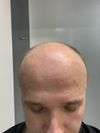
The user had high DHT levels after 8 months on dutasteride, questioning the drug's authenticity. They got dutasteride from a legitimate source and will update on progress.
Everychem's solution, similar to PP405, has mixed results for hair regrowth, with some users reporting improvements and others seeing no change or worsening hair loss. Users are sharing experiences and updates to determine its effectiveness.
A 29-year-old shares their 3-4 month progress using 2.5 mg Minoxidil and 1.0 mg Finasteride daily for hair loss, noting improved hair density and color. They experienced initial body itching and occasional dips in sex drive but are satisfied with the results.
The conversation discusses hair loss treatments, focusing on a new slow-release oral minoxidil compared to topical minoxidil and finasteride. The results show that twice-daily dosing of the new treatment is slightly more effective than once-daily, but concerns about cost, side effects, and the accuracy of reported results remain.
Topical finasteride may have higher systemic absorption and lower efficacy when using a Propylene Glycol/Ethanol formulation compared to the hydroxypropyl chitosan (HPCH) formulation. The safety profile of topical finasteride relies heavily on the HPCH formulation, and using standard solutions might lead to different pharmacokinetics.
The conversation is about making a 20mg/ml RU58841 solution for hair loss treatment using ethanol and propylene glycol. The user receives advice on calculating the correct amount of RU58841 powder needed.
Users discussed the effectiveness of Everychem's solution, similar to PP405, with some reporting improved hair thickness and new growth. Concerns were raised about safety and the legitimacy of the product, with some users advising against purchasing research chemicals.
The user is experiencing significant hair shedding despite 2 years on finasteride, 1.5 years on RU58841, and 10 months on oral minoxidil, and is frustrated with the ongoing issue. Another user shares a similar experience of losing a lot of hair daily for the last 3 years.
A user increased their RU58841 treatment from 5% to 8% to combat hair loss and is questioning the effectiveness of the higher dosage. Another user shared their extensive hair loss treatment regimen, suggesting that while 8% RU58841 might not significantly change results, it's worth trying as individual responses vary.
The conversation is about the effectiveness of low-level laser therapy (LLLT) caps for hair regrowth. One user suggests saving money, implying LLLT caps may not be beneficial.
The user feels insecure about hair loss and is seeking affordable solutions, as hair transplants are too expensive. They are looking for advice on treatments like Minoxidil, finasteride, or RU58841.
The user has been using 1mg finasteride and 2.5mg minoxidil for hair loss but hasn't seen much change and is considering increasing minoxidil to 5mg. They plan to consult a dermatologist for further advice.
A teenager experiencing hair loss is using minoxidil, a derma roller, and plans to add ketoconazole shampoo to their routine. They are advised to continue this regimen consistently for at least six months to see results, with the shedding being a normal part of the process.
A 24-year-old male experiencing diffused thinning discusses his DHT levels and hair density issues. He has not used finasteride or dutasteride and is considering AR inhibitors.
PP405 is being discussed as a potential treatment for hair loss, with uncertainty about its effectiveness compared to existing treatments like finasteride, dutasteride, and minoxidil. There is cautious optimism, but its impact on hair transplants remains unclear.
The user is considering starting finasteride for hair loss but is concerned about potential side effects due to their estradiol levels being near the upper limit. They have consulted a doctor who confirmed their levels are okay to start the treatment.
Dutasteride tablets from India are significantly cheaper than those from pharmacies, but there are concerns about authenticity and customs issues. The user is also using oral minoxidil, finasteride, and RU58841 for hair loss treatment.
PP405 is a promising experimental topical treatment for alopecia that reactivates dormant hair follicles by targeting cellular energy, with large-scale trials planned for 2026. While it shows potential, it cannot regenerate permanently destroyed follicles, making hair transplants the only guaranteed solution for advanced baldness currently.
The user experienced a slight decrease in hair shedding and scalp itch, and reduced sebum production using Pyrilutamide, but stopped due to chest pain, breathing difficulties, and heart issues. They felt normal a week after discontinuing and doubted FDA approval for the drug.
The user experienced initial success with topical finasteride 0.025% and melatonin but noticed rapid hair thinning after three months. They are considering switching to a higher dose of topical finasteride or oral finasteride, as advised by others, while being cautious about potential side effects.
A user is experiencing hair loss and estimates a 40% loss in the front and 50%-60% on the crown. They are using oral minoxidil, topical finasteride, keto shampoo, microneedling, and LLLT for treatment.
The conversation discusses the safety, tolerability, and efficacy of oral Setipiprant tablets for treating androgenetic alopecia compared to finasteride. It mentions the high cost of Setipiprant on the black market and the trial's end date in September 2017.
A user shared their hair loss treatment progress, using 5% Minoxidil twice daily, 0.5 mg Finasteride daily, and a 1.5 mm dermaroller weekly. They started with a 1 mm dermaroller in May 2022.
A user is using minoxidil, finasteride, and tretinoin for hair regrowth. They are advised to be patient for results and to check for vitamin deficiencies.
Pyrilutamide is being discussed as an alternative for those who can't use finasteride, but users report it may be ineffective at low concentrations. Some users are combining it with minoxidil, microneedling, and other treatments, but results vary.
A user is considering a $5,295 one-year hair loss program from HairClub/Bosley, which includes treatments like finasteride, minoxidil, and a DNA test to personalize treatment. Opinions are mixed, with some suggesting cheaper alternatives like standard medications and questioning the value of the program.