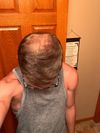
The conversation is about someone's three-year experience with irregular derma rolling, Minoxidil, and Redensyl for hair loss, hoping to thicken areas with fine hair.
People are discussing making their own PP405 for hair loss treatment using JLX069 and DMSO. There is skepticism about the safety and effectiveness of this homemade solution, with some users expressing concerns about potential risks.
A user shared progress pictures showing significant hair regrowth from using 1mg finasteride, Minoxidil, vitamins, and dermarolling over 4 months. The user reported no side effects and takes a generic multivitamin and biotin.
Hair loss treatment with latanoprost, minoxidil, and biotin showed progress. Latanoprost, a glaucoma drug, stimulates anagen phase and increases conversion of vellus hair to terminal hair.
PP405 is discussed as a potential alternative to finasteride, but its effectiveness and market availability are uncertain. Users share experiences with finasteride, minoxidil, and topical treatments, noting side effects and application techniques.
GT20029 is a new hair loss treatment in Phase 3 trials in China, using PROTAC technology to target androgen receptors, potentially with fewer side effects than finasteride and minoxidil. VDPHL01, a second-generation minoxidil, is also mentioned as potentially more effective.
People are discussing obtaining and testing PP405 for hair loss treatment, with concerns about its purity and effectiveness. Some are considering delaying hair transplants, while others suggest using existing treatments like finasteride and minoxidil.
The user experienced good crown progress in 3 months using finasteride, collagen, vitamins B, C, D, zinc, and dermarolling. They are pleased with the results after a hair transplant on the front and mid scalp.
A satirical post humorously discusses a fictional hair regrowth drug called PP405, with users joking about its effectiveness and bizarre presentation. The conversation includes humorous reactions and references to the absurdity of the content.
A user's progress in treating their hair loss with Finasteride, Minoxidil and Dermarolling; they discussed details of their routine and others congratulated them on their success.
User shared progress on hair regrowth after 4 months of Spironolactone and iron infusions for Androgenic Alopecia. They see some improvement but struggle with perception; others note significant improvement.
A 35-year-old who has been using topical and oral Minoxidil and Finasteride with dermarolling and Nizoral for four months, experiencing improved hair health but not yet full coverage on the crown. Others have responded encouragingly to this progress.
A user was prescribed Alpicort E, which contains Estradiol Benzoate, Prednisone, and Salicylic Acid, for hair loss and is seeking others' experiences due to concerns about potential side effects.
PP405 targets hair follicle stem cells differently than exercise-induced lactate, suggesting exercise alone may not replicate its benefits. Minoxidil and finasteride are recommended alongside exercise for hair regrowth, with additional suggestions like spicy food and infrared exposure.
A Swiss product called Redensyl, which is supposed to target hair follicle stem cells and has recently been marketed in Europe. The post inquires if anyone has had any experience with the product.
Pelage PP405 is a new hair loss treatment in trials, potentially reactivating dormant hair follicles without affecting hormones. Results are expected in February 2025, offering an alternative to minoxidil and finasteride.
The conversation discusses personal experiences with hair loss and highlights the potential impact of anemia and nutrient deficiencies on hair health. Treatments mentioned include changing shampoo/conditioner, taking MSM, collagen, hyaluronic acid, astaxanthin, B12, folate, and bovine blood capsules.
The conversation discusses various hair loss treatments, including Minoxidil, Finasteride, Dutasteride, Ketoconazole shampoo, microneedling, and supplements like collagen, biotin, and vitamins. Users suggest additional treatments like red light therapy, scalp massages, and possibly adding RU58841 or Tretinoin.
PP405 is a new hair loss treatment showing early promise with a 20% hair density increase, but skepticism exists due to past failures of similar treatments like Pyrilutamide, RU58841, and Bimatoprost. Users debate its potential effectiveness, with some hopeful due to Google's involvement, while others urge caution without more evidence.
The user shared a 4-month update on their hair regrowth journey using finasteride, minoxidil, and microneedling, reporting significant progress and styling ability. They emphasized persistence, shared their regimen details, and addressed side effects like weaker erections and blurry vision, which improved with lifestyle changes.
Lichen Planopilaris (LPP) is an autoimmune condition causing permanent hair loss and fibrosis, often misdiagnosed. Treatments include pioglitazone, topical corticosteroids, anti-inflammatory medication, and Jak inhibitors.
A user purchased an expensive hair loss treatment called Follicopeptide, which many others in the conversation believe to be a scam, suggesting instead the use of proven treatments like minoxidil and finasteride. Some users report positive effects from Follicopeptide, but skepticism remains high due to lack of transparency about its ingredients and the company's credibility.
The user has been using finasteride, minoxidil, dermarolling, and keto shampoo for hair regrowth, showing positive results after four months. Some users suggest adding tretinoin cream for better absorption, and there's a debate on whether finasteride should be taken at night.
Carpronium chloride 5% is a hair growth treatment in Japan, considered less effective than minoxidil or finasteride. Some users report moderate success with it, but its efficacy is not well-verified.
A dermatologist prescribed methionine with vitamins for hair loss, but the user is doubtful and plans to seek finasteride in France. The user is unsure why finasteride or minoxidil wasn't prescribed, suspecting concerns about side effects or strength.
CRISPR treatments for blood disorders have been approved, leading to discussions about its potential for treating hair loss (AGA). A study showed that editing a gene related to DHT sensitivity could lead to hair regrowth, suggesting CRISPR may eventually be used for AGA, but it's expected to be expensive and not soon available.
The conversation is about a user seeking information on a clinical trial by Amplifica - Scube3 for Androgenetic Alopecia (AGA). The user is unsure if it's a formal phase 1 study.
User found Annurmets, an Italian supplement with apple extract for hair loss treatment. Many reported incredible results using Procyanidin B2 from apple extract.