TGF-B affects hair growth, both causing stem cell division and death depending on amounts. Amplifica's treatment injects Scube3 to increase TGF-B for hair growth.
The conversation humorously discusses hair loss treatments, mentioning Minoxidil, finasteride, and RU58841. It jokingly suggests the creation of a new chemical called RU99999.
JW0061 shows superior hair growth results compared to existing treatments, with significant increases in hair follicles. The Wnt/β-catenin pathway is crucial for hair growth, and JW0061 activates this pathway effectively.
A user hopes to regrow hair using a routine of Min/fin solution twice daily, dermarolling twice weekly, multivitamins daily, and biotin twice daily. Another user doubts the effectiveness of biotin and multivitamins.
The user is experiencing diffuse androgenic alopecia and is trying various treatments, including 5mg finasteride, loniten, and Formula 82D, which contains dutasteride, a steroid, and tretinoin. They report potential regrowth with Formula 82D, despite previous treatments being ineffective.
A 23-year-old user shares their hair regrowth journey, questioning if genetics or other factors are at play. They use Rogaine, finasteride, vitamin B12, biotin, Thera M Plus, and derma stamping, and seek advice on their regimen and hair growth patterns.
The user experienced hair improvement using a topical finasteride, minoxidil, and tretinoin combo, along with supplements like zinc, copper, magnesium, vitamin D3, K2, iodine, and boron. They believe these changes are due to addressing mineral deficiencies and possibly thyroid issues, despite skepticism from others.
A 19-year-old was advised by their primary care provider to take biotin for hair loss instead of minoxidil or finasteride due to potential side effects and age concerns. The user is considering seeking a second opinion from a dermatologist.
Verteporfin is being explored for its potential to improve hair transplant outcomes by reducing scarring and increasing donor hair follicles. There is skepticism about the results, with some claiming misleading presentation of evidence.
The conversation discusses using a multimodal approach to treat androgenic alopecia, including substances like gamma-linolenic acid, DHA, sulforaphane, melatonin, cetirizine, astaxanthin, fisetin, apigenin, curcumin, limonene, genistein, and berberine. Users also mention using ketoconazole, minoxidil, and low-level laser therapy (LLLT) as part of their hair loss treatment regimens.
A user is trying 2-deoxy-D-ribose with distilled water for hair growth, observing new hair and skin pigmentation changes. Others compare it to Minoxidil, expressing interest and caution about its effectiveness and safety.
The conversation discusses using a TCA 35% chemical peel on the scalp to potentially improve hair growth by addressing fibrosis and enhancing the effectiveness of topical treatments. The user also mentions trying microneedling and other methods like topical metformin and dutasteride for hair regrowth.
A 25-year-old male with 10 years of hair loss is using minoxidil and considering adding finasteride or dutasteride, possibly with microneedling, to improve hair regrowth before a hair transplant. Community members suggest starting a DHT blocker immediately, considering oral minoxidil, and addressing low vitamin D and HDL levels.
The user aims to achieve a hypertrichosis look and has used topical Minoxidil for 20 years, now trying oral Minoxidil in a low dose. They seek alternatives to Minoxidil to avoid side effects.
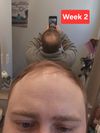
A 20-year-old male shared progress pictures after three months of using 1mg oral finasteride daily, 5% minoxidil twice daily, and a 1.5mm dermaroller weekly. He reported significant hair regrowth.
A user in Russia is trying to make topical finasteride at home using ethanol, finasteride tablets, water, and propylene glycol due to unavailability in their country. They are concerned about tablet residue and considering using isopropyl alcohol or adding finasteride to a hair growth lotion.
The conversation discusses the less impressive results of Pyrilutamide (kx-836) in phase 3 compared to phase 2, with a suggestion that a longer study might show more significant results. One user reports personal success with Pyrilutamide, experiencing no further hair loss and gradual regrowth.
The user is treating androgenetic alopecia with finasteride and discovered a folic acid deficiency. They are asking if curing the deficiency can worsen or improve their hair condition.
The conversation discusses Kintor's initiation of a new Phase 3 trial to assess the long-term safety of Pyrilutamide (KX-826) for hair loss, which will last 52 weeks. Specific treatments mentioned include Pyrilutamide.
Replicel's results were delayed, but Shiseido might share data at BioJapan on October 11. Users are hopeful for new treatments like RCH-01, potentially eliminating the need for finasteride or minoxidil.
A 22-year-old has been using finasteride 1mg daily and keto shampoo 1% weekly for hair loss with some progress but no significant regrowth yet. Users suggest waiting up to 18 months for results and possibly adding minoxidil or microneedling if needed.
The conversation is about someone's six-month hair transplant outcome, with a user suggesting the use of finasteride and minoxidil to improve hair growth. Another user commented on the poor condition of the donor hair area.
A 35-year-old man shows 4-month hair regrowth using Minoxidil, Finasteride, Biotin, a derma stamp, Mane Root Activating Shampoo, and Nizoral Shampoo. He has no side effects from the treatment.
A user shared their positive experience with hair regrowth using finasteride and minoxidil chewables over 20 months, along with a specific conditioner and a new treatment, GHK-Cu. Others discussed their own hair loss experiences and treatments, including oral finasteride/minoxidil and considering hair transplants.
A user's 2 year experience using Minoxidil and Finasteride combined with 20,000mcg of biotin daily and dermarolling for 1 year. The results included thicker hair with some regrowth closer to the hairline, although peak results have not been achieved yet.
The user is experiencing significant hair regrowth using a regimen of 1mg oral finasteride, 1.25mg oral minoxidil, 5% topical minoxidil twice daily, biotin, vitamin D3, fish oil, and weekly microneedling with a 1mm needle roller. They are pleased with the progress and hope their protocol can help others achieve similar results.
The user stopped using finasteride and minoxidil after a hair transplant, now only using coconut oil and serum, and is concerned about potential hair loss. Others advise continuing finasteride to prevent future hair loss, despite the user's doctor suggesting it's unnecessary.
A user's successful hair regrowth after 7 months of using 5% minoxidil, 1mg finasteride, and adding micro needling 4 months ago. The user also took biotin, fish oil, and collagen supplements, and reduced finasteride intake to once every 3 days due to minor libido decay.
The user is documenting their hair regrowth journey using oral finasteride, topical minoxidil, ketoconazole, dermarolling, biotin shampoo, and rosemary oil. They are committed to maintaining this regimen to track progress.