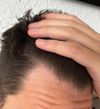
The user uses finasteride, ketoconazole shampoo, and derma stamping for hair loss. They consider rosemary and castor oil as alternatives to minoxidil due to fewer side effects.
The user updated their hair loss treatment to include daily dutasteride, oral minoxidil, topical dutasteride with minoxidil and tretinoin, and RU58841. Commenters feel the extensive treatment is unnecessary for the user's level of hair loss.
RU58841 is being discussed for its effects on hair loss. The user has started using RU58841 with finasteride and is curious about its potential for hair maintenance or regrowth.
The user has been using RU58841 for 6 months without noticeable results and is considering dropping it while continuing oral minoxidil, daily dutasteride, and topical minoxidil. Another user suggests visiting a dermatologist to check for other conditions.
Batana Oil is discussed for its potential benefits in promoting hair growth and addressing balding and receding hairlines, though scientific evidence is lacking. The user seeks personal experiences and any supporting information on its effectiveness.
The potential hair regrowth benefits of ASC-J9, a synthetic modified version of curcumin that is said to be more effective than Minoxidil and Finasteride. Reports from users suggest good thickening and temple regrowth with topical use at 0.025% concentration.
White peony root extract is discussed as a potential treatment for hair loss. The conversation questions if anyone has tried it or researched its use in traditional Chinese medicine.
The conversation discusses hair regrowth using oral minoxidil and RU58841, with visible baby hairs appearing after two months. One user questions the choice of RU58841 over finasteride.
A user experienced significant hair regrowth using topical minoxidil, water-soluble pumpkin seed oil, and saw palmetto. Despite not using finasteride, the user reported reduced hair loss and increased hair growth, especially around the temples and beard.
The conversation discusses a hair loss treatment regimen that includes scalp massage, derma rolling, saw palmetto, rosemary, peppermint oil, pumpkin seed oil, and various supplements like vitamins C and D, multivitamins, biotin, collagen, and fish oil. The user is asking if the treatment has led to hair regrowth.
The conversation discusses the trustworthiness of Indian medications for hair loss, with some users mentioning they have purchased Minoxidil, finasteride, and RU58841 from India. Concerns include dosage and ingredient variations, but no harmful effects are noted.
The post discusses using Sandalore as a potential hair loss treatment, emphasizing precise measurements and safe handling. The user compares Sandalore's effects to Minoxidil and mentions preparing a solution with ethanol and DMSO.
The conversation discusses the use of RU58841 for hair loss, with one user sharing a one-month difference in their hair after using it. Users discuss where to buy RU58841, potential side effects including heart issues, and mixed opinions on its effectiveness, with some questioning the need for treatment based on the before and after pictures.
RU58841's potential side effects, particularly heart palpitations, are debated, with some attributing them to contamination with minoxidil. Users report mixed experiences, with some seeing no side effects and others cautioning about the lack of reliable data on RU58841's safety.
The user experienced anxiety and side effects from topical finasteride and is considering switching to saw palmetto. Another user reported no improvement with saw palmetto and experienced liver issues.
Using finasteride and minoxidil for two months led to noticeable hair regrowth, especially at the temples, with minor side effects. Users discuss their experiences with these treatments, noting minimal sexual side effects and encouraging others to try them.
User noticed tiny black hairs on temples after using rosemary oil along with finasteride, minoxidil, and 0.5mm derma roller. They are curious if these hairs will become terminal.
A user plans to create a DIY topical treatment for hair loss using Rapamycin, possibly combined with alpha-ketoglutaric acid (a-KG). They discuss the concentration and formulation process for Rapamycin, considering safety and skin penetration, and intend to apply it every other day to the scalp.
Pumpkin Seed Oil and Perilla Oil (with alpha-lipoic acid, linoleic acid, and oleic acid) are discussed as potential 5alpha-reductase inhibitors. The conversation focuses on their effectiveness for hair loss treatment.
The conversation discusses hair loss treatments, specifically using Minoxidil, finasteride, and RU58841. The focus is on progress observed at the temples after one month of treatment.
The conversation discusses using RU58841, a research chemical, for hair loss treatment. The user plans to use it due to side effects from finasteride and minoxidil, despite skepticism about its effectiveness and lack of FDA approval.
Moringa extract and oil are suggested to help with hair loss, with some users combining it with treatments like minoxidil, finasteride, and dutasteride. Moringa is claimed to improve hair growth and health, but evidence is mostly anecdotal.
2-deoxy-D-ribose, a sugar molecule, is found to be 80%-90% as effective as Minoxidil in promoting hair growth, showing potential for alopecia treatment. Concerns include high cost, lack of human studies, and possible side effects like diarrhea and nausea.
Hair loss discussion includes alfatradiol (Pantostin/Ell Cranell) as a potential treatment. Users share opinions on its effectiveness in their regimen.
The user is using 2.5mg Minoxidil, 0.5mg Finasteride, a dermastamp, and scalp massages for hair regrowth. There is some visible improvement, but patience is advised as significant results typically take around 6 months.
The user has been using finasteride for hair loss and is considering adding RU58841. They ask about RU58841's effectiveness, potential heart side effects, duration of action, dosage increase over time, transitioning to GT20029, and where to find the liquid form.
Spearmint tea and inositol are discussed as potential treatments for hair regrowth, but their effectiveness is questioned. Alternatives like green tea, MSM, and evening primrose oil are suggested for hair health.
L. reuteri, a probiotic, is being explored for its potential benefits in treating androgenic alopecia, possibly enhancing finasteride's effects and reducing inflammation. The user combines this with finasteride, oral minoxidil, and other supplements, noting some improvement in hair loss.
The user is experiencing hair loss and has been using RU58841 but is considering pyrilutamide and minoxidil, avoiding finasteride due to side effects. Another user suggests finasteride or dutasteride as essential, possibly in topical form, while dismissing saw palmetto as ineffective.
Combining minoxidil 5%, tazarotene 0.1% cream, and lumigan for hair loss treatment is discussed. The conversation focuses on the safety and effectiveness of using these treatments together.