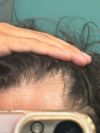
The conversation is about using micro needling and PTD-DBM for hair loss treatment. The user applies PTD-DBM drops on weekdays and performs micro needling weekly.
PP405, a promising hair loss treatment, is expected to be available by 2027, with faster trials due to its topical nature. Users are eager for its release, comparing it to existing treatments like minoxidil and finasteride, but remain cautious about its long-term effectiveness.
How easy it is to fake hair growth, and the skepticism of progress pictures on the subreddit. Some treatments mentioned include finasteride, minoxidil, microneedling, Toppik/Hair Fibers, Dermmatch and a hair transplant.
A user in their early 20s is concerned about minor hair thinning and is considering a hair loss regimen involving PRP sessions, mesotherapy with dutasteride injections, and low-dose finasteride. They dislike minoxidil due to its greasiness and prefer a routine that is easy to maintain.
L'Oreal is working on hair cloning, with multiple companies using similar techniques, making hair cloning likely by 2030. The conversation expresses optimism about the progress and potential affordability of hair cloning solutions.
The user plans to use a "nuclear protocol" for hair improvement, including topical minoxidil 12.5%, topical finasteride 0.1%, and tretinoin 0.05%, with microneedling once a week. They have seen improvements with minoxidil and are seeking opinions on their approach to achieve thicker hair.
A 48-year-old user shared progress pictures after using finasteride daily, minoxidil foam once a day, RU58841 once a day, and a derma pen every other week for almost two months. Another user suggested waiting until month six to see significant results.
Han Bio plans to start clinical trials for a new hair multiplication technology this year, which could significantly reduce the cost and time of hair transplantation. The technology uses a single hair strand to cultivate enough cells for 30,000 hair strands.
Stem-cell hair transplants could potentially create thousands of grafts from a single donor graft, offering a solution for hair loss with DHT-resistant hair. Companies like Stemson Therapeutics and OrganTech are working on this technology, which may become available in the future, possibly reducing the cost and making it widely accessible.
RU58841 can be ordered as a powder and compounded at home, but it should be stored at room temperature to avoid crystallization. Pyraulatmide may follow a similar principle.
The post discusses a DIY Dutasteride Mesotherapy procedure for hair regrowth, supplemented with oral Minoxidil. The user describes the process, including preparation, equipment used, and initial results, expressing excitement for future outcomes.
A user created a web app called TrichoMetrics to track hair loss using photos and metrics like density and thinning. The app supports tracking treatments like Minoxidil and finasteride, with features for setting baselines, comparing progress, and logging treatment adherence.
HairClone plans to start hair multiplication services in 2022. Users discuss various treatments like Minoxidil, finasteride, PRP, and hair cloning, expressing both hope and skepticism about the technology and its costs.
A 28 year old using a hair loss prevention protocol to restore thinning hair, which includes finasteride, dutasteride, minoxidil, stemoxydine, alopecin, nizoral shampoo and microneedling; the user is now adding pyrilutamide solution to the regimen with the hope of improving their results. RU58841 was also ordered but not yet used.
User tried DIY Dutasteride Mesotherapy for hair loss due to unsatisfactory Finasteride results. Used mesotherapy injection gun and liquid dutasteride for better results and fewer side effects.
The user shared progress pictures after 5 weeks of using 5% topical minoxidil, scalp massages, and microneedling for hair loss. They are considering adding finasteride but have decided to wait a few more weeks.
Stemson Therapeutics will start human trials for hair cloning in late 2025-2026. Product development is complete, and they are preparing for production and clinical trials.
The conversation discusses the approval of Kintor Pharmaceutical's AR-PROTAC (GT20029) for clinical trials in China for acne and androgenic alopecia. One user expresses optimism about new treatments being developed and seeks clarification on how the new drug works, specifically if it temporarily degrades the AR protein to reduce DHT sensitivity in hair follicles.
Pelage Pharmaceuticals is developing PP405, a topical treatment for hair growth, currently in Phase 2a trials. There is skepticism about the company's claims, and no fast-tracking approval timeline has been detailed.
Human pluripotent stem cells have been used to create hair and skin, potentially offering a new solution for baldness. A user also mentioned starting finasteride but experiencing unexpected hair thinning.
A user is discussing making a DIY topical finasteride solution using ingredients like water, alcohol, propylene glycol, ethanol, and glycerin, and is concerned about the stability of the mixture. Other users suggest that the solution will work and discuss the importance of propylene glycol for drug dissolution and factors like temperature and light affecting finasteride stability.
User visited derma doctor, suggested finasteride, minoxidil, multivitamins, and PRP therapy. Another user advised against PRP due to cost and ineffectiveness.
A 38-year-old man from Poland, balding for 15 years, shared his hair regrowth progress after 4 months of using finasteride (fin), minoxidil (min), micro-needling, and infrared light treatments. He recently switched from finasteride to dutasteride.
HairClone is developing cell replacement treatments to rejuvenate and generate hair follicles, and has launched a crowdfunding campaign. A user expressed skepticism about the need for crowdfunding.
PP405 is a medicine, and Google Ventures is funding its development based on evidence from each phase, unlike their investment in Juicero, which was a trend-based gamble. Investing in medicine is a calculated risk, not reliant on being "cool."
The user shared their five-month progress using topical minoxidil, oral finasteride, and dermarolling for hair regrowth, noting improvements despite some areas remaining thin. Other users suggested switching from dermarolling to dermastamping for safety and effectiveness.
J. Hewitt plans to trial hair multiplication in Japan by the end of 2019. The technique was developed by German researchers at the University of Berlin and formed the company "TissUse."
PP405 is a topical gel being tested for hair regrowth in adults with androgenetic alopecia. Volunteers aged 18-55 are needed for a 16-week trial in several US locations.
A user is experiencing uneven hair thinning and has tried topical minoxidil without success and finasteride with adverse effects. They are considering microneedling and PRP treatments while avoiding finasteride, and another user suggests trying dutasteride as an alternative.
PP405 is expected to be on the market between 2027 and 2030, with phase 3 trials starting in 2026. There is skepticism about its fast-tracking due to its cosmetic nature, and it may appear on the gray market sooner.