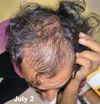
The conversation discusses experiences with hair loss treatments containing RootBioTec and Anagain. Users share their results and compare these treatments to Minoxidil, finasteride, and RU58841.
The conversation discusses Scube3, a seemingly new and obscure treatment for hair loss, with limited information available and a link to a patient intake form.
The user is using a regimen of 0.5mg dutasteride, 5% minoxidil foam at night, hair gummies, and rosemary water in the morning to address hair loss. They are experiencing some regrowth and are advised to be patient, with suggestions to possibly increase minoxidil application to twice a day for better results.
PP405 is a promising experimental topical treatment for alopecia that reactivates dormant hair follicles by targeting cellular energy, with large-scale trials planned for 2026. While it shows potential, it cannot regenerate permanently destroyed follicles, making hair transplants the only guaranteed solution for advanced baldness currently.
Breezula (clascoterone) is expected to be available by late 2026, showing good long-term results with minimal side effects. KX-826 (pyrilutamide) acts faster but is still in earlier development stages.
A 49-year-old is documenting their hair regrowth journey using tretinoin cream, minoxidil foam, and finasteride. They report thicker hair and improved confidence, though progress feels slow and mentally challenging.
The conversation is about a user expressing concerns over the safety of a new drug called Pyrilutamide (also known as KX-826) for hair loss. The user will only trust the drug if it's permitted by EU regulations and sold by a reputable company.
Breezula (clascoterone) and Formula 82F (topical finasteride) are treatments for hair loss that block DHT differently; Breezula competes with DHT at the hormone receptor site without systemic effects, while 82F inhibits the enzyme that converts testosterone to DHT. Breezula may work for those who don't respond to finasteride and vice versa.
The user noticed a slight loss of progress after switching to Milpharm finasteride 1mg and is considering switching to Accord finasteride. They seek advice on whether to continue with Milpharm or switch brands.
People shared mixed experiences with RU58841 for hair loss; one person saw no improvement, another had significant gains and uses it with finasteride, while a third had an allergic reaction to the premixed solution. Some mix RU58841 powder into minoxidil themselves.
The safety and effectiveness of RU-58841 as a hair loss treatment, with some users reporting side effects like chest pains, while others had positive results. The original research on RU-58841 was likely stopped due to financial issues, not safety concerns.
A 30-year-old with Norwood 3V hair loss uses finasteride 1.25 mg every other day and Minoxidil (Regaine 5%) twice daily, experiencing no side effects with the current regimen. The front hairline remains unchanged, but the crown appears better in certain lighting.
PP405 may not need daily use like minoxidil, but finasteride might still be needed to maintain hair regrowth. PP405 reawakens dormant hair follicles, potentially offering a long-term solution, though not a permanent cure.
GHK-Cu is being discussed as a potential treatment for male pattern baldness. Users are sharing experiences and asking about its effectiveness and side effects.
The user noticed hair thinning since age 15, initially attributed to a Vitamin D deficiency. They are currently using Rogaine and considering Propecia but are hesitant about a scalp biopsy; they seek financially practical treatments for male-pattern baldness.
The user experienced side effects from low-dose topical finasteride and is considering using clascoterone (CB-03-01) despite concerns about its risks and cost. They seek advice on its effectiveness and potential side effects compared to other treatments like alfatradiol and fluridil.
Hair loss discussion includes potential HMI-115 treatment. Topical mucuna pruriens shows good results, blocking prolactin possibly more important than blocking DHT.
The conversation is about using RU58841 powder for hair loss treatment and whether to mix it with ethanol/PG or Minoxidil. The user has been using Minoxidil for years with less efficacy and is considering the best method for combining treatments.
Hair loss discussion includes treatments like Minoxidil, finasteride, and RU58841. Platelet rich plasma treatment is considered expensive but cheaper than hair transplant.
User shared progress pictures of hair regrowth on the crown/vertex after a transplant and using finasteride, Minoxidil foam, and a dermapen. They hope to fully regrow or increase density in the crown area.
A new hair loss treatment, PP405, showed promising Phase 2a results with 31% of patients experiencing over 20% hair density increase without systemic absorption, avoiding hormonal side effects. The treatment is expected to be expensive, with Phase 3 trials starting mid-2026, and there is skepticism about the data's strength.
Quitting RU58841 after over two years reduced scalp itching and inflammation, despite concerns about losing hair gains. The user continues using finasteride and oral minoxidil.
Veradermics' phase 2 trial of slow-release oral minoxidil shows promising hair regrowth with minimized side effects, gaining significant attention and funding. PP405 is also noted for its potential as a side-effect-free alternative.
The user shared their 8-week hair regrowth progress using 0.5mg dutasteride, twice-daily topical minoxidil, and weekly 1.5mm microneedling. They noted visible improvement, though some users suggested reducing microneedling depth to avoid potential scalp damage.
A user switched from RU58841 to Pyrilutamide for hair loss treatment after experiencing side effects and continued hair shedding with RU. They are now losing hair faster with Pyrilutamide and questioning if they should revert to RU58841.
A 49-year-old is updating on hair regrowth progress using finasteride, minoxidil foam, tretinoin cream, and ketoconazole shampoo. They report thicker, darker hair and reduced scalp itch after switching to minoxidil foam.
RU58841 is used without finasteride by some due to side effects, with mixed results. Users report combining RU58841 with minoxidil and adjusting finasteride doses to manage hair loss.
The FDA will now require only one clinical trial for drug approval, potentially speeding up the release of hair loss treatments like PP405. Pelage is expected to present full results of PP405 Phase 2a trials and move to Phase III in mid-2026.