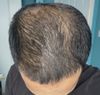
Microneedling does not prevent future hair transplants, but some surgeons report the skin becomes "harder" in treated areas. There is no clear evidence to confirm this effect.
Rotenone, a natural plant extract, may promote hair growth by increasing LDH activity and blocking MPC in the scalp, but it carries risks due to its toxicity. The suggested formulation includes Barbasco extract, DMSO, propylene glycol or PEG-400, ethanol, and a carrier oil.
The conversation discusses experiences with hair loss treatments containing RootBioTec and Anagain. Users share their results and compare these treatments to Minoxidil, finasteride, and RU58841.
The user is pleased with their hair transplant results but is concerned about the vertex area. They use Minoxidil and finasteride daily and had the procedure at a clinic in Athens.
A user reported significant hair improvement using ginseng oil along with Minoxidil, finasteride, RU58841, and microneedling, leading them to cancel a hair transplant. Other users requested more details and proof.
A 36-year-old experienced significant hair regrowth using dutasteride, oral and topical minoxidil, and keto shampoo, and plans a hair transplant for further improvement. Despite progress, they seek hairline restoration and have scheduled a transplant of 3,000 grafts.
A user shared their 6-month hair loss treatment progress, which included 3200 FUE grafts, oral finasteride and minoxidil, keto shampoo, and biotin. The user also mentioned micro needling their temples for further growth and plans to observe the effects of finasteride and minoxidil over the next 6-12 months.
Hair cloning is discussed, focusing on its current status and potential availability. Treatments mentioned include Minoxidil, finasteride, and RU58841.
The user is considering microneedling versus a hair transplant (HT) for crown hair loss while currently using dutasteride and oral minoxidil. They are hesitant about microneedling due to potential scarring but are open to trying it before deciding on a hair transplant.
Avoid burning or scarring the scalp for hair growth; instead, use treatments like finasteride, minoxidil, or consider a hair transplant. Microneedling should be done carefully, and extreme methods can cause harm.
The user is experiencing hair loss and is using oral finasteride, considering adding RU58841 and microneedling, and planning a hair transplant. They are seeking advice on whether to wait for treatment results or proceed with the transplant.
The conversation is about using RU58841 and microneedling (1.5mm) for hair loss. The user seeks advice on whether to avoid applying RU58841 on microneedling days to prevent it from becoming systemic.
A blood cancer survivor in remission since 2022 is experiencing thin and patchy hair after chemotherapy and is using Minoxidil without much success. They are seeking personal experiences and advice on hair transplants after cancer treatment.
ET-02 (RS 5441) shows promising results for hair growth, performing better in humans than in mice. There is debate over the effectiveness compared to minoxidil, with some users wanting more detailed data.
Microneedling with exosomes is being considered for hair regrowth, but concerns exist about their effectiveness and safety, especially since exosomes degrade quickly and lack FDA approval. The user is seeking alternatives for non-responders to minoxidil and dutasteride, as exosomes may not provide additional benefits.
A user humorously discusses wanting to transplant all their hair into one dense circle on their scalp, leaving the rest of their head bald. Replies include a joke about performing the procedure and a story about someone using their hair to fight crime.
Exosomes combined with fractional picosecond laser treatment were effective in treating androgenetic alopecia and promoting repigmentation in white hair patches. The role of exosomes in hair repigmentation, particularly in conditions like poliosis, is not well-studied.
The user shared a positive update on their hair transplant journey one year after the procedure in Turkey, where they received 4,350 grafts. They started taking finasteride at the 6-month mark and also use biotin, B6, B12, and scalp oils to support hair growth.
The user experienced significant hair regrowth using high doses of dutasteride, minoxidil, and finasteride, but still considers a hair transplant due to thin hair and limited temple improvement. They face challenges accessing medication and are exploring additional treatments like microneedling.
The user had a hair transplant in Turkey and started taking finasteride to maintain hair growth. They are satisfied with the results and plan to continue using finasteride while being cautious about hairstyles to prevent traction alopecia.
A 27-year-old male experiencing hair loss post-Covid is considering PRP (platelet-rich plasma) therapy. He's seeking personal experiences about the process, particularly regarding pain levels, despite his dermatologist's assurance of using local anesthesia.
The conversation discusses hair loss treatments, including Minoxidil, finasteride, and RU58841. It highlights an interview with Stemson Therapeutics CEO Geoff Hamilton about advancements in hair cloning technology.
Getting a hair transplant without using finasteride or dutasteride for at least two years can waste donor hair, as these medications can lead to significant hair regrowth in areas like the crown and mid-scalp. Delaying a transplant allows for better results by maximizing natural regrowth and preserving donor hair for more needed areas.
Hair cloning for hair loss is unlikely to be available or affordable in the next 10 years. Current treatments like Minoxidil, finasteride, and RU58841 are still the main options, with skepticism about new advancements.
The post discusses Dr. Rassman's advice on microneedling for hair loss, suggesting holding a Dr Pen with 36 needles in one spot for 10 seconds. The conversation includes differing opinions on this method, with one user explaining the importance of dipping the pen rather than swiping to avoid abrasions.
/82 sokak no:3, Bornova, İzmir Province
This conversation is about a user's progress after hair transplant surgery and the treatments they used to maintain it. They had a transplant of 3000 grafts in April 2022, taking finasteride 1mg daily and minoxidil twice daily foam, as well as using Nizoral shampoo and Hair Growth Shampoo from Watermans once a week. The results have been positive with good hair health improvement.
A hair transplant significantly improved the user's appearance, making them look younger. They consistently use oral finasteride and minoxidil, which may have contributed to the results.
Kintor Pharma finished enrolling and dosing participants in a Phase I trial for a hair loss treatment called AR-PROTAC (GT20029). The effectiveness of another drug, pyrilutamide (KX-826), for hair loss will be clearer after a Phase 2 trial expected to complete in January 2023.
Use finasteride or dutasteride with minoxidil for at least a year to improve hair density before considering a hair transplant. A transplant might be needed if medications don't provide sufficient regrowth.