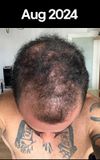
Redensyl improved hair thickness slightly with no side effects, but no regrowth. Minoxidil provided significant regrowth but caused facial side effects like puffiness.
User noticed tiny dots on their head after using 0.5% dutasteride and 8% minoxidil, which others identified as developing hair follicles. Encouragement was given to continue the treatment.
The user has been using topical Minoxidil (5%) and finasteride (0.1%) twice daily for 2 months, with occasional missed applications. They also use a zinc pyrithione shampoo every 2 days and do not dermaroll.
A 28-year-old male is experiencing temple regrowth but crown thinning while using 5mg minoxidil and 0.5mg dutasteride. The shedding phase is seen as a positive sign of treatment effectiveness, with expectations of noticeable improvements around 6 to 12 months.
The conversation is about a person's 6-week progress using 2.5 mg oral minoxidil, 0.5 mg dutasteride, weekly derma stamping at 1.5 mm, and rosemary oil for hair loss, with some initial shedding but no side effects. They are optimistic about future results.
The user shared progress after two months of using finasteride, serioxyl, and NOOANCE casque Pro for alopecia. They are documenting their hair loss treatment journey.
Using RU58841 and topical minoxidil together is fine and does not cancel out the benefits of each. Applying both treatments consecutively is acceptable.
Increased Malassezia and Cutibacterium in the scalp microbiome are linked to higher sebum production and inflammation in androgenetic alopecia (AGA). Treatments include ciclopirox shampoo, benzoyl peroxide shampoo, clobetasol propionate, calcipotriol, minoxidil, finasteride, and dutasteride.
The user is experiencing hair regrowth in small clusters using oral minoxidil, oral finasteride, a red light cap, and Nizoral 2% shampoo. They are hopeful for continued improvement and thicker hair.
User shared a 5-month progress update on using topical minoxidil 6% and finasteride 0.05% once daily, with microneedling and vitamins. They experienced initial shedding but no side effects, and increased the treatment to twice daily after month 4.
The user treated seborrheic dermatitis by cutting sugar, improving sleep, using four different shampoos, and occasionally using steroids. Their hair is growing back thicker and new hair is appearing.
The conversation discusses the need for a localized 5-alpha reductase inhibitor that only affects the scalp without systemic side effects, similar to pyrilutamide's approach. Current treatments like topical liposomal finasteride and dutasteride are mentioned, but concerns about their systemic effects and lack of research are highlighted.
A 38-year-old woman has been using oral Dutasteride for a year without improvement and is now adding a topical solution containing Minoxidil, Dutasteride, Tretinoin, Ketoconazole, and Hydrocortisone. She is seeking advice on whether switching from oral to topical Dutasteride could prevent hair shedding.
Clascoterone 5% topical solution shows promise for treating male-pattern hair loss by blocking DHT at the follicle without systemic absorption, potentially offering fewer side effects than oral treatments like finasteride. While results are promising, long-term safety and effectiveness need further study, and it may serve as a starting point for developing more effective treatments.
A 25-year-old is experiencing chronic telogen effluvium (TE) and androgenetic alopecia (AGA) after surgery, using finasteride, red light therapy, and supplements, and considering oral minoxidil despite heart concerns. They are unsure whether to start minoxidil before or after an upcoming surgery, which may trigger another hair shed.
The user experienced significant hair regrowth with topical finasteride, minoxidil, ketoconazole, and dermarolling, but later faced severe hair shedding after stopping dermarolling and reducing ketoconazole use. Suggestions included switching to oral treatments, resuming dermarolling, and considering lifestyle changes.
The user experienced hair regrowth with Minoxidil but noticed some hair loss after stopping microneedling for two months. They are hesitant to use finasteride again due to side effects and are considering other DHT blockers.
The user has been using finasteride, minoxidil, and a derma stamp for 3 months with significant improvement. They are now adding ketoconazole to their routine.
The conversation discusses using topical dutasteride from minoxidilmax for hair loss and the possibility of crowdfunding for DHT blood tests to check if the treatment goes systemic. The user plans to post before and after pictures.
The user has been using Minoxidil, vitamins, and a derma roller for 2.5 months with some regrowth observed. They are hesitant to add finasteride or dutasteride due to potential side effects, considering topical finasteride as a safer option.
A 19-year-old using topical minoxidil and dutasteride reports significant hair growth and shedding. Minoxidil caused new facial hair growth, and the user hopes for thicker hair regrowth.
The user experienced hair shedding after using finasteride and topical minoxidil since August 2024, and briefly adding oral minoxidil in early 2025. They suspect the shedding might be due to the oral minoxidil, a bad batch of finasteride, or a normal shedding cycle, and are also experiencing an itchy scalp and acne.
The user is using a routine involving microneedling, Minoxidil with tretinoin, a red light cap, scalp massages, Nizoral shampoo, and essence oil shampoo to address hair loss, with visible progress noted. They are considering topical finasteride or dutasteride if progress slows but are cautious due to past side effects.
The user has been using finasteride, minoxidil, a dermastamp, and red light therapy for six months with no visible improvement since the three-month mark. Other users noted improvement, particularly in the left temple area, and encouraged the user to continue.
PP405 is moving to late-stage trials, showing potential for hair regrowth, with 31% of male patients experiencing a 20% increase in hair density. Veradermics is developing an oral minoxidil version, and there is interest in combining treatments for better results.
The user experienced hair regrowth and improved hair quality using topical minoxidil on temples and oral finasteride daily. They also noted thicker eyebrows and some side effects like minor erectile dysfunction.
A 43-year-old male has been using oral minoxidil, finasteride, and dutasteride for hair loss, with some stabilization and thin hair growth but no significant cosmetic improvement. He is considering increasing microneedling frequency and exploring other options, as he is concerned about the lack of terminal hair growth.
The user is seeking an alternative to DualGen 15 that includes Minoxidil and Retinol but is less sticky and more convenient to use. They find the current product inconvenient due to its stickiness and long wait time before washing.