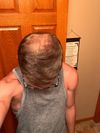
A user experienced significant hair regrowth from Xeljanz after severe alopecia but can no longer afford it. They are seeking ways to obtain the medication despite its high cost and potential side effects.
The conversation discusses finding a source for RU58841 in Australia. Users suggest that while RU58841 is effective, it may harm the scalp, and recommend trying koshine's kx as a safer alternative.
The conversation is about frustration over the delay in phase 2 results for a hair loss treatment called GT20029. One user suspects the treatment may have failed.
The conversation is about recommending a biotin supplement that includes saw palmetto and possibly copper for hair loss. The user is seeking suggestions for these specific ingredients.
PP405 is considered a promising potential cure for hair loss, with phase 2 trial results expected in February 2025. Hair cloning is also discussed as a potential ultimate solution, despite significant scientific challenges.
A user is seeing good results with RU58841 for hair loss, noting reduced shedding and thicker hair. They plan to use pumpkin seed oil as a solvent to avoid water content, which they believe reduces the effectiveness of anti-androgens.
Pelage Pharmaceuticals is developing PP405, a topical treatment for hair growth, currently in Phase 2a trials. There is skepticism about the company's claims, and no fast-tracking approval timeline has been detailed.
A user shared their positive experience with a hair transplant journey over 10 years, involving 3000+ grafts and regular use of minoxidil and finasteride. Other users commented on the hairstyle and suggested alternative treatments like SMP or hairpieces.
ET-02 (RS 5441) shows promising results for hair growth, performing better in humans than in mice. There is debate over the effectiveness compared to minoxidil, with some users wanting more detailed data.
The conversation is about testing the effectiveness of RU58841 for hair loss, with the user planning to increase their dose to 30 mg per day along with 20 mg of Minoxidil. The test results showed approximately 70 mg/ml, which the user considers a good result.
GT20029 is a topical treatment that degrades androgen receptors to prevent hair thinning and loss, potentially offering fewer side effects than systemic treatments like finasteride. Concerns include its impact on hair texture and potential systemic effects, with market availability speculated in 3 to 5 years.
The conversation discusses the approval of Kintor Pharmaceutical's AR-PROTAC (GT20029) for clinical trials in China for acne and androgenic alopecia. One user expresses optimism about new treatments being developed and seeks clarification on how the new drug works, specifically if it temporarily degrades the AR protein to reduce DHT sensitivity in hair follicles.
SCUBE3 and GT20029 are potential treatments for hair loss, with SCUBE3 stimulating hair growth and GT20029 protecting against DHT. A combined approach using SCUBE3, finasteride or dutasteride, and later GT20029 could provide a comprehensive treatment for androgenetic alopecia.
The conversation is about finding 1.5mm cartridges for a Dr. Pen device, with a preference for purchasing through Amazon. The discussion does not mention specific hair loss treatments like Minoxidil, finasteride, or RU58841.
The conversation discusses GT20029, a new topical drug for hair loss and acne without notable side effects, which has been accepted for investigational use in China. Some users express skepticism about the legitimacy of the company and the potential for other drugs like RU58841 to be developed due to patent expiration and lack of profitability.
The post and conversation are about HMI-115, a potential treatment for hair loss. The conclusion is that HMI-115 is not a 5ar-inhibitor and is instead a prolactin receptor inhibitor. Some users are skeptical about its effectiveness and believe that baldness will still be a problem in the future.
Amplifica's new injectable treatment for androgenetic alopecia shows a 15% increase in hair thickness and coarseness in 60 days. The treatment is in early human trials and offers a promising alternative to hormone-related hair loss treatments.
The user is experiencing irritation from using PG with RU58841 and is seeking alternative solutions like K&B in the UK. They report redness, itchiness, and flaky skin from the current treatment.
Hair loss treatments discussed include Minoxidil, Finasteride, and RU58841. HMI-115, a monoclonal antibody drug, is in phase 1 and 2 trials for different conditions, but its availability on the gray market is unlikely due to high production costs.
The conversation discusses the safety and trustworthiness of ordering RU58841 from Lyphar Biotech in China, with a focus on pricing and reliability. The user is seeking advice on whether to proceed with the purchase or consider alternative sources.
GT20029 is discussed as a potential treatment for androgenetic hair loss by targeting androgen receptors, unlike finasteride which reduces DHT broadly. Concerns include its effectiveness, genetic variations in androgen receptors, and availability, with some skepticism about its potential as a true alternative.
PP405 is a new hair growth stimulant different from Minoxidil, currently in phase 2 trials. Users discuss its potential, safety concerns, and the long wait before it might be available.
The conversation discusses the differences in inactive ingredients between Sandoz 5mg Finasteride and Proscar/Propecia, questioning the purpose of certain additives like Docusate sodium. It seeks to determine if these differences affect the effectiveness of the treatment for hair loss.
The conversation is about the FDA approval of WINLEVI for acne treatment and the anticipation of Breezula, a hair loss treatment using the same active ingredient, which may indicate a positive future for Breezula's release. There is disappointment that Breezula's results are not optimal, but it is seen as progress in hair loss treatment.
Kintor changed their KX-826 pictures on Amazon after backlash over fake images. Users are skeptical about the product's effectiveness and trustworthiness, with some preferring finasteride instead.
The conversation is about a user preparing to join the ABS-201 clinical trial for hair loss treatment, which involves a prolactin inhibitor. The user plans to update others on their progress if enrolled.
Pyrilutamide is a selective AR antagonist with a high binding affinity, making it effective in competing with DHT for androgen receptors. The 1% concentration is more effective than the 0.5%, but the latter may suffice for mild hair loss; the drug is considered a good option for those avoiding 5AR blockers due to side effects.
Comparing the effectiveness of RU58841, Pyrilutamide and CB-03-01 as treatments for hair loss, with people discussing different aspects such as binding affinity, time of inhibition, safety data and cost.
Injectable GHK-CU and BPC157 were discussed for hair loss, but users did not notice significant hair changes. BPC157 was noted to help with shoulder issues.