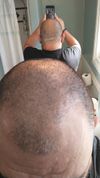
A user's 2.5 months of finasteride, oral minoxidil, and dermarolling treatments for hair loss, with various users giving their opinion on the progress made.
OP is using scalp massages, dermastamping, and rosemary oil for hair improvement, with mixed opinions on effectiveness. Some suggest lighting affects perceived results, while others recommend treatments like finasteride, dutasteride, and RU58841 for better outcomes.
The user experienced significant hair regrowth over four months using oral finasteride, oral minoxidil, micro-needling, and rosemary oil. They reported no side effects and emphasized the importance of continuing the treatment to maintain results.
The conversation discusses using crushed finasteride tablets mixed with topical minoxidil for hair loss treatment. Users share their experiences and opinions on the effectiveness and proper concentration of this method.
A user shared progress pictures showing hairline improvement after using oral finasteride (1mg) and minoxidil (3mg) for 5 months. Replies praised the noticeable regrowth and encouraged continued use.
A user created a web app called TrichoMetrics to track hair loss using photos and metrics like density and thinning. The app supports tracking treatments like Minoxidil and finasteride, with features for setting baselines, comparing progress, and logging treatment adherence.
The conversation discusses confusion over the dosage calculation of a topical solution containing 0.25% finasteride, 5% minoxidil, and 0.001% tretinoin. The user considers switching to a 0.025% finasteride solution to enhance the effects of tretinoin and minoxidil.
A 19-year-old male shared progress pictures showing hair regrowth on his scalp after starting a treatment with Minoxidil and Finasteride on November 24th. He noted improved hair texture and a halt in hair shedding for the past two weeks.
User reports 3-month progress using daily 1mg finasteride, 0.5ml minoxidil (2x daily), 0.5ml dutasteride, and derma rolling 0.5mm 1-2 times per week. They see increased density on crown and top of head, slight progress in corners and temples, and recently added cosmerna.
A user's 9-month progress using daily oral Fin/Min (1mg/2.5mg) for hair loss. The user experienced prolonged shedding but saw significant improvement by month 6, and took the medication in pill form as prescribed by their doctor.
A user shared progress pictures showing significant hair improvement after using a topical 0.3% finasteride/6% minoxidil solution from January to June 2024. They experienced initial shedding but saw progressive improvement with daily evening application.
The user shared progress pictures showing hair improvement over 7-8 months using topical finasteride 0.1% and minoxidil 0.5%. Others complimented the results and inquired about the source of the treatments.
A user in their mid-40s shared a 12-month update on using finasteride for hair loss, showing significant improvement. They started seeing thicker hair and regrowth after 3 months, with no side effects noticed.
User shares progress after 4 months of using finasteride and dermarolling, with occasional use of coconut and rosemary oil. They aim to stop hair loss and hope for increased top density.
The user is switching from oral to DIY topical finasteride due to side effects and is using a solution with 10 mg finasteride in a 100 mL mixture. They are concerned about the effectiveness of the formula due to white sediment forming in the solution.
The user has been using Minoxidil 1.5 times a day for 4 months, Finasteride 1mg for 3 months, and microneedling once a week. They are unsure about their progress due to colorblindness, but another user noted some improvement.
The conversation is about someone's progress with hair loss treatment using a combination of topical finasteride and minoxidil, and dermastamping once a week. They are considering increasing the dermastamp needle size from 1.25mm to 1.5mm.
The user shared progress pictures after 4.5 months of using 0.5 mg finasteride and 2.5 mg minoxidil daily for hair loss, considering increasing the finasteride dose after 6 months. Some attribute the improvement to the hair transplant, while others inquire about changes in crown density.
Norwood 7 hair loss is often excluded from trials to ensure treatments appear more effective and to reduce costs. Some believe treatments effective for Norwood 5 could work on Norwood 7, but companies prioritize market readiness.
The user reported noticeable hair improvement over four months using 1 mg of finasteride and weekly microneedling. Progress photos from October 2024 to January 2025 show positive changes.
A user shared progress pictures showing significant hair improvement using finasteride and minoxidil, expressing satisfaction with the results. Another user accused them of having a hair transplant.
A user shared progress pictures after 7 months on 1.5mg of finasteride, showing significant hair improvement. The user clarified they split 5 mg pills into quarters, resulting in a 1.33 mg dose.
A 29-year-old shares their 3-4 month progress using 2.5 mg Minoxidil and 1.0 mg Finasteride daily for hair loss, noting improved hair density and color. They experienced initial body itching and occasional dips in sex drive but are satisfied with the results.
Slow_Class_4465's progress using finasteride and minoxidil to address hair loss, which has resulted in drastic improvement. Other users have shared their experiences with the treatments, including possible side effects.
Minoxidil and finasteride might help with hair regrowth, but a hair transplant may be necessary for significant improvement. The conversation humorously discusses the severity of hair loss, comparing it to various exaggerated Norwood scale levels.
A user shared progress pictures showing hairline improvement after 2 years of using topical Minoxidil, 1mg oral Finasteride, and sporadic microneedling. Another user praised the progress and shared mutual encouragement.