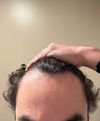
Tretinoin combined with minoxidil is effective for hair loss and can be used once daily. The user seeks a compounding pharmacy to mix these without finasteride.
The user is considering switching from topical minoxidil to a combined oral treatment of finasteride and minoxidil for better consistency but is concerned about potential side effects like shedding, dizziness, and swelling. Another user advises that oral minoxidil should only be used under medical supervision with regular health checks and suggests using reputable brands like Pfizer's Loniten.
The user experienced chest soreness and mild gynecomastia after taking 1mg finasteride three times a week, which resolved after stopping the medication. They are considering trying a lower dose or topical finasteride to avoid side effects.
User on finasteride and redensyl serum sees progress, considers switching to minoxidil and topical finasteride mix. Another user claims topical mix is more effective than oral finasteride and has no side effects.
Latanoprost is discussed as a potential hair loss treatment, noted for its synergy with minoxidil and 5-AR inhibitors, but concerns include its effectiveness on scalp hair, cost, and potential skin darkening. Some users express interest in trying latanoprost or bimatoprost despite limited real-world evidence.
Topical Finasteride is most effective at 0.1-0.25%, and Minoxidil at 5%. Tretinoin is optional, and additional ingredients like biotin, caffeine, and saw palmetto are recommended.
A user discusses a topical prescription for hair regrowth containing Minoxidil, Finasteride, and Latanoprost, noting Latanoprost's side effect of promoting eyelash and eyebrow growth. Others share experiences and information about Latanoprost, highlighting its origins as a glaucoma drug and potential side effects.
Reducing scalp DHT doesn't directly correlate with preventing hair miniaturization, as different follicles have varying sensitivity levels. Dutasteride at 0.5 mg and 2.5 mg shows minimal visual difference in hair regrowth, with side effects being a consideration for higher doses.
The user is using RU58841 twice daily, dutasteride 0.5mg every two days, dutasteride mesotherapy every three months, and 20mg oral minoxidil daily. Other users suggest this regimen is excessive and recommend adding microneedling and ketoconazole shampoo.
Topical finasteride may reduce more scalp DHT but is seen as inconsistent and messy compared to oral finasteride. Users report mixed results with both forms, with some preferring oral for its convenience and consistent dosing, while others find topical effective but harder to apply.
The drugs RU-58841, Pyrilutamide (KX-826), Apalutamide, Enzalutamide, and Darolutamide, which are nonsteroidal antiandrogens (NSAA), potentially impacting male fertility. Pyrilutamide, similar to Enzalutamide, may have reversible effects on fertility.
A user's experience with hair loss treatments such as finasteride, ketoconazole, and oral minoxidil that have not yielded any results; other users suggest shaving the head or getting a wig, while others offer additional advice such as seeing a dermatologist, checking thyroid levels, switching to dutasteride and adding needling, and trying stemoxydine.
A non-binary transfeminine person experienced significant hair regrowth after starting finasteride, minoxidil, microneedling, and hormone replacement therapy with estradiol. They encourage trans individuals concerned about hair loss to consider estrogen as it has greatly improved their hair condition.
The conversation is about a user seeking advice on adding GHK-Cu to RU58841 for hair loss treatment, while already using oral minoxidil, dutasteride, ketoconazole shampoo, and considering LLLT. They are unsure about the concentration and carrier solution for GHK-Cu.
A 20-year-old is experiencing hair thinning and is considering Clascoterone and Minoxidil as treatments, avoiding finasteride due to concerns about fertility and hormones. A suggestion was made to use Clascoterone for local DHT targeting and combine it with Minoxidil for maintenance and regrowth while avoiding systemic side effects.
Minoxidil may cause wrinkles and dark circles, which some users report can be mitigated by adjusting dosage. Reactions vary, and while some dismiss these side effects, others experience significant changes.
The post is about a discount on a 6-month supply of Minoxidil at Costco. The conversation includes users discussing their experiences with purchasing and using Minoxidil, with some mentioning regional price differences and preferences for foam or liquid forms.
Eucapil, containing fluridil, is used for hair loss but has impractical packaging. Some users find it effective for maintenance, while others suggest alternatives like anageninc with pyrilutamide.
The conversation is about the results of using hormone replacement therapy (HRT) with estrogen and finasteride for hair loss, and switching from finasteride to bicalutamide as an anti-androgen treatment. The user shared before and after photos to discuss the effectiveness of these treatments.
The conversation is about treating hair loss without finasteride or dutasteride due to sensitivity causing gynecomastia. The user plans to use pyrilutamide, RU58841, and oral Minoxidil instead.
The user is considering starting topical minoxidil alongside 1 mg oral finasteride but is concerned about potential shedding before their wedding. They are debating whether to start minoxidil now or wait a few months to allow their body to adjust to finasteride.
Finasteride is more accepted than hair systems because it is less visible and maintains natural hair. Treatments like minoxidil and finasteride are commonly used for hair loss, but opinions on hair systems vary.
The conversation discusses the effectiveness and systemic absorption of Topilutamide/Fluridil/Eucapil and topical Dutasteride for hair loss. Users are sharing their experiences and seeking success stories with these treatments.
The user has tried various hair loss treatments, including topilutamide, alfatradiol, pyrilutamide, and topical spironolactone, but experienced headaches. They are inquiring about the availability and legality of clascoterone in Spain.
An 18-year-old woman experiencing hair loss due to stress, possible PCOS, and low vitamin D is concerned about starting 5% minoxidil foam, prescribed by her doctor, due to potential facial hair growth. She is also using a topical steroid for scalp sensitivity and pain.
A user shared their 12-month progress using 0.5% Pyrilutamide once daily, 0.025% topical finasteride once daily, 5% Minoxidil twice daily, and microneedling 3 times a week. They reported good progress but noted a slowdown in recent months, hoping for thicker hair soon.
The conversation discusses the anticipation of Chinese manufacturers producing Clascoterone 5% before its full approval in 2027. It also mentions treatments like Minoxidil, finasteride, and RU58841 for hair loss.
The user seeks alternatives to Propylene Glycol (PG) for delivering topical finasteride due to scalp irritation. They consider using Propanediol 1,3 and ask for other suggestions.
The conversation discusses hair loss treatments, specifically the use of anti-androgens like RU58841 and Pyrilutamide, which are expensive in India. Alternatives like spironolactone and concerns about the effectiveness of finasteride and dutasteride are also mentioned.