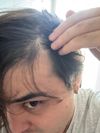
The conversation is about using DIY deoxyribose topical and botox injections for hair loss. The user is experimenting with these treatments and believes the science is strong.
A user received a prescription for a topical solution with Minoxidil 7%, Finasteride 2%, and Tretinoin 0.01%, to be used twice daily for three months. They are concerned about the safety of these dosages compared to commonly recommended lower dosages.
A woman with hair loss discovered she has thyroid cancer, which was found during an MRI and confirmed with an ultrasound. She advises others with symptoms to see a doctor and shares that her cancer was detected after her dog sniffed her neck and she experienced neck pain.
The user is already using topical finasteride and minoxidil for hair loss and is considering adding topical caffeine. They are seeking opinions on the effectiveness of topical caffeine.
A 20-year-old male is frustrated with his dermatologist for refusing to prescribe DHT blockers like finasteride or dutasteride, instead pushing for a hair transplant despite ongoing hair thinning. The user feels dismissed and unreasonably treated, and is advised by another user to find a better dermatologist and consider finasteride or dutasteride for effective treatment.
User discusses group buy for finerenone, a third-gen mineralocorticoid antagonist for hair loss treatment. Finerenone inhibits TGFb, NOX, and ROS, and improves renal and cardiac function; topical dose should be no more than 10mg per day.
The user is using a topical dutasteride/minoxidil/tretinoin gel for hair thinning and has had a positive experience with no side effects. They also mention considering another product, Formula82D, after having decent results with Formula82F.
A 43-year-old from Thailand shares progress after 1 month using topical finasteride, minoxidil, tretinoin cream, and weekly microneedling for diffused thinning. Users compliment his appearance and suggest he doesn't need treatment.
A user experienced significant hair shedding and thinning 10 months post-hair transplant despite using minoxidil and topical finasteride. They are considering switching to oral finasteride or dutasteride and are also dealing with scalp conditions like seborrheic dermatitis.
A user shared their hair loss treatment which includes a custom solution with multiple ingredients, caffeine liquid, and saw palmetto, and mentioned shedding after 40 days of use. Some replies discuss the effectiveness and cost of the treatment, while others debate the usefulness of topical dutasteride.
A 24-year-old woman with AGA and TE since age 14 is questioning if her hair is regrowing or breaking. She has been using minoxidil consistently since September 2025, along with caffeine and ketoconazole shampoos, rosemary oil, and saw palmetto, and has improved her overall hair care routine.
He Shou Wu (Fo Ti) extract was found to prolong the hair growth phase, inhibit 5-alpha-reductase (like finasteride), reduce androgen receptors, and increase growth factors, potentially outperforming minoxidil in recovering hair follicle size after DHT exposure. Two compounds, emodin and TSG, are identified as responsible for these effects and warrant further investigation.
The conversation discusses the potential of GT20029 to stop hair loss and possibly regrow hair, considering the body's regenerative abilities. No specific treatments were mentioned due to the original post being removed.
The post and conversation are about skepticism towards a new hair loss treatment containing 2-deoxy-D-ribose, copper peptides, and exosomes, with concerns about the legitimacy of the product and its website. The treatment's effectiveness and authenticity are questioned due to lack of testing and transparency.
A user shared progress pictures showing significant hair improvement using finasteride and minoxidil, expressing satisfaction with the results. Another user accused them of having a hair transplant.
The user has been using a combination of oral and topical minoxidil, topical finasteride, RU58841, Nizoral, and microneedling for hair loss treatment. They report improvement in hair thickness except for the crown area, which has not changed.
A user shared progress pictures of a hair transplant from Padra Clinic in Toronto, claiming 8000 hairs were transplanted for $4000 CAD. The post faced skepticism, with users questioning the results and clinic's credibility, while the user mentioned using zinc, biotin, and hair laser therapy for aftercare.
The user is considering a hair transplant after 4 years of using finasteride, minoxidil, microneedling, and scalp massages for hair regrowth. Opinions differ, with some suggesting continuing current treatments and others recommending a transplant to reduce maintenance.
The conversation discusses using USB microscopes for scalp photos and provides a link to an overview of trichoscopy. Treatments mentioned include Minoxidil, finasteride, and RU58841.
The user discusses using Follics FR5, FR10, and FR15, which combine Minoxidil, Adenosine, Procapil, Azelaic acid, and Procyanidin B2, to address hair loss. They have previously used Minoxidil, Finasteride, and Dutasteride with varying success.
The conversation is about a user preparing to join the ABS-201 clinical trial for hair loss treatment, which involves a prolactin inhibitor. The user plans to update others on their progress if enrolled.
A 7-month update from Markoj44 regarding their hair transplant results, which includes the use of topical finasteride and minoxidil in combination with Viviscal, biotin, Nizoral shampoo, and donor area photos. People responded positively to the post.
People are discussing using tretinoin gel with minoxidil to improve hair growth, especially for those who didn't respond to minoxidil alone. They apply a mix of tretinoin gel and minoxidil to the scalp, which is said to be more effective than minoxidil by itself.
The conversation is about using tretinoin cream on the scalp for hair loss, including questions about the duration of use, daily amount applied, any issues faced, and its effect on hair fall and oily scalp. Specific treatments discussed are not mentioned in the provided text.
A 21-year-old is experiencing hair thinning and is using oral finasteride and topical minoxidil, considering adding oral minoxidil. They are unsure if the condition is androgenetic alopecia (AGA) or telogen effluvium (TE) and are advised to continue treatments and get a blood test.

Automatic-Law-3612's progress with hair loss treatments, including topical finasteride, topical dutasteride, minoxidil and pyrilutamide. They have been using these products for two weeks and noticed baby hairs in their temples getting longer.
A 27-year-old man shared his hair regrowth progress after using finasteride for 4 years, recently adding a solution of RU58841 with minoxidil and alfatradiol, tretinoin on temples, and occasional ketoconazole. He is seeking opinions on his treatment approach.
DUPA and retrograde alopecia may not be solely DHT-based, and a biopsy is crucial for accurate diagnosis and treatment. Treatments mentioned include dutasteride, oral minoxidil, pioglitazone, clobetasol, calcipotriol, ketoconazole, and doxycycline, depending on the specific condition.
The conversation is about the potential side effects of using verteporfin in conjunction with a hair transplant. Specific treatments discussed include verteporfin, a hair transplant (HT), minoxidil (Min), finasteride (Fin), and RU58841 (RU).
The conversation discusses the completion of a Phase II trial recruitment for Breezula (CB-03-01), a potential treatment for androgenic alopecia. Specific treatments mentioned include Minoxidil, Finasteride, and RU58841.