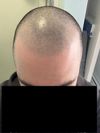
The user had a hair transplant in Turkey and started taking finasteride to maintain hair growth. They are satisfied with the results and plan to continue using finasteride while being cautious about hairstyles to prevent traction alopecia.
A 28-year-old male experienced hair regrowth using a topical spray containing minoxidil, finasteride, and tretinoin, along with occasional microneedling, after stopping oral finasteride due to side effects. He is pleased with the progress after three months and plans to continue using the spray.
Mixing RU58841 with cetosomal minoxidil is discussed due to scalp irritation from ethanol PG vehicles. A mixture of the two turned bright pink when left to dry.
Tretinoin can make minoxidil more effective for hair loss treatment, but some users did not see improved hair density with this combination and had better results with dutasteride.
Exploring hair loss treatments beyond DHT, including Minoxidil, pyruvate, Gt20029 targeting androgen receptors, and vasodilators. Other options like Kx826, adenosine signaling, growth factor topicals, and microneedling are also discussed.
The conversation discusses whether finasteride would still be necessary if Verteporfin becomes a successful hair loss treatment. It also explores the sensitivity of transplanted hair to DHT and the potential for off-label use of Verteporfin post hair transplant.
User on Dut, oral minox 20 mg, Saw Palmetto, Pumpkin Oil, RU, 8% topical minox, and topical fina for hair loss; top of head improves, but retrograde alopecia worsens. Asks for options besides exosomes and where to find topical melatonin.
A user underwent a 3750 graft hair transplant in Turkey, initially promised 4500 grafts, and is satisfied with the results despite some concerns about donor site size and crown coverage. The user has been on medications like finasteride and minoxidil for about four months and may consider a second transplant in the future.
The conversation discusses the effectiveness of oral minoxidil versus topical minoxidil with tretinoin for hair regrowth, with some users suggesting oral minoxidil might be more effective for non-responders to topical treatments. Concerns about side effects and the role of enzymes in activating minoxidil are also mentioned.
GT20029 showed significant hair growth and safety in phase II trials, with no adverse sexual events. Users are hopeful but concerned about future costs and systemic effects.
The conversation discusses that dutasteride may be more effective than finasteride for frontal hair loss due to higher 5ar Type 1 enzyme activity in that area. Some users question the validity of this information, while others confirm it with additional sources.
The conversation discusses a last-resort hair loss treatment combining topical finasteride, minoxidil, melatonin, and progesterone, with claims that topical finasteride can inhibit up to 52% of scalp DHT. One reply clarifies that progesterone is not an anti-androgen but has anti-androgenic properties because it competes with androgens for receptors.
The user has been on finasteride for 4.5 years and minoxidil for 10 years, maintaining hair but not regrowing much on the crown and temples. They are considering using a dermastamp more frequently and possibly trying RU58841, but are hesitant about dutasteride due to concerns about side effects and DHT suppression.
The conversation discusses hair loss treatments, focusing on Tsuji's hair cloning and Shiseido's RCH-01, with skepticism about their effectiveness on humans. It compares these to PRP, noting PRP's higher efficacy in studies.
The user stopped using finasteride due to side effects and switched to RU58841, which seems to be working for hair regrowth. They are considering RU58841 and minoxidil as long-term treatments, while others discuss the safety and effectiveness of these options.
The user reversed male pattern baldness using a pro-thyroid diet, lifestyle changes, and scalp stimulation exercises, without Minoxidil or Finasteride. They reported reduced dandruff, itchiness, oiliness, and experienced hair regrowth and thickening over 15 months.
OP experienced side effects from finasteride and is considering using RU58841 to prevent hair loss during a testosterone cycle. They have also used minoxidil, Nizoral, alfatradiol, and fluridil successfully.
The user halted hair loss using 0.01% topical liposomal finasteride daily, with no side effects or regrowth, and recently added 5% minoxidil and low-level laser therapy. They recommend this conservative approach for those hesitant about finasteride.
Tretinoin may help more minoxidil convert to its active form and could potentially increase its absorption, raising concerns about safety if too much enters the bloodstream. It's unclear if tretinoin affects finasteride absorption.
The conversation is about using Verteporfin with microneedling as a potential hair loss treatment that may regenerate hair follicles with minimal scarring. There are concerns about the optimal dosage and the DHT sensitivity of the new follicles.
The conversation discusses using T3 (triiodothyronine) as a topical treatment for hair growth, with some users noting it showed promising results in studies but lacked follow-up. Users express interest in trying T3 due to its potential effectiveness compared to Minoxidil.
Hair regrowth treatment involving 3aHSD enzyme shows 6% improvement in 18 weeks. Sulforaphane, L-Menthol, and Dexpanthenol are potential ingredients for new hair loss solution.
A user is starting a hair loss treatment with a 3-in-1 spray containing finasteride, minoxidil, and tretinoin. They are concerned about whether to continue shaving their head and how to determine if hair follicles are dead.
The conversation discusses the potential use of verteporfin for hair loss treatment, with one user mentioning their surgeon's interest in trying it and another noting its research status and clinical use as a YAP inhibitor. Some users debate the market size, availability of generics, and the optimism in the hair loss community regarding new treatments.
Finasteride and Dutasteride block DHT, which is needed for vellus hair to become terminal on the beard but not on the scalp. The user considered using DHT cream but learned it's unnecessary for scalp hair.
Dr. Tsuji and Riken announced a hair cloning cure with a 98.9% success rate, expected to be released in 10 years. Users expressed hope and skepticism about the affordability and timeline of the treatment.
Tretinoin may worsen hair loss by inducing premature hair follicle regression. It can be used with minoxidil to increase absorption but should not be used alone.
A 36-year-old man is considering starting oral finasteride and minoxidil, using ketoconazole shampoo, and possibly getting a 3000-graft FUE hair transplant. He previously had scalp micropigmentation but is now exploring medication due to fewer concerns about side effects.