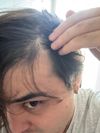
RU58841 is used without finasteride by some due to side effects, with mixed results. Users report combining RU58841 with minoxidil and adjusting finasteride doses to manage hair loss.
Adding tretinoin can enhance the effectiveness of minoxidil by increasing sulfotransferase levels, making it beneficial for hair growth. However, it may not be necessary if using oral minoxidil.
AMP-303 and AMP-601 are new hair loss treatments targeting dermal papilla cells, with AMP-303 showing early efficacy in transitioning vellus hairs to terminal hairs after one injection. Further clinical trials are planned, and these treatments are seen as promising due to their biologic approach and less frequent application compared to daily treatments.
The user is using RU58841 for hair regrowth on the temples and is considering adding minoxidil. They are questioning the potential for vellus hairs to develop into fuller hair and the possibility of reactivating dormant follicles.
A user shared their successful hair regrowth journey using finasteride, oral minoxidil, and oral dutasteride, expressing gratitude for the support received. The conversation includes congratulations and encouragement from others.
A deoxyribose sugar gel may work as well as minoxidil for hair regrowth by boosting blood supply to hair follicles. Some users discuss combining it with minoxidil and cetrizine, but caution is advised due to potential risks and lack of consistent results.
The post and conversation are about a user claiming to be 137 years old with a full head of hair. Specific treatments mentioned include dutasteride, RU58841, and minoxidil.
A 26-year-old individual treating hair loss since 19, using a regimen of Finasteride, Cyproterone, Oral Minoxidil, Microneedling, Dutasteride, and newly added RU58841. They're seeking advice from other RU58841 users about their experiences.
RU58841, an anti-androgenic compound, showed early promise for treating alopecia but faced challenges after its patent in 1997. Despite advancing to Phase II trials, safety concerns and financial struggles led Aventis to abandon its development. Proskelia, which later merged into ProStrakan, couldn't prioritize the drug, leading to its eventual stagnation and failure to reach the market.
A man lost his transplanted hair despite using minoxidil because he wasn't on a DHT blocker like finasteride, which is essential to prevent further hair loss. The conversation emphasizes that hair transplants are not a cure and require maintenance with medications to preserve results.
The user is using dutasteride, oral minoxidil, and topical minoxidil with tretinoin for hair loss. They are considering whether to continue this treatment or opt for a hair transplant for their temples.
Probiotics like L. reuteri ATCC PTA 6475 and B. longum BB536 may improve hair growth and density by reducing inflammation and reversing DHT damage. The user is trialing these probiotics personally, ordering them from the U.S. to Canada, and plans to continue if no adverse effects occur.
People are discussing hair loss treatments, including minoxidil, finasteride, and RU58841, to turn vellus hairs into terminal hairs. Some users also mention using antibiotics, oral minoxidil, dutasteride, DHT blockers, biotin, and natural remedies like onion juice and seeds to improve hair growth.
New product Tomorrowlabs HSF targets hair loss through HIF pathway indirectly by removing scalp iron. Minoxidil and Stemoxydine also relate to HIF pathway.
A new product, a retinoic acid solution (0.3%), is available to enhance minoxidil products like Rogaine and Kirkland by converting them into a tretinoin-containing solution for improved hair loss treatment. One unit of the product is enough for a year's supply.
A 21-year-old is experiencing hair thinning and is using oral finasteride and topical minoxidil, considering adding oral minoxidil. They are unsure if the condition is androgenetic alopecia (AGA) or telogen effluvium (TE) and are advised to continue treatments and get a blood test.
A 25-year-old male with 10 years of hair loss is using minoxidil and considering adding finasteride or dutasteride, possibly with microneedling, to improve hair regrowth before a hair transplant. Community members suggest starting a DHT blocker immediately, considering oral minoxidil, and addressing low vitamin D and HDL levels.
The progress of Phase I of HMI-115, a potential hair loss treatment, which consists of Minoxidil, finasteride, and RU58841. The estimated completion date is June.
Dr. Tsuji's stem cell hair multiplication procedure may offer a future solution for hair loss, but it is initially expected to be very expensive, with prices potentially decreasing over time. In the meantime, users discuss using treatments like finasteride, despite side effects, to manage hair loss.
The post and conversation are about the role of the enzyme 3alpha-hydroxysteroid reductase in hair loss and the potential of compounds like procyanidin B2 and sulforaphane to boost its activity for hair regrowth. Further research is needed to develop effective treatments based on this theory.
A user underwent a hair transplant with 3500 grafts after trying treatments like finasteride and minoxidil, preferring a local clinic in Toronto over traveling to Turkey. The user plans to continue using finasteride to maintain existing hair, as the transplanted hair is DHT resistant.
The conversation discusses hair loss treatments, specifically mentioning Minoxidil, finasteride, and RU58841, and highlights hair multiplication research from Koehler Lab at Harvard. Users express optimism about future advancements.
The user has been on finasteride for 4.5 years and minoxidil for 10 years, maintaining hair but not regrowing much on the crown and temples. They are considering using a dermastamp more frequently and possibly trying RU58841, but are hesitant about dutasteride due to concerns about side effects and DHT suppression.
Verteporfin treatment shows promise for hair regeneration and reducing scar tissue in hair transplants. Some users plan to try verteporfin with hair transplants, and it may also be combined with PRP in future experiments.
The user had a hair transplant with 2,000 grafts in 2017, and after four and a half months of using finasteride, minoxidil, derma rolling, and Boton shampoo, they are seeing hair regrowth including the return of their widow's peak. They are considering switching to RU58841 and a deeper derma rolling treatment.
A non-binary individual experienced hair loss after stopping hormone replacement therapy and is using oral Dutasteride, oral Minoxidil, and ketoconazole shampoo. They are hopeful for regrowth but may use wigs due to the high cost and uncertain effectiveness of additional treatments like mesotherapy and PRP.
The conversation discusses enhancing Minoxidil absorption for hair loss treatment using Tretinoin and MSM (Methylsulfonylmethane). The user is seeking sources for Tretinoin and mentions MSM's potential to improve the absorption of topical agents.
The post and conversation are about skepticism towards a new hair loss treatment containing 2-deoxy-D-ribose, copper peptides, and exosomes, with concerns about the legitimacy of the product and its website. The treatment's effectiveness and authenticity are questioned due to lack of testing and transparency.