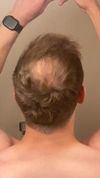
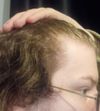
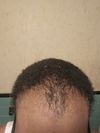
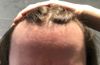
The user is considering switching from liquid to foam minoxidil for hair loss at the crown, while already using finasteride pills. They are also contemplating a hair transplant due to ongoing hair thinning.
Unusual hair growth can occur in unexpected areas, possibly due to topical treatments like Minoxidil. Such hair may appear suddenly and is often unrelated to typical hairline patterns.
A 19-year-old male has been using topical finasteride and minoxidil for 8 months with no progress and is considering seeking a second opinion due to potential misdiagnosis. The discussion revolves around whether the hair loss is due to male pattern baldness, alopecia areata, or a vitamin deficiency.
A 19-year-old is unsure if their hair is receding or just maturing and is seeking opinions before starting treatments like Minoxidil, finasteride, or RU58841. They shared recent and past photos to compare changes over a few months.
A user with diffuse thinning alopecia uses a custom full cap wig for an active lifestyle, costing $450 and lasting about 10 months. They share their positive experience with the wig as an alternative for those for whom treatments like Minoxidil, finasteride, or RU58841 don't work.
Hair appearance fluctuates due to factors like styling, product buildup, and humidity, causing frustration for those with diffuse thinning. Treatments mentioned include minoxidil, finasteride, ketoconazole shampoo, and RU58841, with mixed results.
A 24-year-old noticed hair thinning over 4-6 years and is seeking advice on whether it can be salvaged. Treatments mentioned include Minoxidil, finasteride, and RU58841.
User "hemantch" shares 5 months progress using topical Fin, Min, topical Dut, and a laser cap for hair loss. Significant regrowth was noticed after 1 month, and the treatments worked well despite being bald for 10 years.
A user is frustrated with slow and thin hair regrowth at the temples despite using Minoxidil for six months, along with dermastamping, oiling, vitamins, and exercise. They are seeking advice on why vellus hairs are not thickening.
A user shared a 3.5-month hair loss treatment progress using topical Minoxidil, Finasteride, and RU58841, noting improved confidence and satisfaction with the results. Other users congratulated and praised the progress shown in the pictures.
A 33-year-old man is concerned about potential hair loss, comparing his hairline to his father's and noticing increased shedding and thinning. He is considering treatments like Minoxidil and Finasteride but is unsure if he has male pattern baldness.
Scalp sunburns can cause permanent hair loss, so wearing UPF hats is essential. Tretinoin and Tacrolimus users should be cautious of increased photosensitivity and potential scalp issues.
A 22-year-old male has been experiencing widespread hair loss for over four years, including pain and significant shedding. Treatments tried include ketoconazole shampoo, fluocinonide topical solution, biotin, ACV, and dry shampoo, but none have been effective.
The user has been experiencing diffuse hair thinning despite using finasteride, minoxidil, dermarolling, clobetasol cream, and PRP sessions. They seek advice on additional treatments and are advised to check vitamin D, iron, and thyroid levels.
After a 1,200 graft hair transplant and using minoxidil and finasteride, the user's hair initially improved but later thinned and changed texture. They are seeking advice on this issue and have a dermatologist appointment scheduled.
Hopeful treatments for hair loss, including Verteporfin, Androgen Receptor Degradation, and SCUBE3. These treatments offer potential solutions to slow or stop the effects of androgens on the scalp.
A 21-year-old male diagnosed with telogen effluvium and male pattern baldness started taking finasteride, which initially slowed hair shedding and slightly thickened hair. The doctor recommended iron and vitamin D supplements, and the user is considering minoxidil but wants to stabilize shedding first.
Minoxidil helped with temple regrowth, and finasteride improved overall hair appearance and stopped further hair loss. Minoxidil was also applied to eyebrows and eyelids, with noticeable gains, but was stopped on the beard due to bloating.
The user has been treating hair loss with finasteride, dutasteride, oral minoxidil, and pyrilutamide for several years without success and is experiencing an inflamed scalp, possibly due to seborrheic dermatitis. They are seeking advice on additional treatments after these methods failed to improve their condition.
The conversation discusses using scalp antiandrogens like RU58841, pyrilutamide, or fluridil on the face to reduce sebum production, noting that clascoterone (winlevi) is an approved facial antiandrogen with underwhelming reviews.
A 42-year-old had 2,100 grafts transplanted to the frontal third of the scalp, using treatments like Dutasteride, oral Minoxidil, ketoconazole shampoo, dermarolling, and PRP. They plan to add RU58841 and have scheduled SMP to improve cosmetic results.
The user is seeking advice on hair transplant techniques and surgeons to reshape a natural widow's peak into a more rounded hairline, preferring long hair transplants with minimal scarring and maximum density. They are currently using finasteride and oral minoxidil, which have not been effective, and are considering various surgeons primarily in English-speaking countries and the EU, excluding Turkey.
The user is experiencing hair thinning despite using finasteride for three years and is considering trying minoxidil. They are seeking advice on a hairstyle, like a French crop, to manage their hair loss.
The user experienced rapid hair thinning on top of the head after two GFC treatments, despite using topical minoxidil for four years. Hair on the sides and back became thicker, leading to confusion and questioning of the treatment decision.
Minoxidil, often combined with microneedling, has helped some users improve hair growth at the temples and hairline. Finasteride is also mentioned as a treatment, with mixed results on its effectiveness.
A 29-year-old male is considering treatments for hair loss, including Minoxidil, Finasteride, microneedling, or a hair transplant, and is concerned about potential hair loss due to military service. He is currently at Norwood 2 and has a family history of hair loss.
The conversation discusses using topical Minoxidil and Finasteride from Traya, along with daily dermarolling, as a treatment for hair loss. Progress pictures were shared to show the results of these treatments.
A user is interested in seeing scalp tattoos as a response to hair loss, specifically looking for creative designs rather than scalp micropigmentation. They are considering this approach for their own Norwood 5 hair loss situation.
A 26-year-old male experienced hair regrowth using finasteride, minoxidil foam, and micro-needling over 2-3 months, with significant improvement in the crown, sides, and temples, but less in the hairline. He noted side effects like fluid retention in the ankles and weight gain but no change in libido.