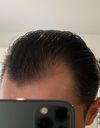
A 35-year-old shared a 2-month update on their hair transplant of 3153 grafts, noting redness, itching, and some pimples, while using finasteride for over 12 years to maintain hair. Users discussed the effectiveness and timing of starting finasteride, with some suggesting consulting a doctor for young individuals considering the treatment.
The user had four DHI hair transplants from 2021 to 2025 and is concerned about the lack of hair thickening despite using treatments like finasteride and minoxidil. They are seeking advice on why these efforts aren't working.
A user shared an 18-month update on their crown hair transplant, performed by Jason Sorgi at Boston Hair Restoration, expressing satisfaction with the results. They continue to use oral minoxidil and finasteride to maintain hair health.
The conversation discusses a 20-year-old transgender female's one-year experience with hair loss treatments, including Estradiol HRT, oral Finasteride, Bicalutamide, and Cyproterone. Specific treatments used for hair loss are oral Finasteride and potentially Estradiol as part of hormone replacement therapy.
The user had a hair transplant in 2020 and later learned they needed to continue medication for hair loss. They shared a 5-month timelapse video of their hair regrowth using topical finasteride/minoxidil, microneedling every 3 weeks, and ketoconazole.
The user underwent a hair transplant in Turkey and has been using a topical solution with 5% minoxidil and 0.0025% finasteride, along with Ket 2% shampoo and derma rolling, to maintain hair status. They are uncertain about improvements, noting thicker non-transplanted hair, and are considering increasing medication frequency to enhance results.
The conversation discusses a new product from Actifolic, which combines RU58841 and GHK-CU for hair loss treatment. The participants are considering whether it's worth trying.
A 25-year-old male experiencing diffuse thinning is advised to address high TSH levels and low iron, and consider treatments like finasteride. Weight loss and improved diet are also suggested to potentially help with hair health.
A user shared their experience with a 2000 FUE hair transplant at Hasson and Wong, noting significant improvement 7.5 months post-op. They also used finasteride and dutasteride to slow hair loss.
COVID and COVID vaccination can trigger hair loss, primarily telogen effluvium, due to stress and immune system activation. Proper diagnosis and addressing factors like nutrition and stress are crucial for recovery.
A 27-year-old shared progress pictures 4 months after a hair transplant, expressing satisfaction with the results and improved self-esteem. They have been using finasteride for nearly a year and minoxidil for 3 months, with significant reduction in hair loss.
A user had a successful hair transplant at Diamond Hair Clinic with Dr. Mehmet Demircioglu, noting excellent care and results after 6 months. They now maintain their hair with Dutasteride, oral and topical Minoxidil, and vitamins.
A Silicon Valley-backed company aims to cure hair loss. Exciting advancements include mRNA therapies, gene editing, hair cloning, AR degraders, anti-androgens, cell-based rejuvenation, and AI-based drug discovery, with hopes for FDA approval of GT20029 within 10 years.
Chris's hair transplant looks better, but the hairline is criticized for being too straight and unnatural. Some recommend using finasteride and minoxidil for maintenance.
A user created a free AI-powered hair transplant simulator to help visualize post-transplant results, seeking feedback and offering it as a tool for clinics. Users discussed its usefulness, limitations, and the requirement for email and phone verification to prevent abuse.
GT20026 is discussed as a potential treatment for hair loss that targets androgen receptors without affecting hormone levels, but it may not promote significant regrowth. It is expected to be available by 2028, with other treatments like Breezula and Clascoterone also mentioned.
A 22-year-old with 4c hair is considering a hair transplant to address traction alopecia caused by braid extensions. They have tried derma stamping, oils, and minoxidil but stopped due to side effects.
A user is concerned that prolonged use of valisone (betamethasone) and clotrimazole solution for scalp dermatitis may be causing hair thinning and loss. They noticed thinning in the area where the solution was applied.
Hair cloning technology is advancing, with clinical trials for improved methods expected by 2028 and 2029, potentially offering a solution for hair loss if donor follicles remain. Organtech's expansion into other biotech areas may secure funding, but the effectiveness of cloning depends on the availability of androgen-resistant donor follicles.
The conversation discusses whether topical caffeine is effective for hair loss, with some users questioning its role due to its vasoconstrictive and vasodilative properties, while another suggests that temporary vasoconstriction might be beneficial by promoting angiogenesis. Specific treatments mentioned include caffeine shampoo, which one user believes is ineffective.
The conversation is about using topical cetirizine for hair loss treatment. The user mixes Aller-TEC tablets with a hair tonic but faces issues with the solution's consistency.
A 29-year-old reports positive hair recovery after 7 months using liposomal topical finasteride and minoxidil, low-level light therapy, and vitamins, following a 3600 graft DHI procedure. They experienced no side effects from the topical treatment, unlike with oral finasteride.
CB-03-01, also known as Breezula, is being considered as an alternative to DHT blockers for hair loss. Users are discussing its effectiveness, potential regrowth, side effects like scalp irritation, and hormonal impacts.
The user has been using topical finasteride and minoxidil since 2021 and is exploring other hair treatment companies like Xyon and Happy Head due to dissatisfaction with the current product's smell. They question the authenticity of consultations from these companies, suspecting they might be automated.
A trans man is experiencing hair loss due to testosterone therapy but is unwilling to stop the treatment despite concerns about using finasteride. The individual is distressed about balding at a young age but acknowledges it is genetic.
The user experienced significant hair regrowth using finasteride and dutasteride, with noticeable results after switching to dutasteride. Minoxidil was deemed unnecessary due to the restoration of the hairline and lack of hair follicles in bald spots.
A male in his early 20s with CCCA (scarring alopecia) started treatment with Finasteride, Fluocinolone, and Doxycycline. Steroid injections were suggested but not yet done.
The user had a hair transplant in 2021 with 1600 grafts and is currently using finasteride, minoxidil, biotin, and collagen. They are considering another transplant in Turkey to address a bald spot and improve coverage in the front and middle.