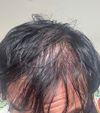
Potential success with the hair loss treatment Pyrilutamide, and possible group buying opportunities for it along with other treatments such as Finasteride and Minoxidil.
User TopBack56 and friends tried pyrilutamide (KX-826) for hair loss without experiencing negative side effects. They observed fine vellus hairs but no thick hair growth yet, and plan to add GT20029 to their regime after safety trials.
RU58841 is not recommended for use around children due to potential exposure risks. Alternatives like CB-03-01 might be considered, but further research is advised.
Using tretinoin to enhance minoxidil absorption for hair loss treatment. Apply tretinoin, wait 30 minutes, then apply minoxidil; use moisturizer to manage skin reactions.
The conversation discusses the effectiveness of topical tretinoin as a monotherapy for hair loss, with users suggesting it may not be as effective as minoxidil or finasteride. The original poster is considering other options like a phenol peel and is concerned about the risks of derma rolling.
The conversation discusses a hair loss treatment regimen using Alfatradiol, Pyrilutamide, and Minoxidil. The user shares their current stack of these treatments.
User started using Pantostin Alfatradiol after watching haircafe on YouTube and noticed thicker hair. They wonder why it's not more popular, as it's a 5α-reductase inhibitor with a different mechanism than minoxidil.
The conversation discusses diffuse unpatterned alopecia (DUPA) and its possible causes, including sensitivity to DHT, not being androgenic alopecia, being diffuse alopecia areata, or hormonal issues. Treatments mentioned include topical melatonin, Clobetasol Propionate for alopecia areata, and the lack of results from using finasteride, dutasteride, and minoxidil.
A person using Minoxidil, Finasteride, Microneedling, and recently added Tretinoin is experiencing heavy shedding and thinning hair. They suspect Tretinoin has made them respond to Minoxidil and are seeking others with similar experiences.
The user is using topical finasteride and minoxidil daily and has had a hair transplant, but their hair remains thin. They are considering using dutasteride to address the issue.
User experienced hair loss after weight lifting, had a successful hair transplant, but later faced significant thinning. Current treatment includes finasteride, minoxidil, dermal rolling, and supplements.
How diffuse unpatterned alopecia (DUPA) is not an invitation to self-diagnose oneself with aggressive AGA and that seeking a specialized dermatologist may help people experiencing hair loss. Treatment options discussed include topical clobetasol propionate, oral minoxidil, and discontinuing finasteride.
Dutasteride can cause hair shedding even with suppressed testosterone levels due to previous damage from DHT. Hair shedding is often a sign of damaged hair being replaced by healthier growth.
The user is experiencing scalp irritation from a compounded treatment of finasteride, minoxidil, and tretinoin. They are considering switching to a non-alcohol, propylene glycol-free formula with a lower tretinoin percentage to reduce irritation.
The conversation is about the difficulty of applying both pyril and min/fin to treat hair loss twice daily and whether combining them yields positive results.
Androgenetic alopecia is affected by scalp DHT levels, not sensitivity, with treatments like finasteride and dutasteride aiming to optimize these levels. Personalized DHT management is crucial for effective hair growth.
The user discussed switching from RU58841 with Minoxidil to Finasteride due to cost, noting better physical feelings and hair growth with RU58841. They are considering returning to RU58841 and checking DHT levels after a month.
A user is exploring VEGF gene therapy to enhance hair transplant results, considering measuring hair shaft diameter and growth rate. Suggestions include using phototrichograms and possibly adding PRP, though its effectiveness is uncertain.
Diffuse hair loss is often linked to genetics but can also be due to health issues like thyroid problems and low vitamin or iron levels. Treatments include finasteride, minoxidil, and dutasteride, with some seeing improvements after addressing health issues.
A user who experienced positive results from using finasteride and dutasteride to treat their hair loss, with 2000 grafts being transplanted in the temples area for further improvement. They also discussed cost and other treatments such as minoxidil.
A user has been using finasteride since 2018, switched to dutasteride, and added minoxidil, microneedling, and a tretinoin/spiro compound. They are pleased with the results and hopeful for more improvement.
The conversation discusses the use of topical finasteride and minoxidil for hair loss and inquires about the effectiveness of adding RU58841. Participants share experiences and opinions on the potential benefits of including RU58841 in their treatment regimen.
The conversation discusses a personal theory on the role of DHT in stress and reproduction, suggesting it converts testosterone for reproductive traits. The discussion includes skepticism and mentions individual differences in physiology and neurochemistry.
Treatments for hair loss, with the user considering Pyrilutamide and RU58841 as options. It is noted that although Pyrilutamide has been studied more and is allegedly more effective, there are doubts about its authenticity in the market. KX-826 is suggested as an alternative as it has a stronger effect than RU58841 and there is scientific research on it.
The user has been using a hair loss treatment protocol including topical dutasteride, minoxidil with tretinoin, ketoconazole shampoo, microneedling, a laser cap, and vitamin D for 15 weeks, showing impressive progress. Feedback suggests continuing medical therapy for 12-24 months before considering a hair transplant.
The user has been using finasteride for over two years with mixed results and is considering starting dutasteride and oral minoxidil, though both are hard to obtain. They are also contemplating a hair transplant in the future due to diffuse thinning.
Minoxidil combined with tretinoin may improve hair regrowth due to their synergistic effects. Using a gel with 0.025% tretinoin and antibiotics might still be beneficial.
People are discussing how to apply tretinoin to the scalp for hair loss treatment and managing scalp dryness. Specific treatments mentioned include tretinoin, minoxidil (Min), finasteride (Fin), and RU58841 (RU).
The conversation discusses hair loss treatments, focusing on Tsuji's hair cloning and Shiseido's RCH-01, with skepticism about their effectiveness on humans. It compares these to PRP, noting PRP's higher efficacy in studies.
A user is using a trichosol-based minoxidil solution to avoid scalp irritation and is asking if it should smell like ginger beer. They like the scent and want to confirm they have the correct product.