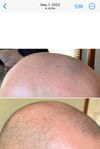
A user shared progress pictures showing hair regrowth after using a homemade oral solution of 1 mg dutasteride and 2.5 mg minoxidil. Commenters noted significant improvement and increased body hair.
The post is about a user starting a hair loss treatment using finasteride, micro needling, and nizoral. The conversation includes supportive replies from other users.
A new brand is seeking 10 U.S.-based individuals aged 25+ experiencing hair loss to test a topical product containing GHK-Cu and Acetyl Tetrapeptide-3. Participants must not be using other treatments like finasteride or minoxidil and will provide feedback and photos.
The conversation discusses the need for a localized 5-alpha reductase inhibitor that only affects the scalp without systemic side effects, similar to pyrilutamide's approach. Current treatments like topical liposomal finasteride and dutasteride are mentioned, but concerns about their systemic effects and lack of research are highlighted.
RU58841 5% is theoretically equivalent to 2mg of dutasteride for hair loss treatment, with RU58841 offering higher potential but more variability due to absorption issues. Users discuss the effectiveness of RU58841 and dutasteride, with some preferring dutasteride for consistent results and others finding success with RU58841.
The conversation discusses a new 0.3% tretinoin topical launched by MinoxidilMax for mixing with other solutions, with some users expressing concern about potential skin irritation compared to lower concentrations. MinoxidilMax has also released other products like topical Dutasteride and RU58841.
Trying out a new exosome treatment for male pattern baldness, in addition to increasing vitamin intake and using existing treatments such as Nizoral and scalp drops. The user has no expectations that the new treatment will work but is giving it a try anyway.
The user is using RU58841, dutasteride, and minoxidil for hair loss, storing RU58841 in the fridge and applying it nightly. They report more baby hairs on the temples but are unsure if it's due to new growth or miniaturization, and seek advice on mixing and results from RU58841.
Amplifica is testing a compound called AMP-303 for hair loss, but it's not Scube3 or osteopontin. The timing for the results from the clinical trial is unknown.
The user experienced reduced hair loss using an online serum but found it too expensive and is seeking a vendor for ptd-dbm. They are also interested in KY19382 but are unable to find it.
A user shares their positive experience using the Rootique Dou applicator with 0.005% finasteride, noting it effectively delivers the product without greasiness and helps with hair regrowth without side effects. Another user reports regrowth using low-dose finasteride from ULO, while avoiding tretinoin due to skin irritation.
Hair loss treatments discussed include Minoxidil, Finasteride, and RU58841. HMI-115, a monoclonal antibody drug, is in phase 1 and 2 trials for different conditions, but its availability on the gray market is unlikely due to high production costs.
The conversation discusses a 20-year-old transgender female's one-year experience with hair loss treatments, including Estradiol HRT, oral Finasteride, Bicalutamide, and Cyproterone. Specific treatments used for hair loss are oral Finasteride and potentially Estradiol as part of hormone replacement therapy.
The conversation discusses creating a foam version of RU58841 for easier application on thick hair, comparing it to minoxidil foam. The user currently uses dutasteride, minoxidil, and needling for hair loss treatment.
The user has scheduled a hair transplant after stabilizing hair loss with finasteride and minoxidil, considering additional dermarolling. They are advised to use 2500-3000 grafts conservatively for temple filling without lowering the hairline too much.
A 34-year-old man had a successful hair transplant in Turkey, receiving 4,400 grafts, and is now using oils, serums, and an aftercare set. The procedure cost approximately $3,500, and he feels much younger and more confident.
Dutasteride is safer than finasteride for long-term use, with fewer sexual side effects. Users experience better hair regrowth and fewer side effects with dutasteride.
A user's experience with a hair transplant procedure and the resulting appearance of their hairline, which included some micro irregularities to make it look natural. Other users asked questions related to cost and safety of similar procedures at different clinics.
A 25 year-old male who has been taking finasteride (1mg/day) for 4 months and then switching to dutasteride (0.5mg twice per week) for 20 months, with positive results; the difference between finasteride and dutasteride is discussed.
A 33-year-old man experienced diffuse thinning and hair shedding due to sleep deprivation and low testosterone. After starting hCG treatment, he noticed hair regrowth on his temples.
Hair loss treatments discussed include promising Pyr available online and Verteporfin dosing after FUE for follicle regeneration, but no updates on SCUBE3.
Start with 0.025% tretinoin to enhance minoxidil effectiveness, gradually increasing to 0.05% to avoid scalp irritation. Users experienced redness, inflammation, and dandruff when introducing tretinoin too quickly.
The conversation is about using finasteride and testosterone replacement therapy (TRT) for hair loss and their role in gender-affirming care. It debates whether these treatments are considered hormone replacement therapy (HRT) and their implications for both cisgender and transgender individuals.
The conversation is about a person's hair improvement after 14.5 months using RU58841 and Minoxidil topically at 50 mg each day, with noticeable hairline improvement but incomplete crown area recovery. The person struggles to take good pictures of their crown area.
RU58841 slowed hair loss for a DUPA sufferer after other treatments like finasteride, dutasteride, and minoxidil failed. Some users reported side effects with RU58841, while others did not experience any.
The conversation discusses the less impressive results of Pyrilutamide (kx-836) in phase 3 compared to phase 2, with a suggestion that a longer study might show more significant results. One user reports personal success with Pyrilutamide, experiencing no further hair loss and gradual regrowth.