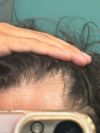
User experienced significant hair regrowth with multiple treatments, but then had a brutal shedding period, losing progress. Others questioned the number of treatments used and potential side effects.
A user's experience with hair loss treatments such as minoxidil and finasteride, which has resulted in positive results. Others have also shared their experiences with similar treatments with encouraging results.
The conversation is about disappointment with hair loss progress despite using treatments like finasteride, minoxidil, nizoral, tretinoin, and a dermaroller. Direct sunlight revealed more hair loss than expected, prompting continued treatment and hope for improvement.
A user shared their successful hair loss treatment using 1.25mg finasteride daily, 2.5mm microneedling every 1-3 weeks, zinc pyrithione shampoo, occasional scalp massages, and 40% glycolic acid on temples. They reported significant progress over 21 months.
A user is starting a topical finasteride treatment for diffuse patterned alopecia, having previously used minoxidil without success. They are cautious about side effects and have chosen topical over oral finasteride, while also using Nizoral and biotin in their routine.
A user is experiencing uneven hair thinning and has tried topical minoxidil without success and finasteride with adverse effects. They are considering microneedling and PRP treatments while avoiding finasteride, and another user suggests trying dutasteride as an alternative.
Some actors are believed to use treatments like finasteride, minoxidil, or hair transplants to maintain their hair, while others are thought to have naturally good genetics. Opinions vary on whether celebrities like Brad Pitt have natural hair or use enhancements.
The conversation discusses hair loss treatments, with the original poster using saw palmetto, biotin, minoxidil, a dermaroller, and rosemary oil, considering finasteride or a hair transplant in the future. Other users suggest finasteride or dutasteride for more effective results, while some recommend additional natural supplements and maintaining overall health.
The user tried oral minoxidil and dutasteride for hair loss after topical treatments failed, but with limited success. They suggest considering a hair system (toupee) as a more cost-effective and less complicated alternative to extensive non-regulated treatments.
The user has been using a strong combination of hair loss treatments for 16 months, including Finasteride, Minoxidil, Dutasteride, and RU-58841, but their hair loss has worsened. They're questioning whether their high testosterone levels or residual scalp DHT are causing further hair loss, with a reply suggesting that even small amounts of DHT can cause hair loss if one is sensitive to it.
The person is experiencing sudden hair loss for six months and treatments like dutasteride, minoxidil, and vitamins are not working. Another person suggests the hair loss might not be androgenetic alopecia but could be telogen effluvium or an inflammatory condition.
A user expressed frustration with hair loss treatments, including finasteride, minoxidil with micro-needling, and RU58841, which all failed to stop hair thinning and miniaturization. Suggestions from others included accepting baldness, considering hair systems, and continuing prescribed antidepressants for depression.
The user tried various hair loss treatments, including Maxogen-X, Dualgen15, minoxidil, finasteride, and dermarolling, but experienced limited regrowth and some side effects. They eventually switched to oral minoxidil, hoping for better results.
Hair follicles are mostly dormant but can be reactivated with treatments like minoxidil, finasteride, and microneedling. A new drug, PP405, shows promise for hair regrowth but may not be available until 2027-2028.
The conversation is about the role of testosterone in hair loss and the effectiveness of different treatments. The conclusion is that DHT is the main culprit for hair loss, and finasteride has been proven to work long-term in maintaining and regrowing hair. Testosterone may have a minor effect, but it is not the primary cause of hair loss.
A person shared their hair regrowth journey using HIMS topical treatments with finasteride, minoxidil, hormone replacement therapy (HRT), and microneedling. They also discussed their transition as a transgender woman and the positive impact of HRT on hair recovery.
A trans man experiencing hair loss after starting testosterone treatment has seen positive results using topical minoxidil and finasteride, though his hair remains thin. He is considering continuing his current treatment and exploring additional options like microneedling and Breezula, while acknowledging the impact of testosterone on hair loss.
The conversation discusses the synthesis and potential use of JXL069 and PP405 for hair loss treatment, with skepticism about their effectiveness and concerns about safety. Users mention that JXL069 has shown no results in hair growth, and there is confusion about its identity and effectiveness compared to PP405.
PP405, a promising hair loss treatment, is expected to be available by 2027, with faster trials due to its topical nature. Users are eager for its release, comparing it to existing treatments like minoxidil and finasteride, but remain cautious about its long-term effectiveness.
Low-dose oral minoxidil is a safe and effective hair loss treatment with fewer side effects than previously feared. Users often prefer it over topical minoxidil for better results, though some experience side effects like increased body hair and cardiovascular issues.
The conversation discusses the potential of PP405 as a hair loss treatment, with some users expressing skepticism and others hopeful about its development. There is also mention of other treatments like Minoxidil, Finasteride, and Pyrilutamide, with users debating the effectiveness and safety of self-experimentation versus waiting for clinical trial results.
The conversation is about sourcing gray market compounds, gt20029 and pp405, for hair loss treatment. The user is interested in these compounds despite their unproven status and potential risks.
A woman is concerned about her husband's hair thinning and researches treatments like finasteride and minoxidil. He decides against medication due to potential side effects and plans to shave his head if necessary.
PP-405, a potential hair loss treatment, shows promise in stimulating dormant hair follicles and may help with various hair loss types. Current treatments like Minoxidil are still recommended as PP-405 is in early trials and may take years to become available.
UCLA's PP405 shows promise in reactivating dormant hair follicles for hair loss treatment but is still in clinical trials. Minoxidil and finasteride remain common treatments until PP405 becomes available.
Finasteride and minoxidil are discussed as hair loss treatments, with mixed opinions on side effects like sexual dysfunction and mood changes. Some users report positive results, while others express concerns about potential risks and insufficient information.
Hair follicles can be dormant and potentially revived with treatments like finasteride and minoxidil, but irreversible loss occurs if certain structures are destroyed. Early intervention is more effective, and additional methods like microneedling may help.
The conversation is about the effectiveness of hair loss treatments like finasteride, dutasteride, and minoxidil. Users agree these treatments help maintain hair but don't guarantee miraculous regrowth, emphasizing early intervention for best results.
The conversation discusses whether dermarolling (microneedling) works with oral minoxidil for hair loss treatment. References to studies on microneedling alone and combined with minoxidil are provided.
The conversation discusses whether it's better to start hair loss treatment with finasteride or dutasteride. Opinions vary, but many suggest starting with finasteride due to its shorter half-life and easier management of side effects, while others argue dutasteride is more effective and has fewer side effects.