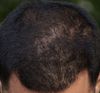
A user on finasteride, minoxidil, dermastamp, and Nizoral is seeing baby hairs and asks if it's regrowth. Another user confirms it is regrowth and encourages them to continue.
The user experienced tiny vellus hairs from 0.5mg finasteride and 2.5mg minoxidil over 9 months. Topical minoxidil, alfatradiol, and RU58841 applied twice daily for 1.5 months significantly improved temple hair regrowth.
The conversation discusses hair regrowth, with users sharing experiences and advice on using finasteride, minoxidil, and dermarolling to stimulate hair growth. Many users report seeing small hairs, which they consider a positive sign, though opinions vary on whether these hairs will develop into thicker, terminal hairs.
The conversation discusses hair loss treatments, specifically mentioning Minoxidil, finasteride, and RU58841, and highlights hair multiplication research from Koehler Lab at Harvard. Users express optimism about future advancements.
The user underwent three hair transplants over five years, totaling 6,500 grafts, and uses a topical solution with minoxidil and finasteride. The procedures were performed at Medikliniek in Amsterdam, with some donor hair taken from the beard during the last surgery.
Finasteride, Minoxidil, Bioneer CosmeRNA, Technoderma, Kintor, Hope, Breezula, and Follicum treatments showed increases in hair count, with Technoderma showing the highest increase at 24.3 hairs/cm². Amplifica has not yet published results.
Human pluripotent stem cells have been used to create hair and skin, potentially offering a new solution for baldness. A user also mentioned starting finasteride but experiencing unexpected hair thinning.
A user plans to undergo a temporary MtF transformation to regrow hair, using estrogen, RU58841, and Dutasteride, then revert with testosterone. Many users criticize the plan, suggesting alternatives like hair transplants, and emphasize that estrogen is not a reliable solution for hair regrowth.
A 25-year-old male experiencing hair shedding due to testosterone use is considering topical finasteride or RU58841 for scalp treatment while continuing minoxidil for beard growth. Topical finasteride is suggested to prevent scalp thinning without affecting beard growth.
A user experienced extreme hair growth on their hairline and temples using natural remedies like onion juice, nail rubbing, more veggies and fruits, less carbs, jojoba oil, and dermarolling. They did not use Minoxidil, finasteride, or any prescription drugs.
The user is experiencing hairline thinning despite using finasteride, minoxidil (solution and foam), dermastamping, and tretinoin. They suspect minoxidil or tretinoin might be causing the issue but are unsure.
Hair cloning technology is advancing, with clinical trials for improved methods expected by 2028 and 2029, potentially offering a solution for hair loss if donor follicles remain. Organtech's expansion into other biotech areas may secure funding, but the effectiveness of cloning depends on the availability of androgen-resistant donor follicles.
The user shares their hair growth progress using topical and sublingual minoxidil, dutasteride, hormone replacement therapy, and a laser comb. They report thicker hair and reduced hairline shedding, seeking advice for further thickening.
A user with long-term hair loss has been using topical minoxidil, finasteride, RU58841, ketoconazole, and dermastamping for 8 months. They are unsure if the new hairs are miniaturized or vellus.
A 31-year-old has been using finasteride, dutasteride, and oral minoxidil for hair loss. They noticed a sudden triangular thinning patch on their scalp and are seeking advice, questioning if it could be medication-related.
Diffuse thinners often experience more hair regrowth with DHT blockers like finasteride, possibly due to less DHT sensitivity and the presence of miniaturized, not completely bald, follicles. However, regrowth varies widely among individuals, influenced by factors like genetics, the stage of hair loss, and treatment methods such as minoxidil, microneedling, and dermarolling.
Baldness is difficult to cure because current treatments like finasteride, dutasteride, and minoxidil only prevent hair shedding, and new developments are mostly ineffective. Botox shows potential in aiding skin regeneration and hair growth, but maintenance therapy with treatments like dutasteride and minoxidil may still be necessary.
The user experienced hair thinning on TRT and considered various treatments suggested by an online clinic, including GHK-Cu Scalp Serum and Minoxidil blends. The consensus is that only finasteride or dutasteride effectively stop hair loss, while Minoxidil can thicken hair.
The person experienced worsening hair loss despite using minoxidil, finasteride, and dutasteride. They are considering increasing dutasteride dosage, trying microneedling, RU58841, and oral minoxidil, and are advised to consult a trichologist.
Hair loss treatments like finasteride, minoxidil, and hair transplants have side effects and limitations. There is hope for future advancements in stem cell therapy and hair follicle regeneration, though skepticism about their effectiveness and timeline persists.
A 33-year-old man using finasteride, minoxidil, thickening shampoo, conditioner, and Nizoral noticed peach fuzz after a month and is hopeful for regrowth. Others shared mixed experiences, with some seeing further growth and others not.
A user had a hair transplant 16 years ago and lost hair after stopping finasteride. They're now using a combination of treatments including oral dutasteride, topical and oral minoxidil, Pyrilutamide, and microneedling, and have seen improved density but are unsure if it's enough to grow their hair out. They also had a bad experience with scalp micropigmentation (SMP) and are considering redoing it.
The user is experiencing hair loss with possible causes including chronic telogen effluvium, diffuse alopecia areata, and androgenic alopecia. They have tried treatments like Nizoral shampoo, minoxidil, and finasteride, and are considering a biopsy for further clarity.
The conversation discusses using T3 (triiodothyronine) as a topical treatment for hair growth, with some users noting it showed promising results in studies but lacked follow-up. Users express interest in trying T3 due to its potential effectiveness compared to Minoxidil.
Hair multiplication or cloning is not available anywhere in the world. The conversation also mentions treatments like Minoxidil, finasteride, and RU58841 for hair loss.
Exploring the idea of transplanting miniaturized hair follicles to healthier areas to potentially reverse hair loss, with concerns about DHT sensitivity and scar tissue formation. The conversation also humorously considers using mice for hair growth experiments.
The conversation discusses hair loss, genetics, and treatments like Dutasteride. It highlights the influence of genetics on hair loss, noting that indigenous people are less prone to it.
A 28-year-old woman with genetic hair loss has tried various treatments, including oral minoxidil, finasteride, dutasteride, vitamins, ketoconazole shampoo, exosome needling, and hair extensions. She plans to pause treatments for pregnancy and is concerned about potential hair loss during that time.
Hair loss treatments are difficult because hair follicles react differently to hormones and have varying growth cycles. Treatments mentioned include Minoxidil, finasteride, and RU58841.
A person started using finasteride, minoxidil, and dermarolling to regrow hair at the temples and is asking if it's possible. Some users report temple regrowth is possible with these treatments, while others find it challenging, and advise consistency and patience with treatment.