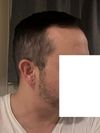
The user is frustrated about not hearing any updates on the HMI-115 trial for hair loss. They are questioning if there will be any updates in the future.
The user has been treating hair loss for a year using Hims topical finasteride/minoxidil, derma stamping, and RU58841, with plans to continue and hopes for more significant results. They have noticed some small hair growth at the temples and will provide updates on their progress.
The user has tried topical Minoxidil and oral Minoxidil for beard and scalp hair growth with minimal results, and has been on Finasteride for 7 months with stabilized scalp hair but no facial hair improvement. They are considering using a SULT1A1 enzyme booster to enhance results and are questioning its effectiveness without concurrent topical Minoxidil application.
The conversation discusses the completion of a Phase II trial recruitment for Breezula (CB-03-01), a potential treatment for androgenic alopecia. Specific treatments mentioned include Minoxidil, Finasteride, and RU58841.
RU58841 worsened hair condition, causing thinning and unusual patterns. The user stopped using it two months ago but hasn't seen recovery, and there's speculation about androgen receptor upregulation.
The conversation discusses a user's plan to inject NAD+ and GHK-Cu into their scalp to improve hair health, with concerns raised about the risks of infection and necrosis. Alternatives like finasteride, dutasteride, microneedling, oral minoxidil, and scalp massages are suggested.
The conversation is about the potential side effects of using verteporfin in conjunction with a hair transplant. Specific treatments discussed include verteporfin, a hair transplant (HT), minoxidil (Min), finasteride (Fin), and RU58841 (RU).
OP asks if face copper peptides from Sephora can be used on the scalp for hair benefits. User233 suggests AHK-CU is mainly for hair, but GHK-CU can also be used.
Peptides, specifically GHK-Cu, are being considered for hair growth benefits, such as increasing blood flow to the scalp and preventing hair follicle shrinkage. A user reported starting GHK-Cu after hearing it made a friend's hair thicker.
Adipose-derived stem cells with ATP improved hair regrowth in male and female mice with androgenetic alopecia. The most effective treatments were low dose stem cells with ATP for males and medium dose stem cells with non-liposomal ATP for females.
A 20-year-old user experienced worsening hair loss despite using various treatments including topical and oral minoxidil, finasteride, and dutasteride. Other users suggested additional treatments like JAK inhibitors, RU58841, and lifestyle changes, but the user remains skeptical and frustrated.
Ultrasound imaging can predict hair shedding and assess hair growth stages by analyzing hair follicle characteristics. The conversation also discusses using ultrasound for personal hair analysis and mentions the potential use of infrared emission for hair treatment.
The user is one month into their FUE treatment and has just undergone PRP treatment at American Mane in Miami. They plan to start using minoxidil and LLT, take xpecia with saw palmetto, and try Exosome from ExoScrt and PRP for better hair growth results.
The experiences of users who have used RU58841 to treat hair loss, including both positive and negative effects. Some side effects reported include chest pain, joint pain in the hands, tinnitus, and increased heartbeat.
A 29-year-old man had a successful hair transplant at Dr. Ulusan Clinic in Izmir, Turkey, receiving over 4600 grafts and exosome injections. He started using finasteride and minoxidil daily a month after shaving his head, which improved his confidence and outlook on life.
PP405 shows promise in activating dormant hair follicles and increasing hair counts but lacks detailed efficacy data compared to minoxidil and finasteride. Opinions are mixed, with some optimism and skepticism about its effectiveness.
The conversation is about a user offering free unused Eucapil after switching to finasteride for hair loss treatment. The user did not use Eucapil and is willing to give it away locally or ship it if costs are covered.
PP405 shows promise in regenerating hair by activating dormant follicles. Other treatments like VDPHL01 and Breezula are also advancing, providing new hope for hair loss solutions.
A user's father experienced hair regrowth and other health improvements after two IV exosome treatments. The user also had four rounds of exosome therapy, noting significant hair regrowth and relief from headaches, but no change in gray hair.
A user is seeking a trusted supplier for RU58841 in the UK, expressing doubts about their current source, rudirect, and considering Anagenic and receptorchem. They are asking for recommendations for other suppliers.
A 25-year-old male with DUPA (diffuse thinning including the donor area) has not seen improvement after 14 months on finasteride. He's considering switching to dutasteride (DUT) after advice from a hair loss YouTuber and is also contemplating trying RU58841.
Injectable GHK-CU and BPC157 were discussed for hair loss, but users did not notice significant hair changes. BPC157 was noted to help with shoulder issues.
A 24-year-old with hair thinning is using a regimen including dutasteride, RU58841, HGH, GHK-cu, and other compounds to protect and regrow hair. They are also incorporating a mild cutting cycle with testosterone propionate, anavar, and tirzepatide.
Scalp biopsies are crucial for diagnosing hair loss conditions like Diffuse Unpatterned Alopecia (DUPA) and retrograde hair loss, as treatments like finasteride and dutasteride may not be effective if other conditions are present. Combining PPAR-GAMMA agonists with retinoids could improve treatments for conditions like Lichen Planopilaris.
AMP-303 and AMP-601 are new hair loss treatments targeting dermal papilla cells, with AMP-303 showing early efficacy in transitioning vellus hairs to terminal hairs after one injection. Further clinical trials are planned, and these treatments are seen as promising due to their biologic approach and less frequent application compared to daily treatments.
A potential non-invasive topical treatment targeting the WNT Signaling Pathway for hair regeneration is being researched, with positive results on human hair follicle cells. Current effective treatments for hair loss include Minoxidil, finasteride, and hair transplantation.
PP405 shows promise for hair growth with significant results after 4 weeks, but skepticism exists due to its unavailability. Some users are hopeful for its potential, while others express concerns about side effects and market release delays.
Osteopontin, a protein involved in hair growth on moles, may help with hair loss. However, it is also linked to Alzheimer's, cancer, and bone development, so caution is advised.