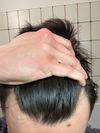
The post and conversation are about the high cost and skepticism surrounding pyrilutamide as a hair loss treatment, with comparisons to minoxidil, finasteride, and RU58841. The original poster defends pyrilutamide's effectiveness and criticizes others for dismissing it without proper understanding.
Combining stemoxydine with topical minoxidil for hair loss treatment. Users discuss application order and effectiveness, with some skepticism about stemoxydine's benefits.
RU58841 powder from a lab supplier was tested at a free drug testing service. The discussion includes using Minoxidil and finasteride for hair loss treatment.
A user shared progress pictures showing significant hair regrowth after using 1mg finasteride and weekly microneedling for about 2.5 to 3 months. The user reported no side effects and maintained good health and mood.
Higher doses of dutasteride, like 2.5 mg, may offer more hair growth than 0.5 mg, but the difference is not significant for most people. Many users find 0.5 mg effective, and increasing the dose is often unnecessary unless experiencing severe hair loss.
The conversation is about someone experiencing hair regrowth using Minoxidil and Dutasteride, along with other treatments. They report their hairline is improving and their forehead appears smaller.
The conversation discusses managing seborrheic dermatitis (sebderm) and male pattern baldness (MPB) with treatments like finasteride, coal tar shampoo, Nizoral, and oral minoxidil. Users suggest dietary changes, regular shampooing, and using antifungal products to control sebderm before considering minoxidil.
The conversation discusses the effectiveness and side effects of DUT mesotherapy for hair loss. Users are seeking evidence and pictures of successful treatments.
The conversation discusses enhancing Minoxidil absorption for hair loss treatment using Tretinoin and MSM (Methylsulfonylmethane). The user is seeking sources for Tretinoin and mentions MSM's potential to improve the absorption of topical agents.
A 25-year-old male with seborrheic dermatitis and hair thinning seeks advice on the severity of his condition and treatment options. Oral finasteride and oral minoxidil are recommended as the most effective long-term treatments.
The user has been using topical minoxidil 5% and oral dutasteride for 2 months and is seeking feedback on progress. Responses suggest small growth and recommend waiting longer for more noticeable results.
Using a combination of Stemoxydine, minoxidil, dutasteride, and keto shampoo to achieve extreme hair and beard growth. The user has experienced positive results with terminal hairs at the hairline and an increase in density to their stubble after several weeks of use.
The user has been using minoxidil, finasteride, and microneedling for two years, resulting in significant hair regrowth and plans for a 4000 graft hair transplant. The treatments have strengthened the donor area, making a hair transplant feasible.
Dutasteride at 2.5mg is considered a potential hair loss cure due to its DHT-blocking ability, but there are concerns about side effects and individual responses. Minoxidil, finasteride, and RU58841 are also discussed, with mixed opinions on their effectiveness and safety.
A dermatologist prescribed methionine with vitamins for hair loss, but the user is doubtful and plans to seek finasteride in France. The user is unsure why finasteride or minoxidil wasn't prescribed, suspecting concerns about side effects or strength.
A 24-year-old male shared his progress after over two years of using finasteride and topical minoxidil, reporting significant improvement from Norwood 3 to Norwood 1.5 with minimal side effects, mainly watery semen. Other users discussed their experiences with similar treatments, noting varying results and timelines for hair regrowth.
The conversation discusses hair loss treatments, specifically oral minoxidil (2.5mg), dutasteride (0.5mg every other day), and ketoconazole. The user reports slow progress but significant hair growth after adding ketoconazole to their routine.
A 23-year-old male reported significant hair improvement using 0.5 mg finasteride and 2.5 mg minoxidil daily, along with 0.5 mg dutasteride twice a week. He noticed increased hair thickness, density, and darker color, attributing the changes mainly to oral minoxidil and DHT blockers.
The user experienced prolonged hair shedding after restarting oral minoxidil (OM) at 2.5 mg in September 2023, following a break due to hypertrichosis. Despite seeing regrowth, the shedding has not decreased after 11 weeks on the increased dosage.
The conclusion of the conversation is that the user has experienced significant hair regrowth using a combination of medications, including dutasteride, RU58841, and minoxidil. They have not experienced any noticeable side effects and are considering a hair transplant in the future.
The user is considering reducing their finasteride dose from 2.5mg to 1.25mg to make the supply last longer and is concerned about potential changes in results. They have been using the 2.5mg dose for four months.
PP405 is a potential hair loss treatment that inhibits mitochondrial pyruvate carriers, increasing lactate dehydrogenase activity and stimulating hair follicle stem cells. In a phase 1 trial, 31% of participants showed over 20% hair density increase with PP405 treatment.
A user is considering dutasteride mesotherapy for hair loss due to concerns about oral side effects from high DHT levels. They have been using topical finasteride with minoxidil but are exploring mesotherapy as an alternative, while another user shares their experience with mesotherapy sessions using dutasteride and minoxidil without side effects.
A 24-year-old male experienced increased hair shedding after switching to a new topical finasteride and minoxidil solution with a better carrier. He is concerned whether this shedding indicates progress or a setback in his hair loss treatment.
SCUBE3 and GT20029 are potential treatments for hair loss, with SCUBE3 stimulating hair growth and GT20029 protecting against DHT. A combined approach using SCUBE3, finasteride or dutasteride, and later GT20029 could provide a comprehensive treatment for androgenetic alopecia.
The conversation discusses using 0.5mg Dutasteride once a week for hair loss, with suggestions to increase frequency for better results. The user plans to reassess the need for a hair transplant in six months and is concerned about potential side effects like gynecomastia.
The conversation is about sourcing gray market compounds, gt20029 and pp405, for hair loss treatment. The user is interested in these compounds despite their unproven status and potential risks.
Topical Finasteride doesn't directly reduce 5ar enzyme on scalp and has the same mechanism as oral, needing to go through the liver. Users debate the accuracy of this information and discuss various studies and experiences.
A user shared progress pictures after 8 months of finasteride, 2 months of minoxidil, and 2 months of vitamin D. The post shows significant hair improvement despite some light differences in the photos.