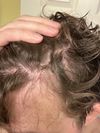
Minoxidil can cause hair growth in unintended areas, leading to humorous situations. The conversation jokes about hair growing on legs instead of the head.
Oral minoxidil is effective for hair loss but can cause cardiovascular side effects, such as pericardial effusion, especially in those with genetic predispositions. Starting with low doses and monitoring cardiovascular health are advised to reduce risks.
A joke about someone named "Fin Diesel" living life one milligram at a time, referencing the treatments Finasteride and Minoxidil used to treat hair loss; users discussed whether the look would be better with or without hair.
A 36-year-old man saw steady improvement in hair thickness after 1.5 years using Hims minoxidil/finasteride spray and hair/nail vitamins, with no side effects. He applies the treatment with an eye dropper for better scalp coverage and emphasizes the importance of patience and consistency.
User suggests a DIY zix formula for hair loss treatment and shares personal success with it. Another user disagrees, calling zix a "snake oil potion" and advises finding a real treatment instead.
A user shared progress pictures showing thicker hair after 8 months of using Fin/Min spray from HIMS. The conversation includes skepticism and humor from other users.
Creating a carrier solution for topical hair loss treatments using ethanol, propylene glycol or glycerin, and instructions on creating topical finasteride. Different recipes are provided with varying ratios of alcohol to humectant.
A serum containing Centella asiatica extracellular vesicles, IGF-1, FGF-7, and caffeine significantly improved hair thickness, density, length, and reduced hair loss after 56 days. The conversation also discusses how treatments like finasteride, minoxidil, and ketoconazole address different aspects of hair loss by reducing DHT, improving blood flow, and lowering inflammation.
The conversation discusses a 13-month hair loss treatment update using dutasteride, minoxidil, nizoral, and a 1.5mm derma roller, with the original poster reporting no side effects and some improvement in hair thickness. Participants request before-and-after pictures with consistent hairstyles to better assess the treatment's effectiveness.
The user experienced increased hair density after starting 1mg finasteride in February and 2.5mg oral minoxidil two months ago, along with 10mg biotin daily. They initially used topical minoxidil but switched to oral due to application difficulties and have seen improvements without significant side effects.
A 28-year-old male has been using oral finasteride and minoxidil for over a year without seeing significant results in hair thickness, particularly in the front. He is considering adding dermastamping to his routine and is exploring whether topical treatments might be more effective.
The conversation discusses a 24-year-old Korean man's progress with hair loss treatments over 8-9 months, with specific treatments not mentioned due to redacted information. Users are commenting on the effectiveness and inquiring if Asians have better results with hair loss treatments.
The user experienced stable hairline but diffuse thinning after switching from oral finasteride to a topical solution of minoxidil and finasteride. They are concerned about the effectiveness of the topical treatment and are considering other options due to a recent decline in hair density.
John Cazale's hairline showed strong recession at the temples but maintained solid volume and density, sparking discussion on different hair loss patterns and the importance of overall hair density. Treatments like Minoxidil and Spironolactone were mentioned as potential factors in maintaining hair, though genetics and styling were also considered significant.
A 26-year-old male with high testosterone is experiencing diffuse hair thinning despite using a comprehensive treatment regimen including dutasteride, oral minoxidil, RU58841, ketoconazole shampoo, microneedling, and low-level laser therapy. Suggestions include adjusting dutasteride dosage, monitoring iron levels, and consulting a dermatologist for further evaluation.
A user started taking 0.5 mg of finasteride daily and noticed watery semen, questioning if it's normal or if they should adjust the dosage. Another user suggested it might indicate reduced fertility and may not improve.
KX-826 is a potential hair loss treatment, with users discussing its effectiveness compared to finasteride and concerns about its trial results. Some users express skepticism about new treatments, while others discuss the potential of androgen receptor degraders and the need to manage drug resistance.
Hair loss treatments discussed include Minoxidil, Finasteride, and RU58841. A user asks about alfatradiol's availability, public perception, and usage in Germany.
The user is experiencing hair thinning and is considering using minoxidil. They are concerned about the progression of hair loss and whether it will lead to complete baldness.
The user applies Rogaine foam, Toppik hair fibers, and Tresemme mousse to improve hair appearance and has restarted finasteride after a year off. They are considering a hair transplant and are working on self-esteem related to hair loss.
The user has been on 1 mg oral finasteride for 12 months but feels they have lost some hair density and are considering switching to dutasteride. They are hesitant to use minoxidil due to scalp irritation and are seeking advice on maintaining hair into their 30s.
Mixing RU58841 with cetosomal minoxidil is discussed due to scalp irritation from ethanol PG vehicles. A mixture of the two turned bright pink when left to dry.
The user has been on finasteride for 5 months and noticed their hair becoming wispy/frizzy, suspecting minoxidil might have also contributed to the change. They are distressed by the change in their hair's appearance.
Deoxyribose sugar gel is discussed as a potential hair loss treatment, but it lacks human trials and credible evidence. Users express skepticism and humor about its effectiveness compared to established treatments like minoxidil and finasteride.
The conversation discusses using very low dose topical finasteride to achieve specific serum DHT reduction percentages. It concludes that finasteride dosage increases linearly between 5-30% DHT reduction but requires exponential increases for reductions up to 70%.
The user is experiencing diffuse hair thinning despite using finasteride and oral minoxidil, with no hairline recession or bald spots. Suggestions include checking for telogen effluvium, considering a JAK inhibitor for potential autoimmune issues, and conducting further tests to rule out other causes.
The conversation is about making homemade topical finasteride, discussing mixing it with Kirkland minoxidil and creating a solvent with alcohol, glycerin, and water. A formula suggestion includes 50% ethyl alcohol, 25% propylene glycol, and 25% distilled water.