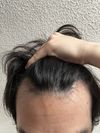
The effects of Finasteride on hair loss and its side-effects, such as aching balls. The user has been taking it for two years with no changes to the symptom.
Scientists discovered a new T cell treatment that could regrow hair. Users are skeptical but hopeful, with some relying on finasteride and minoxidil in the meantime.
KOSHINE826 is a new anti-hair loss and hair growth solution that claims to effectively control oil, reduce hair fall, and promote real hair growth. It targets androgenetic alopecia by inhibiting DHT and has shown promising results in clinical trials.
The conversation discusses interest in peptides for hair loss, specifically mentioning ahkCU and ghkCU. A user is considering adding ghkCU to their treatment regimen.
DHT causes hair loss by driving cells into senescence, and a polyphenol in black chokeberry may reverse this. A product using this theory is being considered for use alongside finasteride, minoxidil, and microneedling.
A user's 10-month progress update using finasteride and minoxidil to treat hair loss, with other users offering congratulations, jokes, advice, and questions.
PP405 is moving to late-stage trials, showing potential for hair regrowth, with 31% of male patients experiencing a 20% increase in hair density. Veradermics is developing an oral minoxidil version, and there is interest in combining treatments for better results.
The user shared a 10-month hair loss treatment update using finasteride, minoxidil, derma stamping, red light therapy, and keto shampoo, reporting improved styling ability but a stubborn frontal hairline. The user experienced lower libido as a side effect of finasteride.
People discussed their intense hair loss treatments, including the use of dutasteride, RU58841, minoxidil, tretinoin, essential oils, microneedling, and various topical sprays. Some users reported success with these methods in preventing hair loss and stimulating hair growth.
A 25-year-old male with DUPA (diffuse thinning including the donor area) has not seen improvement after 14 months on finasteride. He's considering switching to dutasteride (DUT) after advice from a hair loss YouTuber and is also contemplating trying RU58841.
Pyrilutamide (KX-826) is discussed as an anti-androgen treatment for hair loss, with mixed user experiences. Some users report no results, while others find it mildly effective.
The conversation is about a user assessing their hair loss as Norwood 1.5 and discussing their use of oral minoxidil and finasteride for 2.5 years, which improved their hair density. They are content with their current progress but hope to reach Norwood 1.
The conversation is about when GT20029, a hair loss treatment, might be available on the grey market, with users discussing the challenges of compounding it and speculating it might be available after phase 2 results, similar to pyri. Specific treatments mentioned are pyri, RU58841, and GT20029.
A user with stage 1 hair loss is inquiring about the release date of GT20029, hoping to use it instead of Minoxidil and finasteride, as they believe it has better results. They want to know if it will be available in the next couple of years.
The user reports progress in hair regrowth using topical finasteride/minoxidil, microneedling, topical dutasteride, latanoprost, and MSM supplements. They express frustration over the lack of interaction on progress posts compared to trivial topics.
The conversation discusses Breezula, a hair loss treatment, and its Phase 3 clinical trial recruitment at 50 locations. Specific treatments mentioned include Minoxidil, Finasteride, and RU58841.
User "hairlossblows" shares their positive experience with minoxidil, microneedling, and finasteride for hair loss treatment. They report significant hair regrowth, especially in the hairline, and minimal side effects from finasteride.
Clascoterone 5% solution (Breezula) is a promising alternative for androgenetic alopecia, showing continued hair growth with consistent use and no significant side effects. It may be suitable for those who cannot tolerate finasteride or dutasteride, especially when trying to conceive.
A 33-year-old woman shared her successful hair regrowth journey using topical Minoxidil 5% once daily, resulting in thicker hair and increased confidence. She avoided oral treatments like finasteride due to potential side effects and focused on consistent application of Minoxidil.
The post discusses the completion of the HMI-115 Australian Phase 1 Trial for hair loss treatment. The user speculates about the potential early release of the trial results.
Pyrilutamide, a new drug being tested to combat hair loss that has been found to perform comparably or better than finasteride and dutasteride in the initial 6 months of treatment with minimal reported side effects.
Hair loss treatments are advancing, with Coegin Pharma's FOL005 expected this year and Breezula potentially later. Pyrilutamide is available but not very effective, while Kintor's products face skepticism; traditional treatments like finasteride and minoxidil remain dominant.
Hair regrowth after 13 weeks using topical minoxidil, oral finasteride, peptide shampoo, serum, and a red light hat. Some growth is attributed to a recent hair transplant.
Breezula shows promising results for hair loss, with one trial showing a 539% improvement and another 168%, but lacks combination data with treatments like minoxidil or dutasteride. Its mechanism differs from finasteride, potentially offering fewer side effects by blocking receptors locally at the follicle.