STS01 1% effectively promotes hair regrowth with minimal side effects.
 September 2021 in “Farmacja Polska”
 Scalp needle mesotherapy can effectively treat hair loss and improve hair growth.
 January 2019 in “Oncogen”
 Triple Hormonal Blockade (ADT3) can effectively manage prostate cancer but requires careful monitoring for heart risks.
 January 2019 in “Przegląd Dermatologiczny”
 Patients with one autoimmune disease should be checked for other autoimmune disorders.
June 2025 in “British Journal of Dermatology” An AI device for skin cancer was successfully integrated into the NHS, improving diagnosis accuracy and service capacity.
5 citations
,
April 2024 in “JAAD International” AI can accurately measure hair loss severity in alopecia areata.
 2 citations
,
October 2022 in “The journal of investigative dermatology/Journal of investigative dermatology”
2 citations
,
October 2022 in “The journal of investigative dermatology/Journal of investigative dermatology” AIRE deficiency causes hair loss similar to alopecia areata in mice.
 January 2026 in “International Journal of Science and Research (IJSR)”
 AI is now essential in Indian aesthetic medicine.
March 2026 in “JID Innovations” Aire mutation reduces alopecia areata, while Notch4 mutation prevents it in mice.
86 citations
,
December 2002 in “Tissue Antigens” A specific gene change is linked to severe hair loss.
 September 2023 in “International journal of medicine”
 AI is revolutionizing healthcare by improving diagnosis, treatment, and monitoring, but still needs close supervision.
July 2025 in “Journal of Investigative Dermatology” AI-09 is safe, effective, and reduces wrinkles for up to 6 months.
 January 2024 in “Wiadomości Lekarskie”
 AI and advanced technologies are improving medical diagnostics and treatments.
 8 citations
,
October 2019 in “Immunological investigations”
8 citations
,
October 2019 in “Immunological investigations” The AIRE gene variant rs2075876 is linked to a higher risk of alopecia areata in males.
26 citations
,
September 2009 in “Clinical genetics” Arab APS1 patients have unique and recurrent AIRE gene mutations.
 January 2024 in “Wiadomości Lekarskie”
 AI improves medical care by enhancing diagnosis and treatment for better patient outcomes.
 February 2026 in “Dermatology and Therapy”
 AI can improve hair disorder diagnosis and treatment but can't replace doctors yet.
 5 citations
,
June 2023 in “Engineering Technology & Applied Science Research”
5 citations
,
June 2023 in “Engineering Technology & Applied Science Research” The AI model accurately classifies Alopecia Areata with 96.94% accuracy.
 November 2025 in “Scientific Reports”
 AI improves accuracy and consistency in diagnosing male pattern hair loss.
 1 citations
,
December 2018 in “International Journal of Modern Computation Information and Communication Technology”
1 citations
,
December 2018 in “International Journal of Modern Computation Information and Communication Technology” AI can greatly improve healthcare by enhancing disease prevention, detection, diagnosis, and treatment.
AI can predict hair loss patterns to improve care and treatment.
 June 2025 in “Journal of Cosmetic Dermatology”
 AI improves aesthetic medicine but faces challenges like biases and privacy issues that need addressing for successful integration.
2 citations
,
March 2024 in “JAAD Case Reports” AI can help track and improve hair loss treatment outcomes.
September 2025 in “PubMed” AI can greatly improve skin cancer diagnosis and treatment.
October 2025 in “Journal of Bahria University Medical and Dental College” Many dental professionals are aware of AI but need more education and support to use it effectively.
 March 2026 in “Aesthetic Plastic Surgery”
 AI is revolutionizing non-surgical cosmetic procedures by improving personalization, safety, and access.
 January 2024 in “Wiadomości Lekarskie”
 AI is transforming healthcare by improving diagnostics and therapy, despite challenges with data and trust.
 January 2024 in “Wiadomości Lekarskie”
 AI can help diagnose Follicular Lymphoma by accurately identifying specific cell types.
 September 2022 in “Research Square (Research Square)”
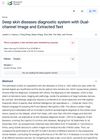
 The AI model DIET-AI effectively diagnoses skin diseases as well as doctors.
 January 2024 in “Wiadomości Lekarskie”
 AI improves vascular surgery by enhancing precision and safety, but doctors make final decisions.