 November 2023 in “Cell Proliferation”
 A protein from fat-derived stem cells, DKK1, is linked to hair loss and blocking it may help treat alopecia areata.
Fat stem cell treatment is safe and increases hair density for hair loss, but more research is needed.
 September 2023 in “International Journal of Trichology”
 Adipose-derived stem cells may help with hair loss, but more research is needed.
 August 2023 in “Stem Cell Research & Therapy”
 Using adipose-derived stem cell media with minoxidil may help regrow hair in men with hair loss.
March 2023 in “Clinical Cosmetic and Investigational Dermatology” Microneedling and fractional CO2 laser are compared as methods for delivering stem cell secretomes for skin rejuvenation.
August 2022 in “Regenerative Medicine” Adipose-derived stem cells show promise for cosmetic treatments but need more research.
 June 2021 in “Research Square (Research Square)”
 Using fat-derived cells to treat hair loss increased hair density and thickness without side effects.
July 2020 in “Research Square (Research Square)” A 3D co-culture model improved stem cell function and wound healing.
Treating vitiligo with stem cells and melanocytes from hair, along with UVB light, works better than without the light.
 November 2019 in “Клітинна та органна трансплантологія”
 Adipose-derived stem cells are useful in aesthetic medicine and dermatology for improving skin and tissue appearance.
 September 2019 in “Journal of Investigative Dermatology”
 Dermal Papilla Cells grown in 3D and with stem cells better mimic natural hair growth conditions than cells grown in 2D.
January 2018 in “Belarusian State Pedagogical University repository (Belarusian State Pedagogical University)” Adipose-derived stem cells can be used to create cells that help grow new hair.

Processed fat, SVF, and PRP are safe and effective for facial rejuvenation and hair growth.
 September 2016 in “Springer eBooks”
 Fat-derived stem cells may help treat skin aging and hair loss.
 January 2015 in “Springer eBooks”
 Fat-derived stem cells and their secretions show promise for treating skin aging and hair loss.
October 2021 in “Plastic and reconstructive surgery. Global open” Adipose-derived stem cells may help treat hair loss.
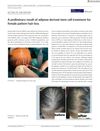 April 2021 in “Journal of Cosmetic Dermatology”
 Stem cell treatment improved hair density in female hair loss patient.
Higher levels of certain proteins in hair loss areas may help understand and treat hair loss.
January 2010 in “Seoul National University Open Repository (Seoul National University)” The medium from stem cells in fat tissue may boost hair growth.
 88 citations
,
July 2019 in “International Journal of Molecular Sciences”
88 citations
,
July 2019 in “International Journal of Molecular Sciences” Using human fat tissue derived stem cells in micrografts can safely and effectively increase hair density in people with hair loss.
 83 citations
,
March 2015 in “International Journal of Dermatology”
83 citations
,
March 2015 in “International Journal of Dermatology” ADSC-CM treatment improved hair density and thickness in women with hair loss, safely and effectively.
 81 citations
,
December 2009 in “Journal of Dermatological Science”
81 citations
,
December 2009 in “Journal of Dermatological Science” Fat tissue stem cells may help increase hair growth.
 57 citations
,
July 2018 in “Scientific Reports”
57 citations
,
July 2018 in “Scientific Reports” Using adipose tissue-derived fragments improves early skin graft success.
21 citations
,
August 2017 in “Journal of veterinary internal medicine” Combining amino acid and stem cell therapy may help manage hepatocutaneous syndrome in dogs.
 1 citations
,
October 2023 in “bioRxiv (Cold Spring Harbor Laboratory)”
1 citations
,
October 2023 in “bioRxiv (Cold Spring Harbor Laboratory)” Printing human stem cells and a special matrix during surgery can help grow new skin and hair-like structures in rats.
 April 2024 in “Skin research and technology”
 Adding stromal vascular fraction to platelet-rich plasma injections did not significantly improve hair growth in androgenetic alopecia treatment.
 September 2020 in “Kocatepe Veterinary Journal”
 Equine adipose stem cells can become different cell types and are promising for healing injuries.
May 2026 in “World Journal of Stem Cells” Low oxygen conditions improve the healing ability of older stem cells from fat tissue.
January 2013 in “프로그램북(구 초록집)” Adipose stem cell-conditioned media improved hair density and thickness in women with hair loss.
48 citations
,
March 2020 in “Stem Cell Research & Therapy” Using a collagen sponge scaffold helps stem cells become more like skin cells.