A new treatment using conjugated linoleic acid in nanovesicles can rejuvenate hair follicles and improve hair growth in androgenic alopecia.
January 2025 in “Regenerative Biomaterials” A dissolving microneedle patch with collagen XVII effectively promotes hair regrowth in androgenic alopecia.
 5 citations
,
December 2021 in “Frontiers in Cell and Developmental Biology”
5 citations
,
December 2021 in “Frontiers in Cell and Developmental Biology” Enzymes called PADIs play a key role in hair growth and loss.
15 citations
,
February 2014 in “Journal of Investigative Dermatology” NF-κB activity is crucial for keeping hair in the growth phase.
July 2024 in “Journal of Investigative Dermatology” Allergic contact dermatitis may promote hair growth by activating hair follicle stem cells.
 49 citations
,
July 2019 in “British Journal of Dermatology”
49 citations
,
July 2019 in “British Journal of Dermatology” Wnt signaling is important for the change from the resting phase to the growth phase in human hair cycles.
 19 citations
,
January 2013 in “International journal of medical sciences”
19 citations
,
January 2013 in “International journal of medical sciences” Increasing Wnt5a in mice skin delays hair growth but doesn't stop it.
July 2024 in “Journal of Investigative Dermatology” JW0061 may be a new treatment for hair loss by promoting hair growth through WNT signaling.
 210 citations
,
July 1993 in “The journal of investigative dermatology/Journal of investigative dermatology”
210 citations
,
July 1993 in “The journal of investigative dermatology/Journal of investigative dermatology” Hair color production in mice is closely linked to the hair growth phase and may also influence hair growth itself.
 August 2024 in “Quality in Sport”
 New treatments for common hair loss are needed.
 31 citations
,
January 2003 in “Dermatology”
31 citations
,
January 2003 in “Dermatology” Steroidogenic isoenzymes may help improve treatments for common hair loss.
Loose anagen syndrome causes easy hair shedding in children, often resolving on its own.
 October 2024 in “Small Methods”
 Platinum nanozyme microneedles can effectively and safely promote hair growth for androgenetic alopecia.
 May 2024 in “FEBS open bio”
 Annurca apple extract may help treat hair loss and protect against oxidative stress.
TGF-β1 and 2 in hair follicles may be linked to hair loss in AGA.
 September 2007 in “Journal of Investigative Dermatology”
 ANp63 is crucial for skin integrity, new filaggrin gene mutations link to eczema, hair can regrow from non-stem cells, sunburns are increasing, and glucocorticoids help treat skin allergies by affecting immune cells.
 24 citations
,
September 1997 in “PubMed”
24 citations
,
September 1997 in “PubMed” Loose anagen hair can appear at any age and may improve over time.
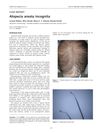 19 citations
,
January 2011 in “Clinics”
19 citations
,
January 2011 in “Clinics” A young woman with a rare hair loss condition improved with steroid and biotin treatment.
 1 citations
,
April 2017 in “Journal of Investigative Dermatology”
1 citations
,
April 2017 in “Journal of Investigative Dermatology” SM04554 may increase hair growth as a topical treatment for androgenetic alopecia.
 85 citations
,
February 1989 in “Journal of The American Academy of Dermatology”
85 citations
,
February 1989 in “Journal of The American Academy of Dermatology” Children with loose anagen hair have easily pluckable hair due to root sheath problems, and it might improve without treatment.
June 2020 in “bioRxiv (Cold Spring Harbor Laboratory)” IGN genes may regulate hair growth and could be targeted for hair-loss treatments.
 July 2024 in “Experimental Dermatology”
 AP collagen peptides help hair grow and improve hair health.
5 citations
,
January 1993 in “PubMed” Retinoic acid can change skin structures in vertebrates, like turning scales into feathers or hair buds into glands.
 April 2024 in “JEADV. Journal of the European Academy of Dermatology and Venereology/Journal of the European Academy of Dermatology and Venereology”
 A new change in the WNT10A gene caused a condition leading to short hair growth in a Chinese family.
 61 citations
,
January 2013 in “Indian Journal of Dermatology, Venereology and Leprology”
61 citations
,
January 2013 in “Indian Journal of Dermatology, Venereology and Leprology” Hair usually grows back 1-3 months after treatment for anagen effluvium, and children with Loose Anagen Hair Syndrome often improve by adolescence.
![Discovery of (2S)-N-(6-Cyano-5-(Trifluoromethyl)Pyridin-3-Yl)-3-(6-(4-Cyanophenyl)-3,6-Diazabicyclo[3.1.1]Heptan-3-Yl)-2-Hydroxy-2-Methylpropanamide as a Highly Potent and Selective Topical Androgen Receptor Antagonist for Androgenetic Alopecia Treatment](/images/assets/693e7bf6-2325-4ddc-a20f-3470db9f4516/small/25627.jpg) December 2023 in “Journal of Medicinal Chemistry”
December 2023 in “Journal of Medicinal Chemistry” A new topical treatment for hair loss shows strong hair growth effects with low toxicity.
 December 2023 in “bioRxiv (Cold Spring Harbor Laboratory)”
 Abnormal contraction of connective tissue in hair follicles causes hair loss by killing off important cells, and treating this could improve hair growth.
 September 2016 in “Journal of Dermatological Science”
 Certain factors can start hair growth in adult skin by making cells communicate and form new hair follicles.