May 2025 in “International Journal of Trichology” Hair Heat Disease is caused by wet, oily hair and friction in hot, humid conditions.
5 citations
,
January 2009 in “International Journal of Trichology” Two siblings had a rare hair condition with banded hair, which doesn't need treatment.
1 citations
,
December 2018 in “Veterinary dermatology” The hair coat disorder in Schipperkes is similar to Alopecia X and involves increased androstenedione levels and hair cycle arrest.
1 citations
,
September 1993 in “Archives of Disease in Childhood” Biotinidase deficiency can be easily diagnosed and treated with biotin to prevent serious harm.
2 citations
,
October 1974 in “Archives of Dermatology” The woman's skin condition persisted for 20 years despite treatments.
 1 citations
,
October 2022 in “Dermatology practical & conceptual”
1 citations
,
October 2022 in “Dermatology practical & conceptual” Isolated patchy heterochromia with pili annulati can occur without other health issues.
5 citations
,
November 2021 in “The journal of investigative dermatology/Journal of investigative dermatology” Wnt/β-catenin signaling is important for keeping skin cell attachment structures stable.
2 citations
,
March 2010 in “European journal of dermatology/EJD. European journal of dermatology” A young Caucasian girl had both woolly hair and alopecia areata, which is rare.
September 2014 in “Archives of disease in childhood” A 12-year-old boy had severe shingles and skin damage after a stem-cell transplant.
9 citations
,
January 1999 in “Dermatology” Men with X-linked recessive ichthyosis may not experience typical male-pattern baldness.
14 citations
,
September 2001 in “Archives of Dermatological Research” Blocking hair follicle development stops key gene signals needed for hair growth in mice.
8 citations
,
January 2006 in “Dermatology Online Journal” The girl's skin condition is benign but challenging to treat due to its size and location.
December 2019 in “Saintika Medika” A woman with lupus also developed a severe skin condition linked to a genetic factor.
 9 citations
,
July 2017 in “Dermatologic Therapy”
9 citations
,
July 2017 in “Dermatologic Therapy” Two elderly men developed scalp inflammation after using a gel for skin lesions, which healed with treatment except for some permanent hair loss.
January 2000 in “The Mouseion at the JAXlibrary (Jackson Laboratory)” The lanceolate hair-J mutation in mice helps understand human hair disorders like Netherton's syndrome.
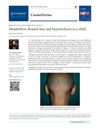 January 2026 in “Cosmoderma”
 A 9-year-old girl has a rare hair disorder causing beaded, sparse hair.
 July 2022 in “The journal of investigative dermatology/Journal of investigative dermatology”
 A patient with a PLEC mutation has epidermolysis bullosa, muscular dystrophy, and myasthenia gravis, which improved with steroid treatment.
 March 2021 in “bioRxiv (Cold Spring Harbor Laboratory)”
 Removing a specific gene in certain skin cells causes hair loss on the body by disrupting normal hair development.
 86 citations
,
October 2017 in “Translational pediatrics”
86 citations
,
October 2017 in “Translational pediatrics” Skin changes can help diagnose and manage endocrine disorders like thyroid problems, diabetes, and adrenal gland conditions.
March 2024 in “International journal of molecular sciences” Three specific genetic variants cause severe skin issues in children with EBS, highlighting the need for early genetic screening.
 2 citations
,
August 2014 in “Archivos argentinos de pediatría”
2 citations
,
August 2014 in “Archivos argentinos de pediatría” A 6-year-old girl with Turner syndrome also had psoriasis, alopecia areata, and trachyonychia.
 10 citations
,
January 2011 in “Annals of Dermatology”
10 citations
,
January 2011 in “Annals of Dermatology” A rare scalp tumor involving two hair follicles was successfully removed with surgery, with no recurrence after 7 months.
1 citations
,
February 2013 in “InTech eBooks” LEKTI is crucial for skin barrier and immune function, affecting conditions like Netherton syndrome and atopic dermatitis.
53 citations
,
August 2015 in “The Italian Journal of Pediatrics/Italian journal of pediatrics” Excessive body hair can signal complex health issues.
 June 2024 in “British Journal of Dermatology”
 KRT14 gene variants cause dermatopathia pigmentosa reticularis, affecting nails, teeth, and hair.
73 citations
,
January 2004 in “Journal of the American Academy of Dermatology” Immunocompromised patients can develop skin and hair issues due to a virus.
 9 citations
,
March 2018 in “European journal of dermatology/EJD. European journal of dermatology”
9 citations
,
March 2018 in “European journal of dermatology/EJD. European journal of dermatology” A new mutation in the ST14 gene causes a rare skin and hair disorder in a specific family.
2 citations
,
February 2022 in “bioRxiv (Cold Spring Harbor Laboratory)” Impaired LEF1 activation speeds up skin cell development in Hutchinson-Gilford Progeria Syndrome.
3 citations
,
August 2017 in “Clinical case reports” A rare skin condition causes red and dark patches on the face and limbs.
 January 2017 in “IMC Journal of Medical Science”
 A rare endocrine disorder, APS 1, was diagnosed in a 26-year-old man in Bangladesh.