Search
for
Sort by
Research
30-60 / 1000+ results
research Type 1 interferon signature in the scalp lesions of alopecia areata
Alopecia areata shows a unique type 1 interferon signature, suggesting potential treatment by targeting this pathway.

research Perifollicular Inflammation and Fibrosis in Androgenetic Alopecia: Implications for Diagnosis and Treatment - A Comparative Histopathologic and Clinical Study with Normal-Appearing Scalp
Early diagnosis and targeted anti-inflammatory treatments can improve outcomes in androgenetic alopecia with perifollicular inflammation and fibrosis.

research IMPORTANCE OF SEQUENTIAL FOLLOW-UP OF AUTOANTIBODIES IN ANA-POSITIVE PATIENTS WITH DIFFUSE HAIR LOSS
Regular monitoring of autoantibodies in ANA-positive patients with hair loss helps detect and treat lupus early.
research The role of autoimmune thyroid disorders in patients with alopecia areata
The study concluded that there is no significant link between thyroid autoimmunity and alopecia areata.
research Refractory alopecia areata with single hairs imitating frontal fibrosing alopecia: a prospective observational study
A unique type of hair loss mimics another condition but has minimal inflammation and specific immune cells present.
research Thyroid Autoimmunity in Patients with Skin Disorders
People with alopecia areata often have thyroid autoimmunity.
research ‘Follicular Swiss cheese’ pattern - another histopathologic clue to alopecia areata
Dilated follicular infundibula and increased catagen/telogen follicles are key indicators for diagnosing alopecia areata.
research Perifollicular Fibrosis: Pathogenetic Role in Androgenetic Alopecia
Androgen hormones cause hair follicle scarring in hair loss, and finasteride helps reduce it.
research Possible Involvement of Skin‐Resident Memory T Cells in Refractory Chronic Alopecia Areata
Skin-resident memory T cells may contribute to chronic alopecia areata and baricitinib could be a potential treatment.
research Thyroid peroxidase Antibody (TPO Ab) Can Be Used As a Marker For Persistence of Symptoms of Hypothyroidism in Patients with Primary Hypothyroidism Despite Normal TSH Level: Cross-Sectional Study
TPO antibodies can help identify hypothyroid patients who still have symptoms despite normal TSH levels.
research A Case of Frontal Fibrosing Alopecia in a Patient with Primary Biliary Cirrhosis and Polymyalgia Rheumatica
Frontal fibrosing alopecia might be linked to autoimmune diseases.
research Hormonal and Immunological Correlations in Alopecia Areata Patients: Focus on Luteinizing Hormone (LH) and Follicle Stimulating Hormone (FSH)
Alopecia areata patients have higher hormone levels, suggesting hormonal screening could help in treatment.

research Alopecia secondary to severe discoid lupus responding to anifrolumab
Anifrolumab significantly improved skin lesions and hair regrowth in severe discoid lupus.
research Alopecia frontal fibrosante. Valoración diagnóstica y terapéutica
Early diagnosis of frontal fibrosing alopecia is crucial to prevent permanent hair loss.
research Perifollicular erythema as a trichoscopy sign of progression in frontal fibrosing alopecia
Perifollicular erythema can indicate active frontal fibrosing alopecia.
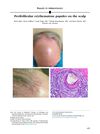
research Perifollicular erythematous papules on the scalp
The woman has a type of scarring hair loss with red bumps around hair follicles.

research Resident T cell activation leads to human hair follicle immune privilege loss ex vivo, which is prevented by the DHODH inhibitor farudodstat: relevance for alopecia areata
Farudodstat may help prevent hair loss in alopecia areata by stopping immune attacks on hair follicles.

research Widespread and eruptive comedonal lesions with alopecia
A man with skin and hair symptoms improved partially with specific treatment.
research Recalcitrant lichen planopilaris and frontal fibrosing alopecia responding to tildrakizumab
Tildrakizumab significantly improved recalcitrant lichen planopilaris and frontal fibrosing alopecia.
research 0054 Treg-targeted therapies restrain disease in a murine model of alopecia areata
Enhancing Tregs can protect against alopecia areata.

research Perifollicular Inflammation and Fibrosis in Androgenetic Alopecia: Implications for Diagnosis and Treatment - A Comparative Histopathologic and Clinical Study with Normal-Appearing Scalp
Early biopsy and targeting inflammation can improve treatment for hair loss in androgenetic alopecia.
research A novel monoclonal antibody to the outer root sheath cells
The new antibody, TYHF-1, specifically targets certain hair-related structures.
research Folliculotropic mycosis fungoides masquerading as alopecia areata
Folliculotropic mycosis fungoides can look like alopecia areata.

research Image 1_Resident T cell activation leads to human hair follicle immune privilege loss ex vivo, which is prevented by the DHODH inhibitor farudodstat: relevance for alopecia areata.pdf
Farudodstat can prevent hair follicle immune damage linked to alopecia areata.
research Antiandrogenic drugs, a therapeutic option for frontal fibrosing alopecia patients
Antiandrogenic drugs could be a good treatment option for frontal fibrosing alopecia.

research 148 Decreased IL-10 producing regulatory B cells in patients with alopecia areata
People with alopecia areata have fewer IL-10 producing immune cells, which might contribute to the condition.
research Follicular dystrophy of immunosuppression
Follicular dystrophy in immunocompromised patients may be linked to medication or viral factors and can improve with treatment changes.
research Refractory folliculitis decalvans treated with adalimumab: A case series of 23 patients
Adalimumab improved folliculitis decalvans in most patients.
research Targeting the ovary in female patients with alopecia areata
Treating ovarian-related inflammation may help hair regrowth in women with alopecia areata.