 November 2016 in “Therapeutic Delivery”
 New drugs for Alzheimer's and rheumatoid arthritis advanced, a Zika vaccine is in development, and there were business deals in anesthesia and oncology.
 January 2012 in “Elsevier eBooks”
 New treatments for skin and hair repair show promise, but further improvements are needed.
 9 citations
,
September 1997 in “Dermatologic Surgery”
9 citations
,
September 1997 in “Dermatologic Surgery” The technique of transplanting micrografts in hair restoration surgery is fast, practical, and efficient, minimizing damage to follicles and grafts.
2 citations
,
May 2002 in “PubMed” Micro-graft hair transplantation is an effective, simple, and painless method for permanent hair restoration in men and women.
August 2018 in “Analysis of the application of various variants of bone plasty in victims with intraarticular fractures (Transplantology)” Follicular microautotransplantation effectively improves scalp scars and enhances quality of life.
 67 citations
,
September 2003 in “Plastic and Reconstructive Surgery”
67 citations
,
September 2003 in “Plastic and Reconstructive Surgery” Micrografts and minigrafts are safe and effective for hair transplantation in facial and scalp reconstruction, providing high patient satisfaction.
August 2001 in “Dermatologic Surgery” Elliptografting gives better hair appearance and satisfaction than other methods.
172 citations
,
December 1994 in “The Journal of Dermatologic Surgery and Oncology” This hair transplant method improves cosmetic results for hair loss.
 November 1995 in “Dermatologic Surgery”
 The concentric mini-micrografting method is effective for extensive baldness, creating a natural look and efficiently using donor hair.
Micrografts and minigrafts effectively treat male hair loss with natural-looking results.
 5 citations
,
April 2005 in “Clinics in Plastic Surgery”
5 citations
,
April 2005 in “Clinics in Plastic Surgery” Micrografts and minigrafts for hair restoration provide high patient satisfaction and can cover large areas of hair loss, including sideburns, eyebrows, and beards.
January 2001 in “Chinese Journal of Medical Aesthetics and Cosmetology” Micrografts can grow natural hair and most patients are satisfied, but some need multiple procedures.
 6 citations
,
August 2003 in “Aesthetic Surgery Journal”
6 citations
,
August 2003 in “Aesthetic Surgery Journal” Hair restoration using micrografts and minigrafts can provide natural-looking hair without scars and good density in 1 or 2 sessions.
 January 2026 in “International Society of Hair Restoration Surgery”
 Tattoo machine-assisted drug delivery may improve hair growth in androgenetic alopecia.
 1 citations
,
January 1998 in “Seminars in Plastic Surgery”
1 citations
,
January 1998 in “Seminars in Plastic Surgery” Hair transplantation using micro- and minigraft megasessions is safe, effective, and provides natural results with high patient satisfaction.
1 citations
,
January 1996 in “Aesthetic Plastic Surgery” The tumescent technique makes hair micrografting more comfortable and efficient.
The treatment successfully integrated hair follicles into a dermal template, showing new hair growth and blood vessel formation.
 17 citations
,
January 1996 in “Aesthetic Plastic Surgery”
17 citations
,
January 1996 in “Aesthetic Plastic Surgery” The tumescent technique improves hair micrografting by providing lasting anesthesia, reducing bleeding, and increasing patient comfort.
 8 citations
,
May 2003 in “Hair transplant forum international”
8 citations
,
May 2003 in “Hair transplant forum international” New storage solutions improve the survival of small hair grafts and results of hair transplant surgeries.
 January 2012 in “Elsevier eBooks”
 Hair transplantation is highly effective with careful technique and attention to patient needs.
 10 citations
,
January 1997 in “Scandinavian journal of plastic and reconstructive surgery and hand surgery”
10 citations
,
January 1997 in “Scandinavian journal of plastic and reconstructive surgery and hand surgery” A new technique using a multibladed knife makes preparing hair transplant minigrafts faster and more uniform, leading to natural-looking results.
 1 citations
,
November 2005 in “Dermatologic Surgery”
1 citations
,
November 2005 in “Dermatologic Surgery” Aminoguanidine increases VEGF in stored hair micrografts, potentially improving their viability after transplant.
 5 citations
,
September 1998 in “Atlas of the oral and maxillofacial surgery clinics of North America”
5 citations
,
September 1998 in “Atlas of the oral and maxillofacial surgery clinics of North America” Hair transplantation and micrografting, used for baldness, involve moving hair follicles from hair-rich to bald areas, requiring careful procedure and post-care for success.
 3 citations
,
November 2005 in “Dermatologic Surgery”
3 citations
,
November 2005 in “Dermatologic Surgery” Aminoguanidine increases a specific growth signal in stored hair grafts, which may help them survive better after being transplanted.
38 citations
,
June 2016 in “Journal of Tissue Engineering and Regenerative Medicine” Microcolumn grafting can effectively regenerate full-thickness, functional skin without scarring.
 1 citations
,
January 2001
1 citations
,
January 2001 Micrografting is the most effective surgical method for permanent hair restoration.
5 citations
,
September 2017 in “PubMed” A new type of amniotic tissue graft improves wound healing better than other grafts.
 November 2023 in “Computational and Structural Biotechnology Journal”
 A single robotic system can accurately harvest and implant hair grafts, showing promise for real-world use.
 January 2011 in “Plastic Surgery”
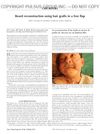
 Hair grafts successfully restored a realistic beard and hid scars, satisfying the patient.
 5 citations
,
May 2005 in “Seminars in Plastic Surgery”
5 citations
,
May 2005 in “Seminars in Plastic Surgery” Hair transplantation using micrografts and minigrafts is effective and safe for facial and scalp reconstruction with natural-looking results.