
Plakophilin 1 helps control skin cell immune responses to prevent excessive inflammation.
66 citations
,
February 2013 in “PeerJ” Activating cannabinoid receptor 1 reduces certain keratin levels, potentially aiding psoriasis treatment.
14 citations
,
February 2011 in “Experimental dermatology” A protein called COMP is part of the connective tissue in normal human hair follicles and may be important for hair health.
 9 citations
,
December 2002 in “Novartis Foundation Symposium”
9 citations
,
December 2002 in “Novartis Foundation Symposium” LEF1 is essential for the development of airway glands and is regulated by the Wnt/ß-catenin pathway.
April 2025 in “The Journal of Dermatology” Janus kinase inhibitors may help treat cutaneous T-cell lymphoma, but more research is needed.
28 citations
,
January 2005 in “Photochemistry and Photobiology” Protein kinase C epsilon may increase skin cancer risk by affecting nearby cells.
The scant hair in snthr-1Bao mice is likely caused by a deletion affecting the Plcd1 gene.
 April 2019 in “Journal of Investigative Dermatology”
 Non-coding RNA boosts retinoic acid production and signaling, aiding regeneration.
 December 2023 in “The journal of cell biology/The Journal of cell biology”
 The mTurq2-Col4a1 mouse model shows how the basement membrane develops in live mammals.
1 citations
,
December 2023 in “JAAD International” Mast cells may significantly contribute to central centrifugal cicatricial alopecia.
Type XVII collagen helps control skin cell growth and rejuvenates skin.
57 citations
,
August 2002 in “American Journal Of Pathology” Cathepsin L deficiency causes hair and skin issues in mice.
 31 citations
,
October 2018 in “Frontiers in Cell and Developmental Biology”
31 citations
,
October 2018 in “Frontiers in Cell and Developmental Biology” The conclusion is that CD90 is not a specific marker for fibroblast subtypes and better methods are needed to identify them.
 1 citations
,
April 2019 in “JAAD case reports”
1 citations
,
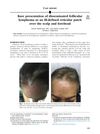
April 2019 in “JAAD case reports” A woman with lymphoma had a rare skin rash on her scalp and forehead, which was hard to diagnose but responded well to treatment.
 April 2016 in “The journal of investigative dermatology/Journal of investigative dermatology”
 RPGRIP1L helps skin cells stick together by blocking PKCβII, which can prevent skin blistering like in pemphigus.
September 2023 in “World Rabbit Science” The FRZB gene slows hair growth in rabbits.
 51 citations
,
February 2009 in “Journal of dermatological science”
51 citations
,
February 2009 in “Journal of dermatological science” Pitx2 helps outer root sheath cells differentiate but can't start hair growth on its own.
178 citations
,
April 2011 in “Journal of Clinical Investigation” Basal cell carcinomas in mice can start from hair follicle stem cells and other skin cell types, depending on signaling levels.
December 2012 in “Expert review of dermatology” New findings suggest the protein linked to Birt–Hogg–Dubé syndrome is important in cell signaling and could affect treatment understanding.
 10 citations
,
July 2013 in “British Journal of Dermatology”
10 citations
,
July 2013 in “British Journal of Dermatology” High MUC-18/MCAM levels in blood indicate a worse outlook for melanoma patients.
5 citations
,
May 2023 in “Frontiers in Cell and Developmental Biology” Integrin α6 helps identify different neural crest cell types in the skin.
3 citations
,
September 2022 in “European Journal of Dermatology” Gene sequencing is crucial for diagnosing Junctional epidermolysis bullosa.
January 2025 in “Genetics in Medicine Open” A new gene variant in a girl with Coffin-Lowry Syndrome may link the condition to early puberty.
 March 2024 in “EMBO molecular medicine”
 Antiviral drugs, especially daclatasvir, may be a new treatment for a rare skin disease, improving survival and reducing symptoms in mice.
 1 citations
,
February 2015 in “Clinical and Experimental Dermatology”
1 citations
,
February 2015 in “Clinical and Experimental Dermatology” A man got six skin cancers within a year after a cell transplant for leukemia but was cancer-free 32 months later; skin checks are important post-transplant.
 3 citations
,
May 1999 in “Dermatologic Surgery”
3 citations
,
May 1999 in “Dermatologic Surgery” Dr. Connelly agrees that linear basal cell carcinomas might be more aggressive but highlights the study's lack of clear criteria to identify them.
 September 1997 in “Journal of The European Academy of Dermatology and Venereology”
 Skin lymphoproliferative disorders are hard to diagnose and often linked to systemic diseases, but most have a good prognosis with accurate diagnosis.
 January 2025 in “PLoS ONE”
 Elf5 controls skin cell growth and development, making it a potential target for skin treatments.
 10 citations
,
March 2015 in “Journal of dermatology”
10 citations
,
March 2015 in “Journal of dermatology” The boy's severe skin disorder is caused by two new mutations in his TGM1 gene.
 6 citations
,
July 2021 in “Microbial biotechnology”
6 citations
,
July 2021 in “Microbial biotechnology” The combined treatment with engineered bacteria and yellow LED light improved wound healing in mice.