 1 citations
,
October 2017 in “Food Additives & Contaminants: Part A”
1 citations
,
October 2017 in “Food Additives & Contaminants: Part A” A new minoxidil-like substance, triaminodil, was found in an illegal hair growth supplement.
 4 citations
,
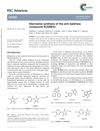
January 2014 in “RSC Advances”
4 citations
,
January 2014 in “RSC Advances” A new, less toxic and more efficient method to create the anti-baldness compound RU58841 was developed in 2014.
February 2026 in “Journal of Surfactants and Detergents” Potassium monoester maleates can effectively repair damaged hair and improve haircare products.
23 citations
,
February 2010 in “European Journal of Medicinal Chemistry”  2 citations
,
December 2020 in “American Journal of Dermatological Research and Reviews”
2 citations
,
December 2020 in “American Journal of Dermatological Research and Reviews” The combination therapy was effective and well-tolerated, especially in young patients.
1 citations
,
January 1998 in “Cosmetics and toiletries” Both amodimethicone and dimethicone copolyol amine are effective hair conditioners.
September 2010 in “대한화장품학회지(J. Soc. Cosmet. Scientists Korea)” The study developed a reliable method to measure active ingredients in hair nourisher products using HPLC.
1 citations
,
December 2022 in “Skin Research and Technology” The technique helps measure how hair styling ingredients affect hair's stiffness and flexibility.
 13 citations
,
May 2011 in “Bioorganic & Medicinal Chemistry”
13 citations
,
May 2011 in “Bioorganic & Medicinal Chemistry” Changing the 6-position on benzopyran molecules affects insulin release, with some compounds showing strong inhibitory effects.
2 citations
,
May 2024 in “International Journal of Dermatology”  11 citations
,
August 2017 in “Journal of Chromatographic Science”
11 citations
,
August 2017 in “Journal of Chromatographic Science” The new method is rapid, sensitive, and accurate for evaluating the quality of the medicinal herb Platycladi cacumen.
December 2025 in “Zenodo (CERN European Organization for Nuclear Research)” December 2025 in “Zenodo (CERN European Organization for Nuclear Research)” Fenugreek gel significantly reduces split ends and improves hair health.
 October 2024 in “Journal of Advanced Pharmaceutical Technology amp Research”
 Trigonelline nanocrystal cream effectively promotes hair growth and may reduce side effects.
8 citations
,
January 1991 in “Soviet physics. Doklady” 25 citations
,
October 2008 in “Chromatographia” A fast and accurate method was developed to measure alfuzosin and dutasteride in human plasma.
December 2022 in “Scientific Reports” Compound 4 is a promising treatment for hair loss with low toxicity.
 7 citations
,
July 2018 in “International Journal of Applied Pharmaceutics”
7 citations
,
July 2018 in “International Journal of Applied Pharmaceutics” Chitosan nanoparticles are promising for sustained caffeine delivery through the skin.
 1 citations
,
January 2021 in “JIFFK Jurnal Ilmu Farmasi dan Farmasi Klinik”
1 citations
,
January 2021 in “JIFFK Jurnal Ilmu Farmasi dan Farmasi Klinik” Celery extract didn't significantly boost hair growth in the gel.
April 2023 in “Journal of Investigative Dermatology” Trichohyalin in hair can trigger immune attacks in alopecia areata.
8 citations
,
July 2003 in “Annals of the Rheumatic Diseases” A 13-year-old girl with various symptoms was successfully treated with an antibiotic called co-trimoxazole.
 February 2024 in “Health Sciences”
 Botulinum neurotoxin A is effective and safe for treating various conditions, but more clinical trials are needed to fully assess its benefits and risks.
January 2007 in “Journal of Instrumental Analysis” A new method accurately detects tiny amounts of chloroform and dichloromethane in finasteride.
 December 2024 in “International Journal of Drug Delivery Technology”
 The new delivery method for dutasteride is more effective and has fewer side effects.
1 citations
,
August 2024 in “Journal of Pharmacy & Pharmaceutical Sciences” The DPCP/HPβCD complex improves solubility and anti-inflammatory effects for alopecia areata treatment.
 37 citations
,
May 2007 in “International Journal of Pharmaceutics”
37 citations
,
May 2007 in “International Journal of Pharmaceutics” PPCM microspheres allow controlled finasteride release over 24 hours.
 3 citations
,
May 2018 in “Reproductive Sciences”
3 citations
,
May 2018 in “Reproductive Sciences” The drug BAY 1158061 is safe, well-tolerated, and shows potential for treating diseases related to prolactin.
April 2011 in “HAL (Le Centre pour la Communication Scientifique Directe)” Chitosan-decorated nanoparticles improve skin delivery of finasteride, with PS404-b-PAA63 being most effective.
 13 citations
,
August 2013 in “Journal of pharmaceutical sciences”
13 citations
,
August 2013 in “Journal of pharmaceutical sciences” Researchers created a skin patch that delivers two drugs for treating enlarged prostate, which may improve patient use and dosage control.