 August 2024 in “Journal of Animal Science and Technology”
 Angora goat hair growth is influenced by gene expression, sex hormones, and breed differences.

A neck lesion misdiagnosed as benign was later treated successfully with Mohs Micrographic Surgery.
 June 2022 in “Veterinary evidence”
 Clomipramine alone does not reduce overgrooming in cats with psychogenic alopecia.
 March 2022 in “Benha Journal of Applied Sciences”
 ULBP3 levels are higher in Tinea capitis patients and may help predict the disease's severity.
 April 2017 in “Journal of Investigative Dermatology”
 Researchers improved a method to study individual cells in newborn mouse skin and found a way to assess the severity of a skin condition in humans.
 April 2017 in “Journal of Investigative Dermatology”
 Early and late matrix progenitors in hair follicles create different cell layers, with early ones forming the companion layer and later ones forming the inner root sheath and hair shaft.
 April 2017 in “Journal of Investigative Dermatology”
 Sweat glands and hair follicles are determined by opposing signals, with BMPs promoting sweat glands and blocking BMPs leading to hair follicles.
 April 2017 in “Journal of Investigative Dermatology”
 Chemotherapy and radiation therapy cause skin and hair damage by altering gene expression and signaling pathways.
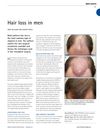 May 2013 in “Trends in Urology & Men's Health”
 Male-pattern hair loss is normal, often involves hormone effects on hair follicles, and can be treated with medication or surgery, but new treatments are being researched.
 January 2012 in “Postgraduate obstetrics & gynecology”
 Up to 50% of women may experience significant hair loss by age 50, with various causes and treatments available.
 January 2006 in “Elsevier eBooks”
 Cats with Feline Symmetrical Alopecia can regrow hair with proper treatment based on the specific cause, including diet, medication, or stress management.
 June 2003 in “Obstetrical & Gynecological Survey”
 After chemotherapy for a gestational trophoblastic tumor, normal pregnancy rates are possible, but there's a slightly higher risk of the tumor reoccurring in future pregnancies.
 June 2003 in “Obstetrical & Gynecological Survey”
 Postmenopausal ovary stromal cells have a unique makeup and limited steroid production, suggesting androgens come from the adrenal gland.
 May 2003 in “Facial Plastic Surgery Clinics of North America”
 Hair loss can be treated with medications like minoxidil and finasteride or surgery, but treatment effectiveness varies by alopecia type and accurate diagnosis is important.
 June 2001 in “Annals of Internal Medicine”
 The document concludes that more research is needed on the hepatitis B vaccine's side effects and the effectiveness of certain treatments for specific diseases.
 June 2001 in “Annals of Internal Medicine”
 The conclusion suggests that the zinc lozenge study is valid despite imperfect blinding, as many participants could not correctly identify their lozenge type.
 July 1996 in “Annals of Internal Medicine”
 Long-term high-dose fluconazole can cause reversible hair loss.
 July 1996 in “Annals of Internal Medicine”
 In 1995, international medical graduates did better than U.S. graduates on a medical exam.
 July 1996 in “Annals of Internal Medicine”
 International medical graduates scored higher than U.S. graduates on a medical exam.
 April 2017 in “Journal of Investigative Dermatology”
 Most patients with cutaneous dermatomyositis either improved or remained stable over 3.5 years.
 April 2017 in “Journal of Investigative Dermatology”
 Laser treatment may help with hair growth in some people with frontal fibrosing alopecia, but results vary and the exact way it works is unclear.
 April 2017 in “Journal of Investigative Dermatology”
 10% carbamide peroxide is safe and effectively reduces mild to moderate acne.
 April 2017 in “Journal of Investigative Dermatology”
 People with hidradenitis suppurativa who are more resilient tend to have better quality of life and less anxiety and depression.
 April 2017 in “Journal of Investigative Dermatology”
 Psoriasis patients experience moderate functional impairment related to disease severity and less satisfaction.
 April 2016 in “Journal of The American Academy of Dermatology”
 AGA patients have a lower quality of life than AA patients.
 April 2016 in “Journal of The American Academy of Dermatology”
 Online medical education helps doctors better understand and treat nail fungus.
 September 1997 in “JEADV. Journal of the European Academy of Dermatology and Venereology/Journal of the European Academy of Dermatology and Venereology”
 The document concludes that treatments like oral anti-androgens, minoxidil, and topical spironolactone can be effective for hair loss in men and women.
 November 2015 in “Springer eBooks”
 Hair loss treated with minoxidil, finasteride, laser/light, hair transplant, and scalp prostheses; more research needed for skin of color.
 April 2016 in “Journal of The American Academy of Dermatology”
 Alopecia areata affects quality of life more than androgenetic alopecia.
 September 1997 in “Journal of The European Academy of Dermatology and Venereology”
 Topical spironolactone effectively treats hair loss in women.