5 citations
,
January 2011 in “International Journal of Cosmetic Science” 1,2,3,4-tetrahydroquinoline compounds are great for stable, pure blue hair dye.
![Synthesis and Structural Characterization of a New Dinuclear Platinum(III) Complex, [Pt2Cl4(NH3)2{μ-HN=C(O)Bu^t}2]](/images/assets/fcbeee85-f5bd-406e-936d-9134a0f200d4/small/36266.jpg) 2 citations
,
November 2022 in “Acta crystallographica. Section B, Structural science, crystal engineering and materials./Acta crystallographica. Section B, Structural science, crystal engineering and materials”
2 citations
,
November 2022 in “Acta crystallographica. Section B, Structural science, crystal engineering and materials./Acta crystallographica. Section B, Structural science, crystal engineering and materials” A new platinum complex was made and studied, which might help fight cancer better.
September 2015 in “Photodiagnosis and Photodynamic Therapy” December 2022 in “Ecological Chemistry and Engineering S” A new compound was made to detect copper ions effectively.
 November 2022 in “Journal of Investigative Dermatology”
 A new molecule was found to be a safe and effective skin lightener and anti-aging product.
10 citations
,
July 1980 in “British Journal of Dermatology” Topical putrescine and spermine increased DNA synthesis in hairless mouse skin.
16 citations
,
September 1999 in “Journal of Investigative Dermatology Symposium Proceedings” ![Synthesis and 5α-Reductase Inhibitory Activity of 8-Substituted Benzo[ƒ]Quinolinones Derived from Palladium Mediated Coupling Reactions](/images/assets/2aedba8c-b0ac-4fa3-9ac7-9f375a016bba/small/15581.jpg) 14 citations
,
February 1998 in “Bioorganic & Medicinal Chemistry Letters”
14 citations
,
February 1998 in “Bioorganic & Medicinal Chemistry Letters” Some newly made compounds can block an enzyme linked to hair loss and prostate growth, with one in particular being very selective.
![Verification of the Major Metabolic Oxidation Path for the Naphthoyl Group in Chemoattractant Receptor-Homologous Molecule Expressed on Th2 Cells (CRTh2) Antagonist 2-(2-(1-Naphthoyl)-8-fluoro-3,4-dihydro-1H-pyrido[4,3-b]indol-5(2H)-yl)acetic Acid (Setipiprant/ACT-129968)](/images/assets/d743d32f-3115-48ff-9697-2f2d56130701/small/14175.jpg) 6 citations
,
September 2015 in “Journal of Medicinal Chemistry”
6 citations
,
September 2015 in “Journal of Medicinal Chemistry” The document confirms the structures of major metabolites of the CRTh2 antagonist Setipiprant and identifies minor metabolites.
15 citations
,
April 2011 in “The journal of investigative dermatology/Journal of investigative dermatology” A3B5 can reduce skin pigmentation and slow melanoma growth.
 51 citations
,
March 2006 in “Bioorganic & Medicinal Chemistry”
51 citations
,
March 2006 in “Bioorganic & Medicinal Chemistry” Newly made nicotinamide compounds could potentially treat cancer.
 5 citations
,
September 2014 in “Journal of Pharmaceutical Sciences”
5 citations
,
September 2014 in “Journal of Pharmaceutical Sciences”  May 2026 in “International Journal of Scientific Research in Chemistry”
 Finasteride breaks down into new compounds under acidic conditions.
25 citations
,
August 2015 in “Molecules” Mimosine dipeptides are promising for treating hyperpigmentation and inflammation.
 15 citations
,
January 2020 in “RSC advances”
15 citations
,
January 2020 in “RSC advances” The new palladium catalyst is effective and reusable for making pharmaceutical ingredients.
 May 2022 in “Annals of Oncology”
 Photobiomodulation therapy may speed up hair regrowth after chemotherapy in the short term.
 16 citations
,
September 2018 in “Journal of Molecular Liquids”
16 citations
,
September 2018 in “Journal of Molecular Liquids” The PS-b-PAA copolymer nanomicelles are effective for delivering a cancer treatment drug in photodynamic therapy.
 April 2019 in “The journal of investigative dermatology/Journal of investigative dermatology”
 Scientists discovered a new way UVB light increases skin pigmentation through the ATP-P2X7 pathway.
16 citations
,
October 2009 in “Xenobiotica” The tested hair dye ingredients do not form harmful oxidized metabolites in the liver.
 May 2019 in “Asian Journal of Chemistry”
 Finasteride forms three new products under acidic stress.
14 citations
,
September 2016 in “Journal of Photochemistry and Photobiology B Biology” UV exposure damages hair, increasing thiols and altering protein structure.
March 2026 in “Dyes and Pigments” Riboflavin and blue light speed up genipin hair dye, making it fast, glossy, stable, and eco-friendly.
September 2017 in “Journal of Investigative Dermatology” Photodynamic therapy can potentially remove nonpigmented hair by damaging hair follicles.
 60 citations
,
January 2004 in “The journal of investigative dermatology/Journal of investigative dermatology”
60 citations
,
January 2004 in “The journal of investigative dermatology/Journal of investigative dermatology” Applying a specific inhibitor lightens skin and hair color.
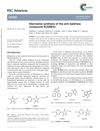 4 citations
,
January 2014 in “RSC Advances”
4 citations
,
January 2014 in “RSC Advances” A new, less toxic and more efficient method to create the anti-baldness compound RU58841 was developed in 2014.
22 citations
,
September 1986 in “Journal of Investigative Dermatology” Low-dose topical alpha-terthienyl may be a safer option for treating skin conditions with light therapy.
New steroid derivatives show promise as anticancer agents, even against resistant cells.

The research created new azasteroids and pseudoazulenyl nitrones, which could be useful in medicine.
4 citations
,
December 2024 in “European Journal of Medicinal Chemistry” New pyrazole-based inhibitors show promise for treating metabolic diseases and other conditions.
1 citations
,
July 2025 in “Journal of Photochemistry and Photobiology B Biology” Photobiomodulation helps protect hair follicle cells from damage caused by DHT.