 4 citations
,
March 2006 in “Journal of dermatology”
4 citations
,
March 2006 in “Journal of dermatology” A Chinese-Japanese boy had a rare fungal infection on his scalp and skin, likely caught in China.
2 citations
,
December 2019 in “Chinese medical journal/Chinese Medical Journal” A woman with a scalp infection and herpes recovered fully after treatment.
46 citations
,
January 2002 in “Paediatric drugs” Tinea capitis, a scalp fungal infection in children, is best treated with newer antifungal agents for shorter periods.
Visible lesions are not always needed to diagnose tinea capitis.
 1 citations
,
January 2015 in “Indian journal of dermatology, venereology, and leprology”
1 citations
,
January 2015 in “Indian journal of dermatology, venereology, and leprology” A woman's scalp infection caused by a fungus led to permanent hair loss and was hard to treat but responded to a specific antifungal.
8 citations
,
October 1993 in “International Journal of Dermatology” The man's scalp infection was treated successfully, and his hair grew back.
 32 citations
,
January 2014 in “Dermatology Research and Practice”
32 citations
,
January 2014 in “Dermatology Research and Practice” Trichoscopy can effectively tell apart tinea capitis and alopecia areata in children by looking for specific hair shapes.
 3 citations
,
April 2021 in “Berkala ilmu kedokteran/Journal of the medical sciences”
3 citations
,
April 2021 in “Berkala ilmu kedokteran/Journal of the medical sciences” A fungus called Epidermophyton floccosum can cause scalp infections.
 1 citations
,
January 2017 in “International Journal of Dermoscopy”
1 citations
,
January 2017 in “International Journal of Dermoscopy” Dermoscopy is useful for identifying and tracking different types of hair loss without scarring.
May 2024 in “Journal of Fungi” Tinea capitis in adults, especially postmenopausal Black women, needs prompt treatment with oral antifungals to avoid scarring.
 21 citations
,
February 2009 in “Journal of the American Academy of Dermatology”
21 citations
,
February 2009 in “Journal of the American Academy of Dermatology” Some cases of tinea capitis, a fungal scalp infection, can look like scarring hair loss due to the body's immune response and the fungus itself.
 9 citations
,
October 2013 in “Pediatric dermatology”
9 citations
,
October 2013 in “Pediatric dermatology” Proper antifungal treatment is crucial to avoid misdiagnosis and prevent scarring alopecia.
 4 citations
,
January 2000
4 citations
,
January 2000 Piedraia hortae fungi dissolve both the outer and inner layers of hair.
 2 citations
,
January 2022 in “Eduvest”
2 citations
,
January 2022 in “Eduvest” A teenage girl with a fungal scalp infection got better with antifungal and allergy medication, and special shampoo.
 1 citations
,
January 2013 in “Elsevier eBooks”
1 citations
,
January 2013 in “Elsevier eBooks” The document reviews various hair and nail disorders, their causes, and treatments, emphasizing the need for proper diagnosis and the link between nail changes and systemic diseases.
 33 citations
,
December 2013 in “Journal of cutaneous pathology”
33 citations
,
December 2013 in “Journal of cutaneous pathology” A fungal infection can look like a different scalp condition in teens, leading to wrong treatment until proper tests are done.
 33 citations
,
February 1996 in “Journal of The American Academy of Dermatology”
33 citations
,
February 1996 in “Journal of The American Academy of Dermatology” Treat scalp and beard fungal infections early with oral antifungal medication and sometimes topical therapy, avoiding unnecessary allergy tests and surgery.
 32 citations
,
June 2017 in “Journal of infection/The Journal of infection”
32 citations
,
June 2017 in “Journal of infection/The Journal of infection” The document concludes that terbinafine is effective for treating scalp fungal infections in children and recommends not excluding them from school during treatment, while also highlighting the need for updated treatment guidelines due to changing infection patterns.
 32 citations
,
August 2003 in “Journal of the American Academy of Dermatology”
32 citations
,
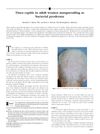
August 2003 in “Journal of the American Academy of Dermatology” Tinea capitis can be misdiagnosed as bacterial infection in adult women but is treatable with antifungal medication.
 7 citations
,
May 2012 in “Actas Dermo-Sifiliográficas”
7 citations
,
May 2012 in “Actas Dermo-Sifiliográficas” Scalp fungus infections in Spain are a health concern, with changing causes and a need for better treatment and prevention.
 1 citations
,
January 2019 in “Paediatrics and Child Health”
1 citations
,
January 2019 in “Paediatrics and Child Health” The document concludes that understanding hair biology and recognizing hair conditions are crucial for managing and treating hair loss in children.
 7 citations
,
January 2003 in “Nippon Ishinkin Gakkai Zasshi”
7 citations
,
January 2003 in “Nippon Ishinkin Gakkai Zasshi” The girl's scalp infection healed well with terbinafine treatment.
 156 citations
,
September 2014 in “British journal of dermatology/British journal of dermatology, Supplement”
156 citations
,
September 2014 in “British journal of dermatology/British journal of dermatology, Supplement” Accurate diagnosis and effective oral treatment are key to managing tinea capitis and preventing its spread.
 41 citations
,
September 2007 in “Pediatric emergency care”
41 citations
,
September 2007 in “Pediatric emergency care” Oral medication is necessary to treat scalp fungus in children, with griseofulvin being the usual choice.
 38 citations
,
July 2010 in “Clinical, cosmetic and investigational dermatology”
38 citations
,
July 2010 in “Clinical, cosmetic and investigational dermatology” To treat tinea capitis in children, oral antifungal medication is necessary, with newer drugs offering shorter treatment times than the traditional griseofulvin.
 30 citations
,
January 2013 in “International Journal of Trichology”
30 citations
,
January 2013 in “International Journal of Trichology” The most common causes of hair loss in Jordanian children are fungal infections, autoimmune hair loss, and hair shedding after fever, with zinc deficiency also being a notable cause.
 6 citations
,
November 2007 in “Archives of Disease in Childhood: Education & Practice”
6 citations
,
November 2007 in “Archives of Disease in Childhood: Education & Practice” The document concludes that accurate diagnosis of alopecia in children relies on thorough examination and history, and while treatments exist, none can alter the course of alopecia areata, which can significantly affect a child's psychological well-being.
 February 2026 in “International Journal of Research in Dermatology”
 Two adults with unusual scalp fungus symptoms were successfully treated.

Neem leaf extract combined with eucalyptus and lemongrass oils can effectively treat Tinea capitis.
 October 2022 in “Gadua Journal of Pure and Allied Science”
 Terbinafine is the most effective treatment for tinea capitis, a scalp infection often confused with other conditions.