14 citations
,
September 2017 in “Proteomics. Clinical applications” Hair protein analysis could improve medical testing and understanding of hair characteristics.
 1 citations
,
November 2022 in “Frontiers in medicine”
1 citations
,
November 2022 in “Frontiers in medicine” The study found that giant pandas have more melanin in black hair follicles than white, with gene expression differences that could affect hair color and skin health.
12 citations
,
July 2012 in “Journal of Applied Polymer Science” Botanical extracts can protect and repair bleached hair.
January 2012 in “The Journal of Practical Medicine” Chinese Han individuals have fewer hair follicles and hairs than Caucasians and Africans.
 March 2024 in “Medical lasers”
 Multiple-wavelength radiation helps hair grow by boosting early hair follicle development.
 6 citations
,
March 2020 in “Anais brasileiros de dermatologia/Anais Brasileiros de Dermatologia”
6 citations
,
March 2020 in “Anais brasileiros de dermatologia/Anais Brasileiros de Dermatologia” Most people in Turkey start getting gray hair around 33 years old, with factors like age, education, hair loss, skin type, family history, and anxiety playing a role.
12 citations
,
January 2010 in “The anthropologist/Anthropologist” Human hair is valuable for identifying people and detecting drug use.
 September 2024 in “Journal of Investigative Dermatology”
 A new tool can analyze hair to detect changes due to hormones, genetics, and aging.
January 2019 in “Figshare” Redheaded people have higher levels of vitamin D precursor, suggesting their hair color may be an adaptation to low sunlight areas.
235 citations
,
July 1999 in “Journal of biological chemistry/The Journal of biological chemistry” Human hair is made up of different keratins, some strong and some weak, with specific types appearing at various stages of hair growth.
September 2006 in “Fertility and Sterility” Heavier birth weight may increase the risk of early hair graying in women.
 10 citations
,
January 2013 in “Actas Dermo-Sifiliográficas”
10 citations
,
January 2013 in “Actas Dermo-Sifiliográficas” Most white Spanish women have a widow's peak, and their hairline measurements could help in hair restoration surgery.
5 citations
,
November 2023 in “Journal of Advanced Research” New methods may change hair color and shape from the root, revolutionizing hair styling.
 July 2024 in “Clinical and Experimental Dermatology”
 Hair loss patterns in Asian and Black women are unique and may affect treatment.
6 citations
,
November 2001 in “Der Hautarzt” Photothermolysis is the best method for permanent hair removal.
August 2006 in “Experimental dermatology” Human scalp hair follicles can produce and respond to several hormones, affecting hair growth and pigmentation.
 September 2017 in “Journal of Investigative Dermatology”
 Blue light helps hair growth by affecting specific proteins in hair follicle cells.
April 2017 in “Annales de Toxicologie Analytique” Hair analysis is crucial for diagnosing, managing, and monitoring addiction.
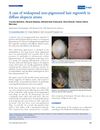 March 2019 in “Our Dermatology Online”
 A woman with severe hair loss regrew mostly white hair after treatment.
 3 citations
,
June 2017 in “International Journal of Radiation Biology”
3 citations
,
June 2017 in “International Journal of Radiation Biology” Gamma rays did not change hair follicle density but increased white and hypopigmented hairs in mice.
2 citations
,
January 2022 1 citations
,
January 2020 85 citations
,
January 1990  16 citations
,
January 2013 in “Internal Medicine”
16 citations
,
January 2013 in “Internal Medicine” Early hair whitening may indicate a higher risk of heart disease in young and middle-aged men.
January 2022 in “SSRN Electronic Journal” Mouse hair follicles age, causing more white hairs due to fewer pigment stem cells.
 2 citations
,
January 2023 in “International journal of biological sciences”
2 citations
,
January 2023 in “International journal of biological sciences” Gray hair can potentially be reversed, leading to new treatments.
1 citations
,
April 2013 in “Pakistan Journal of Biological Sciences” Hair coloring, waving, and ironing cause more hair damage than not using these treatments.
 24 citations
,
November 2015 in “Scientific reports”
24 citations
,
November 2015 in “Scientific reports” Human hair has a new region with ordered filaments and the cuticle contains β-keratin sheets.
2 citations
,
March 2024 in “Journal of Cosmetic Dermatology” White hair from alopecia areata can turn pigmented after treatment.
 April 2024 in “Nepal journal of dermatology, venereology & leprology”
 Premature graying of hair is common and stressful, but not well understood or treated.