Search
for
Sort by
Research
60-90 / 1000+ resultsresearch BULGE CELLS OF RAT HAIR FOLLICLES: ISOLATION, CULTIVATION, MORPHOLOGICAL AND BIOLOGICAL FEATURES
Rat hair follicle bulge cells can become nerve and glial cells, showing potential for neuroprotection.

research BMP2 and BMP7 play antagonistic roles in feather induction
BMP2 and BMP7 have opposite roles in feather formation.
research Gap junctions in Turing-type periodic feather pattern formation
Gap junctions help control feather pattern formation by enabling cell communication.
research Basonuclin as a cell marker in the formation and cycling of the murine hair follicle
Basonuclin helps identify and track hair follicle development and cycling in mice.

research Boundary Conditions Cause Different Generic Bifurcation Structures in Turing Systems
Boundary conditions change how patterns form in Turing systems.
research 線維芽細胞凝集塊形成による幹細胞形成機構の解明
Fibroblast spheres can form stem cells, but marker distribution needs more study.
research Rippled‐pattern trichomatricoma
A unique hair tumor with a rippled pattern was identified, showing incomplete differentiation and unusual cell arrangements.

research Brg1 Governs a Positive Feedback Circuit in the Hair Follicle for Tissue Regeneration and Repair
Brg1 is crucial for hair growth and skin repair by maintaining stem cells and promoting regeneration.
research Basonuclin as a cell marker in the formation and cycling of the murine hair follicle
Basonuclin is crucial for hair follicle development and cycling in mice.

research BUZZ: an essential gene for postinitiation root hair growth and a mediator of root architecture in Brachypodium distachyon
The BUZZ gene is important for root hair growth and overall root structure in the plant Brachypodium distachyon.
research 251 Morphogenetic events in hair follicle heterotypic spheroids
The research concluded that hyaluronic acid affects the formation and growth of hair follicle-like structures in a lab setting.
research Dynamic Behavior and Spontaneous Differentiation of Mouse Embryoid Bodies on Hydrogel Substrates of Different Surface Charge and Chemical Structures
Hydrogel surface properties affect mouse embryoid body differentiation.
research Viewpoint 4
Skin patterns form through molecular signals and genetic factors, affecting healing and dermatology.

research Gap junctions in Turing-type periodic feather pattern formation
Gap junctions help control feather pattern formation in chickens.
research Differential sensitivity of epidermal cell subpopulations to β-catenin-induced ectopic hair follicle formation
Sebaceous glands can form new hair follicles when activated, but hair follicle bulges cannot.
research Morphogenesis of Mammary Glands in Buffalo (Bubalus bubalis)
Buffalo mammary glands develop in stages from 34 to 229 days during prenatal growth.

research Cyclical dermal micro-niche switching governs the morphological infradian rhythm of mouse zigzag hair
Mouse zigzag hair bends form due to a 3-day cycle of changes in hair progenitors and their environment.

research Rapid formation of multicellular spheroids in double-emulsion droplets with controllable microenvironment
A new method quickly creates controllable cell clusters for tissue engineering and drug testing.
research Making Waves with Hairs
Skin patterns are formed by simple reaction-diffusion mechanisms.

research A Window into Mammalian Basement Membrane Development: Insights from themTurq2-Col4a1Mouse Model
The mTurq2-Col4a1 mouse model shows that cells can divide while attached to stable basement membranes during development.
research Epithelial skirt and bulge of human facial vellus hair follicles and and associated Merkel cell-nerve complex
Merkel cells are abundant in facial vellus hair follicles, especially during the anagen phase.

research 1435 Dynamic morphogen-p63 chromatin interactions that guide epigenetic changes and p63 activity in surface ectoderm commitment
The study found that p63 needs signals from morphogens to help skin cells differentiate properly.
research Dermal Blimp1 Acts Downstream of Epidermal TGFβ and Wnt/β-Catenin to Regulate Hair Follicle Formation and Growth
Blimp1 is crucial for hair follicle growth and skin health.
research The multipotency of adult vibrissa follicle stem cells
Adult vibrissa follicle stem cells can regenerate hair follicles, glands, and skin.
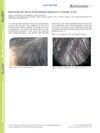
research Banded Scalp Hair with an Unusual Glistening Appearance in a Teenager: A Quiz
A teenager's hair with alternating white and dark bands, known as Pili annulati, is a genetic condition that is usually harmless and often considered attractive.
research In vivo effects of epidermal growth factor on epidermal pattern formation and hair follicle initiation in the marsupial bandicoot Isoodon macrourus
Epidermal growth factor disrupts hair and gland formation in bandicoots.
research De novo filament formation by human hair keratins K85 and K35 follows a filament development pattern distinct from cytokeratin filament networks
Human hair keratins K85 and K35 create unique filament patterns important for early hair formation.
research Alarm reaction of pilosebaceous apparatus
The hair and oil glands react by changing structure when stressed.

research Consecutive transposition flaps for the management of slot formation after alopecia-reducing surgery.
Using consecutive transposition flaps can manage gaps in hair growth after multiple hair loss surgeries.