September 2019 in “Mağallaẗ al-ʿulūm al-ṭabīʿiyyaẗ wa-al-ḥayātiyyaẗ wa-al-taṭbīqiyyaẗ” Camel hair from Afif can be improved for textiles by adding chemicals or blending with other fibers.
November 2025 in “Veterinary and Animal Science” Camel hair structure, not color, helps camels stay cool in the desert.
 46 citations
,
January 2009 in “Textile Research Journal”
46 citations
,
January 2009 in “Textile Research Journal” Researchers developed a new method to identify animal hair in textiles, which is effective for various fibers and more reliable than previous methods.
 6 citations
,
December 1966 in “Textile Research Journal”
6 citations
,
December 1966 in “Textile Research Journal” Animal hair fibers like wool and mohair are strong when dry, but vicuna fibers are very brittle.
1 citations
,
January 1992 in “Bangladesh Journal of Animal Science” Camel skin has typical mammalian layers, with hair follicles, glands, and muscles, varying by body area.
 6 citations
,
January 2016 in “Environmental footprints and eco-design of products and processes”
6 citations
,
January 2016 in “Environmental footprints and eco-design of products and processes” The industry should promote pure luxury hair fibers, improve technology, and diversify products to support growers and ensure sustainable use.
 January 2014 in “Sen'i Gakkaishi”
 Researchers developed a method to identify animal fibers in textiles, which works on processed and blended materials.
 35 citations
,
February 2006 in “Textile Research Journal”
35 citations
,
February 2006 in “Textile Research Journal” Enzymes xylanase and pectinase clean wool and specialty hair fibers effectively without damage, offering an eco-friendly alternative to soap and hot water.
 8 citations
,
May 2004 in “Textile Research Journal”
8 citations
,
May 2004 in “Textile Research Journal” Scientists made antibodies to tell cashmere and wool apart, which could improve how we identify animal fibers.

Ancient herders in the Keriya Valley fed their animals mainly C3 plants, with some C4 plant feeding possibly due to herd movement or seasonal changes.
 9 citations
,
January 1989 in “Sen'i Gakkaishi”
9 citations
,
January 1989 in “Sen'i Gakkaishi” Wool and hair fibers absorb moisture similarly due to their keratin structure, with the amount of non-crystalline areas affecting the moisture uptake.

Acidic sandy clay damages archaeological hair the most, while dry conditions preserve but make it brittle; silicone oil can help keep the hair flexible.
 4 citations
,
March 2021 in “Journal of Surfactants and Detergents”
4 citations
,
March 2021 in “Journal of Surfactants and Detergents” Shampoo B, which uses water-soluble silicone, is better at detangling hair in wet conditions due to its two-layer conditioning film.
 3 citations
,
January 2018 in “Open Access Macedonian Journal of Medical Sciences”
3 citations
,
January 2018 in “Open Access Macedonian Journal of Medical Sciences” Implant safely and effectively treats hair loss.
 169 citations
,
June 2010 in “Molecular & cellular proteomics”
169 citations
,
June 2010 in “Molecular & cellular proteomics” Pectin biosynthesis is essential for the growth of cotton fibers and Arabidopsis root hairs.
 27 citations
,
January 2010 in “Animal”
27 citations
,
January 2010 in “Animal” South American camelids should be sheared early, fleece type affects fiber quality, and the S/P follicle ratio doesn't distinguish between Bolivian llama genotypes.
 9 citations
,
November 2015 in “Key Engineering Materials”
9 citations
,
November 2015 in “Key Engineering Materials” Improving skills and technology in Baluchistan's wool industry could boost quality, jobs, and Pakistan's economy.
 8 citations
,
June 1979 in “JAMA”
8 citations
,
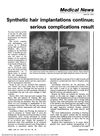
June 1979 in “JAMA” Synthetic hair implants can cause severe infections and are risky.
 20 citations
,
January 1979 in “JAMA”
20 citations
,
January 1979 in “JAMA” Fiber implantation for baldness is not recommended because it causes many problems and doesn't work well.
 29 citations
,
December 2011 in “British Journal of Dermatology”
29 citations
,
December 2011 in “British Journal of Dermatology” A new hair treatment with caffeine and other ingredients makes hair thicker and less likely to break.
 94 citations
,
February 1994 in “The journal of investigative dermatology/Journal of investigative dermatology”
94 citations
,
February 1994 in “The journal of investigative dermatology/Journal of investigative dermatology” EGF makes hair follicles grow longer but stops hair production.
 15 citations
,
February 2017 in “International Journal of Women's Dermatology”
15 citations
,
February 2017 in “International Journal of Women's Dermatology” Hair camouflage offers various options for hair loss, helping reduce psychological impact.
A new system for classifying curly hair types using precise measurements can improve hair care products and cultural inclusion.
 30 citations
,
March 2019 in “Archives animal breeding/Archiv für Tierzucht”
30 citations
,
March 2019 in “Archives animal breeding/Archiv für Tierzucht” The KRTAP15-1 gene affects cashmere fiber thickness in goats.
 4 citations
,
July 2022 in “Scientific reports”
4 citations
,
July 2022 in “Scientific reports” Crossbreeding improves goat fiber quality, and specific genes affect hair traits and color.
 89 citations
,
August 2008 in “Human genetics”
89 citations
,
August 2008 in “Human genetics” The EDAR gene greatly affects hair thickness in Asian populations.
8 citations
,
July 2019 in “The journal of investigative dermatology/Journal of investigative dermatology” Curly hair is mechanically different from straight hair and may need new testing methods.
New methods to classify curly hair types were developed based on shape and strength.
 August 2020 in “Textile research journal”
 The model helps understand how wool fiber structure affects its strength and flexibility.
 June 2023 in “Livestock studies”
 The article concludes that understanding the molecular processes in hair follicle development can improve the quality of fibers like Angora and cashmere.