Deleting the MAD2L1 gene in mice led to rapid tumor growth despite chromosomal instability.
 1 citations
,
April 2019 in “JAAD case reports”
1 citations
,
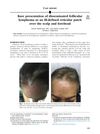
April 2019 in “JAAD case reports” A woman with lymphoma had a rare skin rash on her scalp and forehead, which was hard to diagnose but responded well to treatment.
 October 2014 in “Aktuelle Dermatologie”
 A 19-year-old with MRKHS developed complete hair loss, and treatment options were discussed.

CD4 T cells need IFN-γ to cause hair loss in alopecia areata.
5 citations
,
January 2021 in “Indian Journal of Critical Care Medicine” Testing for the NUDT 15 variant is crucial before starting azathioprine, especially in Asians.
 April 2023 in “Authorea (Authorea)”
 A young woman with a rare skin cancer was diagnosed late because her symptoms were unusual for the disease.
BCG injection helps reduce long COVID symptoms and affects hair loss differently in men and women.
 15 citations
,
July 2023 in “EClinicalMedicine”
15 citations
,
July 2023 in “EClinicalMedicine” ADCs can effectively treat breast cancer but may cause side effects like nausea and hair loss.
10 citations
,
December 2015 in “International Journal of Dermatology” CK 15, follistatin, and Bmi-1 can help differentiate basal cell carcinoma from squamous cell carcinoma.
October 2025 in “Science Advances” IFN-γ production by CD4 T cells is crucial for causing alopecia areata.
 November 2022 in “The journal of investigative dermatology/Journal of investigative dermatology”
 IL-15 promotes hair growth and protects hair follicles.
 June 2021 in “Working paper of public health”
 Six months after COVID-19, most patients still had autoantibodies.
7 citations
,
January 2025 in “Journal of Experimental & Clinical Cancer Research” PRMT5 inhibitors effectively fight adenoid cystic carcinoma in salivary glands.
1 citations
,
July 2020 in “Qanun Medika - Medical Journal Faculty of Medicine Muhammadiyah Surabaya” Timely treatment with antibiotics and antiretrovirals can significantly improve health in HIV patients with syphilis.
1 citations
,
September 2024 in “Journal of the American Academy of Dermatology” Farudodstat may effectively treat alopecia areata without harmful side effects.
21 citations
,
April 2019 in “Journal of cutaneous pathology” People with alopecia areata have fewer regulatory T-cells than those with other skin conditions.
 April 2019 in “Journal of Investigative Dermatology”
 Non-coding RNA boosts retinoic acid production and signaling, aiding regeneration.
 April 2023 in “Dermatology practical & conceptual”
 Some patients with hair loss after mild COVID-19 had positive tests for certain autoantibodies.
 10 citations
,
July 2013 in “British Journal of Dermatology”
10 citations
,
July 2013 in “British Journal of Dermatology” High MUC-18/MCAM levels in blood indicate a worse outlook for melanoma patients.
 April 2012 in “Journal of the American Academy of Dermatology”
 Clofazimine effectively treated ashy dermatosis in a patient.
September 2011 in “Chinese Journal of Dermatology” A man's skin condition was misdiagnosed and later identified as a rare type of skin cancer, which did not improve with treatment.
2 citations
,
January 2004 in “Linchuang pifuke zazhi” ZD1839 can cause skin issues like acne and hair changes.
76 citations
,
January 1998 in “Mammalian Genome”  1 citations
,
April 2018 in “Journal of Investigative Dermatology”
1 citations
,
April 2018 in “Journal of Investigative Dermatology” Tofacitinib helped most patients with alopecia areata regrow hair and changes in immune cells were linked to the treatment's effectiveness.
 7 citations
,
August 2020 in “Scientifica”
7 citations
,
August 2020 in “Scientifica” Most HIV-positive patients had skin problems, and conditions like oral thrush and boils were linked to weaker immune systems.
July 2024 in “Journal of Investigative Dermatology” PH-762 shows promise in treating skin cancer by effectively targeting and silencing PD-1 in tumors with minimal side effects.
1 citations
,
April 2017 in “Journal of Investigative Dermatology” Abatacept may help some people with alopecia areata regrow hair.
 148 citations
,
April 2009 in “Molecular Pharmaceutics”
148 citations
,
April 2009 in “Molecular Pharmaceutics” Researchers developed promising agents for prostate cancer imaging, with the best one showing high potential for clinical use.
86 citations
,
November 2015 in “Journal of Gastroenterology” The NUDT15 R139C variant causes thiopurine-induced leukocytopenia through a different mechanism than previously thought in Japanese patients with inflammatory bowel disease.
 August 2023 in “The journal of investigative dermatology/Journal of investigative dermatology”
 Longer immunotherapy treatment may improve outcomes for Merkel cell carcinoma patients.