 September 2023 in “Frontiers in medicine”
 The mTOR signaling pathway is crucial for hair health and targeting it may lead to new hair loss treatments.
 July 2023 in “Journal of Microbiology and Biotechnology”
 Terminalia bellirica extract may help promote hair growth and prevent hair loss caused by testosterone.
 January 2006 in “Advances in developmental biology”
 The Hairless gene is crucial for healthy skin and hair growth.
January 2023 in “Iranian Journal of Pharmaceutical Research” Stauntonia hexaphylla extract can help treat hair loss by blocking certain hormones.
 December 2023 in “Journal of ethnopharmacology”
 Tribuloside can increase skin pigmentation by enhancing melanin production and distribution.
 May 2021 in “Histochemistry and Cell Biology”
 The May issue discussed publishing agreements and four studies on cholesterol in hair, cancer cell changes, hormones in the uterus, and skin protein effects.
 314 citations
,
April 2010 in “Developmental Cell”
314 citations
,
April 2010 in “Developmental Cell” β-catenin in the dermal papilla is crucial for normal hair growth and repair.
 220 citations
,
August 1988 in “Clinical endocrinology”
220 citations
,
August 1988 in “Clinical endocrinology” Melatonin may help with sleep issues, depression, and cancer, but more research is needed.
 163 citations
,
April 2019 in “Nature Communications”
163 citations
,
April 2019 in “Nature Communications” Mechanical stretching of the skin can promote hair growth by activating certain immune cells.
130 citations
,
December 1998 in “The journal of investigative dermatology/Journal of investigative dermatology” Hair follicle melanocytes die during hair regression.
 90 citations
,
June 2006 in “The American Journal of Dermatopathology”
90 citations
,
June 2006 in “The American Journal of Dermatopathology” The document concludes that accurate diagnosis of different types of hair loss requires careful examination of hair and scalp tissue, considering both clinical and microscopic features.
 86 citations
,
October 2005 in “Experimental Dermatology”
86 citations
,
October 2005 in “Experimental Dermatology” The Foxn1 gene mutation causes hairlessness and immune system issues, and understanding it could lead to hair growth disorder treatments.
 75 citations
,
March 2014 in “Journal of Investigative Dermatology”
75 citations
,
March 2014 in “Journal of Investigative Dermatology” Aging mice have slower hair regeneration due to changes in signal balance, but the environment, not stem cell loss, controls this, suggesting treatments could focus on environmental factors.
 65 citations
,
January 2018 in “Nature Reviews Endocrinology”
65 citations
,
January 2018 in “Nature Reviews Endocrinology” Skin fat has important roles in hair growth, skin repair, immune defense, and aging, and could be targeted for skin and hair treatments.
54 citations
,
May 2001 in “Journal of Investigative Dermatology” Excessive putrescine causes hair loss in transgenic mice by disrupting hair follicle development.
43 citations
,
December 2006 in “The American journal of pathology” Edar signaling is crucial for controlling hair growth and regression.
 42 citations
,
February 2018 in “International Journal of Molecular Sciences”
42 citations
,
February 2018 in “International Journal of Molecular Sciences” Minoxidil boosts hair growth by triggering growth factor release from specific stem cells.
 42 citations
,
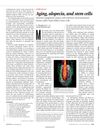
February 2016 in “Science”
42 citations
,
February 2016 in “Science” The document concludes that both internal stem cell factors and external influences like the environment and hormones affect hair loss and aging, with potential treatments focusing on these areas.
 37 citations
,
February 2019 in “Experimental Dermatology”
37 citations
,
February 2019 in “Experimental Dermatology” Spiny mice are better at regenerating hair after injury than laboratory mice and could help us understand how to improve human skin repair.
 35 citations
,
February 2019 in “Cell Communication and Signaling”
35 citations
,
February 2019 in “Cell Communication and Signaling” BMP6 and Wnt10b control whether hair follicles are resting or growing.
 31 citations
,
January 2014 in “International Journal of Trichology”
31 citations
,
January 2014 in “International Journal of Trichology” The arrector pili muscle might play a role in hair loss and needs more research to understand its impact.
 31 citations
,
May 2008 in “Drug Discovery Today: Disease Mechanisms”
31 citations
,
May 2008 in “Drug Discovery Today: Disease Mechanisms” Different hair growth problems are caused by genetic issues or changes in hair growth cycles, and new treatments are being developed.
 27 citations
,
July 1990 in “International Journal of Dermatology”
27 citations
,
July 1990 in “International Journal of Dermatology” A pulsed electrical field safely and effectively increased hair growth.
25 citations
,
December 2018 in “Journal of Investigative Dermatology” TRPV4 slows hair growth by affecting hair follicle cells.
16 citations
,
September 2019 in “Journal of biological chemistry/The Journal of biological chemistry” Mice without certain skin enzymes have faster hair growth and bigger eye glands.
15 citations
,
December 2020 in “International journal of molecular sciences” Epidermal stem cells create and maintain skin structures like hair and nails through specific signaling pathways and vary by location and function.
11 citations
,
March 2001 in “Clinics in dermatology” The new microneedle method delivers hair loss treatment more effectively by enhancing growth pathways.
 10 citations
,
June 2016 in “Wound Repair and Regeneration”
10 citations
,
June 2016 in “Wound Repair and Regeneration” The microenvironment, especially mechanical forces, plays a crucial role in hair growth and could lead to new treatments for hair loss.
 9 citations
,
April 2019 in “International journal of molecular sciences”
9 citations
,
April 2019 in “International journal of molecular sciences” Human hair grows better in a special gel that mimics skin.
 8 citations
,
June 2022 in “Scientific Reports”
8 citations
,
June 2022 in “Scientific Reports” LGR5 is a common marker of hair follicle stem cells in different animals and is important for hair growth and regeneration.