March 1995 in “The Journal of Dermatology” Immature hair cells can grow and change into different types of hair cells over time.
 1 citations
,
August 2023 in “bioRxiv (Cold Spring Harbor Laboratory)”
1 citations
,
August 2023 in “bioRxiv (Cold Spring Harbor Laboratory)” The research created a detailed map of skin cells, showing that certain cells in basal cell carcinoma may come from hair follicles and could help the cancer grow.
22 citations
,
September 1982 in “Journal of ultrastructure research” Wool follicle cells are more complex than previously thought.
 December 2012 in “Journal of undergraduate research in Alberta”
 Elongating cilia boosts SKP stem cell renewal, especially with PDGF.
 75 citations
,
August 2011 in “Journal of Investigative Dermatology”
75 citations
,
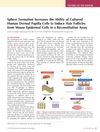
August 2011 in “Journal of Investigative Dermatology” Forming spheres boosts the ability of certain human cells to create hair follicles when mixed with mouse skin cells.
 2 citations
,
November 2024 in “Journal of Nonlinear Science”
2 citations
,
November 2024 in “Journal of Nonlinear Science” Domain shape greatly affects pattern formation.
July 2024 in “Journal of Investigative Dermatology” Cell movements and forces shape feather growth in chicken skin.
 2 citations
,
September 2023 in “PLoS biology”
2 citations
,
September 2023 in “PLoS biology” Newly divided skin cells quickly move to join skin structures due to tissue tension and specific signals.

Proper niche formation in Drosophila requires Slit-Robo signaling for cell migration.
47 citations
,
August 2012 in “Cell Cycle” Stem cells in hair follicles can become neurons and other cells, especially in the upper part, useful for nerve repair.
1 citations
,
January 2011 in “ScholarlyCommons (University of Pennsylvania)” Notch signaling is crucial for specifying niche cells in Drosophila testis.
28 citations
,
September 2011 in “Stem Cell Reviews and Reports” 112 citations
,
January 2004 in “The International journal of developmental biology” Feather patterns form through genetic and epigenetic controls, with cells self-organizing into periodic patterns.
 June 2022 in “Research Square (Research Square)”
 Nestin-expressing cells turn into a specific type of skin cell in hair follicles during development and in adults.
7 citations
,
March 1993 in “International Journal of Oncology” Basal cell carcinoma shows keratin patterns similar to hair follicle structures.
 January 1995 in “Skin Cancer”
 The outer root sheath in hair follicles changes during growth, with different keratinization processes in its layers.
Rat hair follicle bulge cells can become nerve and glial cells, showing potential for neuroprotection.
 31 citations
,
September 2016 in “PLoS ONE”
31 citations
,
September 2016 in “PLoS ONE” Cell division orientation varies by body site and is linked to epidermal thickness and cell density.
January 2011 in “Shiyong kouqiang yixue zazhi” Dermal papilla cells and bulge stem cells can help reconstruct hair follicles.
 3 citations
,
December 2022 in “bioRxiv (Cold Spring Harbor Laboratory)”
3 citations
,
December 2022 in “bioRxiv (Cold Spring Harbor Laboratory)” The research reveals how early embryonic mouse skin develops from simple to complex structures, identifying various cell types and their roles in this process.
 May 2022 in “Research Square (Research Square)”
 Nestin marks cells that can become a specific type of skin cell in hair follicles of both developing and adult mice.
June 2018 in “British Journal of Dermatology” Hair cells lose their nucleus and mitochondria in a specific order as they fill with keratin, which could help develop treatments for hair issues.
3 citations
,
April 2019 in “Stem cells international” Markers CRABP1, Nestin, and Ephrin B2 are present in skin cancer environments and may influence their development.
July 2025 in “PNAS Nexus” A new tool accurately identifies human cornea cell states and key factors.
 61 citations
,
October 1996 in “Development”
61 citations
,
October 1996 in “Development” Hair growth can be stimulated by combining certain skin cells, which can rejuvenate old cells and cause them to specialize in hair follicle creation.
55 citations
,
November 2010 in “Development” Hair follicles in mutant mice self-organize into ordered patterns within a week.
4 citations
,
February 2023 in “Stem Cell Research & Therapy” Mouse skin cells can become sperm-like cells in the lab.
2 citations
,
September 2018 in “bioRxiv (Cold Spring Harbor Laboratory)” Hair follicle niches are specified before they form and depend on progenitor cells.
34 citations
,
January 1998 in “Archiv für Pathologische Anatomie und Physiologie und für Klinische Medicin” Trichoblastomas may mimic fetal skin development by having many Merkel cells, unlike adult skin.
 January 2023 in “bioRxiv (Cold Spring Harbor Laboratory)”
 Newly born mesenchymal cells quickly spread out in response to tissue tension during early development.